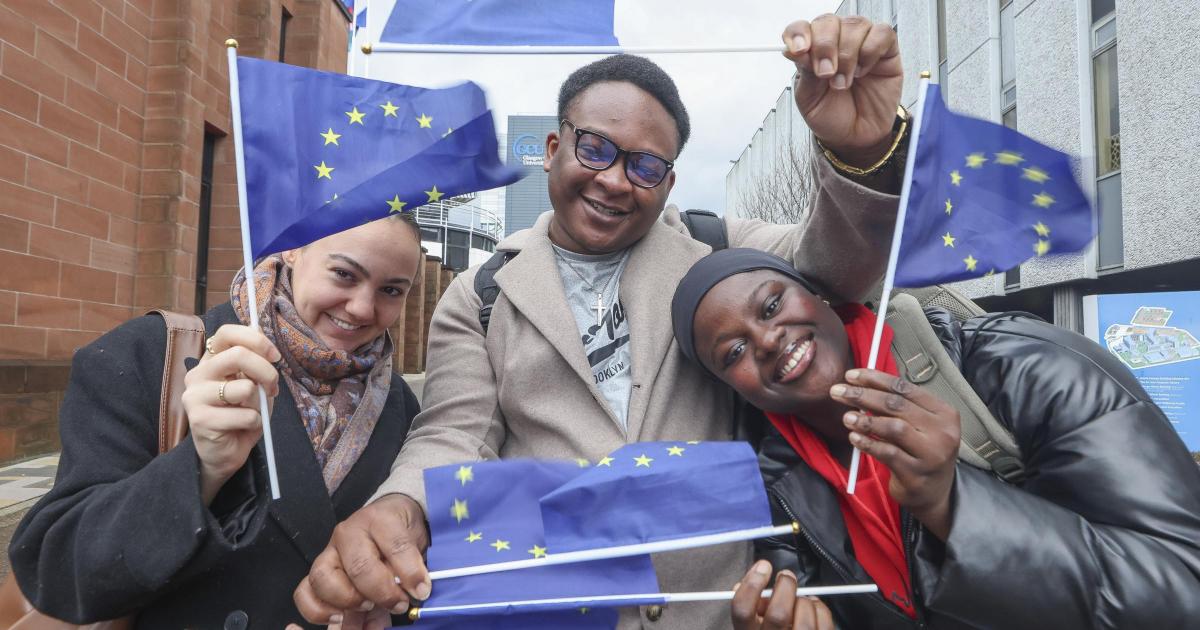
The Glasgow Caledonian University (GCU) society was formed in September by nursing student Mordecai Akoh.
The Nigerian formed the group after attending several events in London and Newcastle, some which looked at relations between students across Europe post-Brexit and others which involved talks with politicians and delegates from the EU Embassy in London.
The main focus of the society has so far been the loss of the Erasmus exchange programme, which the UK left in December 2020 and replaced with the Turing Scheme.
“Our main aim is to create an awareness among students on campus of UK and EU relations and to see how much damage Brexit has done,” said Akoh.
READ MORE: Over half of voters would back Remain if Brexit referendum held again
“We focus our attention on the most notable effects, which has been [the loss of] Erasmus for students. There’s been a notable difference in how students can study abroad. With Erasmus it was a lot easier and more flexible.
“That’s our main focus among many other disadvantages which we tend to get speakers to come and speak to us about, speakers who have been in EU politics for decades.
Mordecai Akoh (centre), Durdane Oz (left) and Demilade Babarinde (Image: NQ)
“Our goal is to foster a network of students who are passionate about EU relations. Things will only get better if students are actively demanding change and accountability.”
Earlier this month it was confirmed the UK would rejoin the Erasmus scheme in 2027 amid Labour efforts to improve relations with the EU.
Akoh told The National this was “undoubtedly great news” but he stressed how he wanted to see the UK Government extend opportunities to students who have already graduated and been unable to benefit from the initiative.
Durdane Oz, who helps to organise events for the society, has not been able to continue her studies in France after studying for a year at the University of Lille through the Turing Scheme.
She said not having the opportunity made her passionate about joining the group.
“I had just come back from my studies in France, and I got engaged over there with youth-led organisations that were focused on EU values, and I didn’t really find that in Glasgow, so it made me passionate about looking for it when I came back,” she said.
“I don’t have the opportunity at the moment to continue my work in Europe and that’s’ something I want to do, so I’m very passionate about Scotland rejoining the Erasmus+ programme for young Scots to have that opportunity to go abroad and explore where they might be able to find work if not here.”
She added: “The most important point out of this for me is when we’re discussing the effects of Brexit, we’re trying to get young Scots engaged in the fact that we are the ones that are living the effects, but the generation before us made the decision.”
READ MORE: Keir Starmer acknowledges the Brexit elephant in the UK’s room
So far, the society has welcomed lecturers from the University of Glasgow, the law department at GCU and Glasgow for Europe, while an event was held with the GCU Ukrainian society on the lasting effects of war.
There are plans to hold debates in the coming year and it’s hoped at some stage members will be able to go on a trip to the European Parliament if enough students join the society.
Akoh said: “We currently have 21 members in the society. It’s a decent start to be honest.
“This is not a topic most people find fun and catchy. Given our mission and what we focus on, which is more serious, it’s quite a decent number.”
Demilade Babarinde was one student who joined the society out of pure curiosity, having arrived in Scotland after Brexit and has now become treasurer.
“I am a very active person, I engage in a lot of things and I’m a very curious person about politics and what’s happening in Europe about Brexit,” she said.
“At the time Brexit happened I wasn’t in the country at the time so I’m naturally very curious as to why it happened and the downsides to it.
“When Mordecai mentioned he was going to start a society I was cheering him on and joined. The sessions we’ve had have been very informative and very good for someone like me and I think they will be beneficial for young people at the university who are curious and just want to increase their knowledge about what is happening in Europe.”
Oz added: “We’re the ones who are now putting in the work to try and have some change or reform. We’re living the reality of someone else’s decision.
“I think that can be met with a lot of frustration and that’s one of the things we’re trying to address, turn that frustration into something else like curiosity and engagement. There’s a lot of uncertainty in young Scots’ lives about where their career is going to go and I have that fear as well and it’s about championing that sense of community.
“We understand this isn’t the easiest topic to come into and it’s maybe not the most fun compared to other societies, but we’re living the reality, so we have to face it.”