Upon entering the White House in January 2025, Donald Trump launched a trade policy ostensibly to reduce the US trade deficit with major partners, including China and the EU, by imposing tariffs on surplus countries to shrink imports and encourage reshoring of manufacturing into the USA.
Economic—ultimately national—security (as defined by the USA) was the underlying motivation for a tsunami of WTO-illegal tariff measures. As Trump made clear in his 2 April “Liberation Day” Executive Order imposing punitive duties on partners:
“Persistent trade deficits have hollowed out…and rendered the defense-industrial base dependent on foreign adversaries.”
Whilst China was perceived as the main threat to US hegemony, the US did not disguise its dislike of the EU, which, in Trump’s typically elegant vocabulary, was invented “to screw us.”
The historical inaccuracy here is not the point. Perception is all; China and the EU had abused US magnanimity by running unacceptable trade surpluses [1] and, in the EU case, over-regulating.
Trump’s abhorrence of supranational institutions, of which the EU is a prime example, and disregard for domestic and international law also marked his first months in office. The US withdrew from several international bodies—WHO, the Paris Climate Accord, and more—eliminated USAID, defunded several UN agencies, and sanctioned ICC members, etc., in the name of American exceptionalism.
This is not the place to talk about the unqualified US military support for the destruction of Gaza and butchering of thousands of innocent people, the ICE abductions of citizens from American streets, or the assassinations in international waters of fishermen in the Caribbean. The relative lack of protest against these actions reflects a world that now regrettably regards them as within the norm. The point to be underlined is that Trump’s violent disregard of the rules-based international order—one the US largely created—is reflected in its trade policy too. William Shirer would have recognized this pattern.
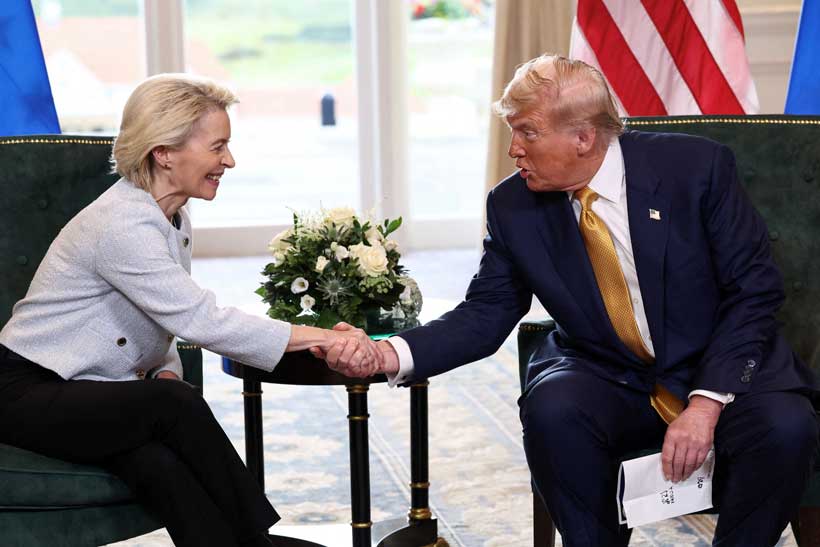
Threatened in April 2025 with a 30% across-the-board tariff on EU exports (100% for pharmaceuticals) and restrictive car and steel quotas, the EU under duress concluded with the US in July 2025 a framework agreement, the so-called Turnberry Agreement, after Trump’s Scottish golf course where it was inked.
Reader, I tarred him.
Turnberry is not a legal treaty but a political declaration. The EU undertook to remove tariffs on all US industrial goods and selected agricultural products, to recognize US car standards, to cooperate on AI, semiconductor sourcing, and steel overcapacity, to address technical barriers to US pork and dairy exports, and to negotiate new origin rules governing bilateral trade (presumably to reduce Chinese parts and value in EU exports like steel, autos, and IT).
The EU also undertook to invest at least US$600 bn in US manufacturing in the next 3 years and buy at least US$750 billion of US energy, US$40 bn of US semiconductors, and an unspecified amount of weaponry. The EU has no competence to promise any of this. It explained that the figures were based on its understanding of existing industry intentions.
The US in turn agreed to fix tariffs on EU imports at 15% once the EU began the legislative process to eliminate industrial tariffs. The US would also restore some stability—at a price—by establishing quotas for steel, aluminum, and cars and, as part of a fully-fledged agreement, provide “zero for zero” duty elimination on pharmaceutical products, aeronautics, and—but less clear—wines and spirits.
The agreement was heavily criticized both for being unbalanced and for breaking WTO law (notably Articles I and II of GATT), which forbids raising bound tariffs or discrimination between different countries.
A weak EU felt, however, it had no choice given the alternative of an across-the-board 30% tariff. The 15% tariff restores some stability to EU-US trade. Exporters are adjusting and face lower duties than competitors like China, Switzerland, India, or Brazil. The EU also saw the agreement—maybe naïvely—as the price for keeping the US an ally in Russia’s war against Ukraine. The commitment to buy US weapons should be seen in this light.
But the commitments call into question the EU’s 2025 “strategic autonomy,” i.e., its determination to reduce undue dependencies, to re-industrialize and “make in Europe,” and to procure mostly European armaments.
Queensberry or Turnberry?
The two sides are now starting to implement Turnberry. The US duly fixed its maximum tariff at 15% in late 2025 after the EU issued its proposed regulation to eliminate US duties. Approved by the EU Council in October, it is now with the European Parliament (co-legislator with the Council).
The US, however, has not yet provided the expected duty-free quotas on steel and aluminum, to EU frustration, and has not yet indicated possible additional sectors for zero duties. Trump continues to claim that tariffs benefit the US economy, even if the opposite is true, and states that he wants to maintain tariffs as far as possible. The average US tariff, 2.5% when Biden left office, stands today at 19%—its highest since the 1930 Smoot-Hawley Act.
A strategic error of the EU going into Turnberry was to assume that the US is ultimately a reliable trading partner that will keep its word and, as it were, follow Queensberry Rules.
So, as Charlotte Brontë might have said, “Difficulties, dear reader, are therefore emerging.” The US has understood that the EU can only introduce its zero duties on imports sometime in mid-2026, due to European Parliament procedures. The Parliament is also mulling attaching conditions on this duty elimination—US acceptance of EU digital and other regulations, maintenance of the 15% tariff ceiling, and eschewing any other restrictive trade measures to leverage political goals. And automatic termination of the agreement if the US reneges.
The US’s delay in opening quotas for EU steel and aluminum, or considering other tariff exemptions, appears linked to the EP approving, unqualified, the EU tariff regulation. A game of chicken is emerging.
Here Is A Place of Disaffectation
In November USTR Jamieson Greer warned that trade is a flashpoint in EU-US relations. We see it. Though digital regulation was outside the Turnberry agreement, the US continues to pressure the EU to waive requirements on US data platforms. Last month’s EUR120m fine on Microsoft for breaching the Digital Services Act is the first act in this play. An infuriated US accused the EU of both over-zealous regulation and curtailing free speech, even if the sum by Microsoft standards is but a slap on the wrist and unrelated to freedom of speech.
I assume that the EU’s continued enforcement of its digital legislation (a stated red line) will be a major irritant in relations with the US in 2026.
A second flashpoint will be the (increasingly confused) implementation during 2026 of EU Green Deal legislation—notably CBAM, the Deforestation Regulation, the Corporate Sustainability Directive (CS3D), and tighter restrictions on pesticides. The US will continue to attack and pressure the EU legislator for exemptions, despite several measures having already been delayed or diluted at the demand of EU industry.
Continued restrictions on US agricultural exports due to production methods—hormone-fed beef, chlorinated chicken, ractopamine pork, and excessive antibiotic use—may also aggravate tensions. Europe is tightening controls on food safety, not relaxing them. The US recently withdrew from a much-trumpeted $31bn US-UK digital partnership due to the UK’s refusal to relax its food standards, currently aligned to the EU. The US may use its G20 chairmanship to seek lower safety standards.
The US is also skeptical about the EU’s promises on inward investment and energy purchases and watches for backtracking. In July 2026 the US will carry out a one-year health check on Turnberry, probably find that the investment and energy commitments have not delivered, and take restrictive trade measures against Europe.
So far there is scant evidence that several commitments made at Turnberry—on AI and semiconductor cooperation, steel overcapacity, pork and dairy standards, and origin rules—are being pursued vigorously.
Into the Bunker
Implementation of the golf course deal is threatened by several other factors. First, the impending US Supreme Court decision on the legality under the International Emergency Economic Powers Act (IEEPA) of Trump’s April tariffs. If found illegal, the administration will transfer the tariffs to various provisions of the Trade Act. This will be messy, and the EU will rightly pause its own tariff cuts awaiting clarity on the US side.
Secondly, the US Trade Act S.232 investigations on the economic security implications of imports of steel, aluminum, cars, and pharma, which may give the US pretexts to impose or extend tariffs or quotas.
And three, future EU decisions penalizing US breaches of EU digital law.
Any of these may reduce the US’s readiness to grant zero-duty exemptions for EU imports, which will in turn color the EP’s position on duty-free treatment for US goods, already illegal under international law.
The wild card is whether the concept of a fully-fledged bilateral trade agreement (referred to in a September Executive Order) will take shape. This writer finds it hard to envisage any kind of agreement the two sides could reach other than to implement their respective tariff reduction commitments, which are being done unilaterally. Even that is under stress.
There’s No Use in Crying… It’s all over.
So 2026 ushers in a period of immense uncertainty. Several factors—the Ukraine war and decisions on defense procurement, relations with China, the impact of the EU’s regulatory agenda, and the extent of reshoring of EU manufacturing into the US—will impact positively or negatively in 2026 the broader trade relationship. Spring 2026 will be decisive. April, as T.S. Eliot said, may be the cruellest month.
Because politics will prevent a spring thaw in the trade relationship or a return to pre-Trump business as usual. The US’s new National Security Strategy calls out the EU for its excessive regulatory zeal, its lack of political leadership, and its self-inflicted destiny of “civilizational erasure” by allowing unchecked Islamic immigration. It pledges to incite right-wing populists across Europe to split the EU.
While not directly trade related, the NSS provides insight as to how the US views the ‘old continent.’ It prevents the US from looking objectively at future trade relations.
Following the NSS, the US has stepped up its ideological cold war against the EU, renewing its menace to occupy Greenland and sanctioning EU officials for enforcing the EU’s digital regulations. This is not the behavior of an ally but of a putative enemy. The US has, in the view of many, confirmed itself as a rogue state hellbent on weakening Europe from the inside, as it proudly advertises in its NSS. The gloves are off.
The EU has not helped itself. Turnberry revealed its weakness. It has—ever since it condoned several member states’ illegal bans on Ukrainian imports—struggled to control trade policy. Its strategy to put the polis into trade policy has backfired; member states are increasingly in the driving seat, and they are divided on open trade vs. protectionism, on Ukraine, and above all on relations with the US and China, which lends itself to manipulation by either.
There is therefore little hope for improvement in trade relations in 2026. The US does not separate trade policy from defense or politics. Quite the reverse—it wields trade like a bludgeon for nakedly political ends. Only if the damage done by the US’s tariffs and trade policy becomes a determinant of the midterm elections will we see any tilt back to civilized trade behavior.
Great Unrest
That is to hope against hope. It’s inconceivable that the trade relationship will remain immune to Trump’s increasingly manic attempts to deflect attention from the Epstein Files. Trade relations will deteriorate further in 2026. The EU will need to summon its dwindling political courage to de-risk from the USA and pursue a genuine policy of strategic autonomy and diversification. Whether it is up to the task remains questionable, since divisions between member states induce paralysis.
To quote the novelist Julian Barnes, “There is unrest. There is great unrest in the year ahead.
[1] Taking into account both goods and services, the EU and US are almost in balance.