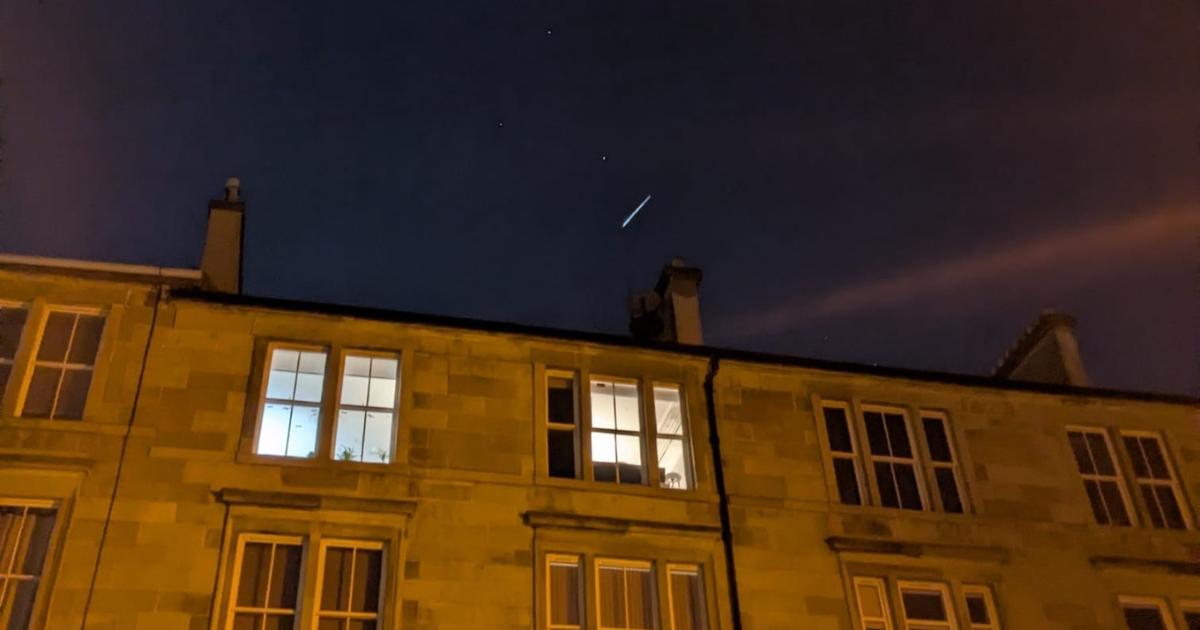
The cosmic fireball, spotted above The Scallion Bar on Great Western Road, is likely the first sign of the start of the Quadrantid meteor shower, which returns every year in early January,
Each year, stargazers in the UK have the chance to see up to 50 “shooting stars” an hour with the arrival of the phenomenon, which will remain visible in the sky until January 12.
Meteors are the result of small particles entering the Earth’s atmosphere at high speed, typically around 40km per second for the Quadrantids.
The shooting star briefly lit up the night sky (Image: NQ)
The pieces of debris heat up due to friction with the air and are usually destroyed in under a second at altitudes above 80km.
The superheated air around the meteor glows briefly, and is visible from the ground as a streak of light known as a “shooting star”.
Unlike many astronomical events, meteor showers are easy to watch and do not require any special equipment to be enjoyed.
As 2025’s shower arrived, Dr Robert Massey, deputy director of the Royal Astronomical Society, said observers hoping to catch a glimpse of the celestial fireworks after sunset will need to get “as far away from light pollution as possible”.
He said the showers “have a pretty strong intensity if you happen to be in the right place at the right time”.
Read More:
Dr Massey added: “They won’t be the brightest meteors on the whole, but (the Quadrantids) do include a fair number of fireballs.
“A fireball is a dramatic sounding thing but what it really means is a really bright meteor.
“The Quadrantids is a meteor shower which produces that kind of event.
“So for that reason alone, if you have the time to look out and the weather is good, then do take a look because it’s a perfect New Year treat.”