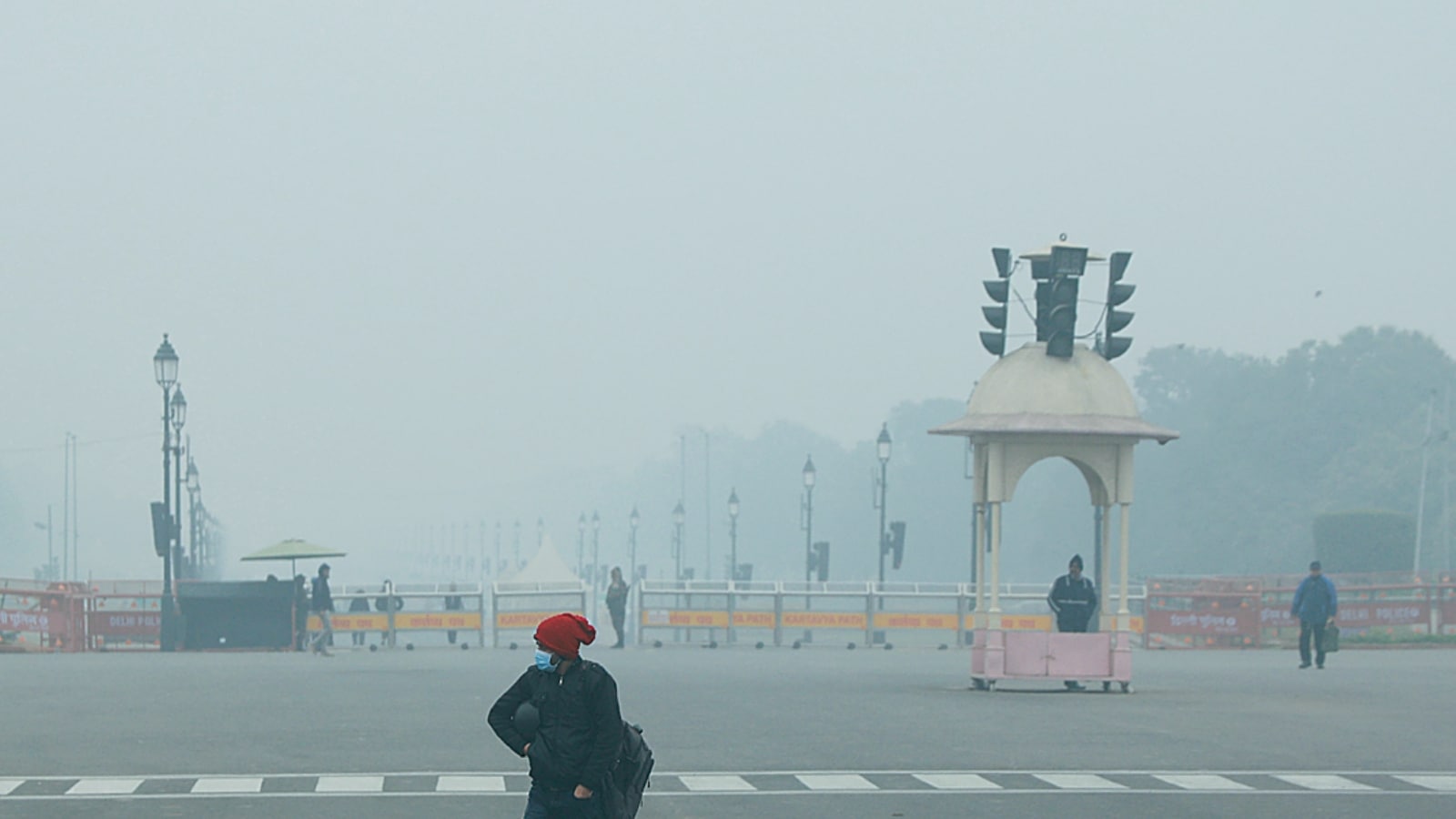
Delhi has experienced its worst December air since 2018 this year, with PM 2.5 averaging 211 µg/m³ for the month so far.
An analysis of data from the Central Pollution Control Board (CPCB) across the Capital’s 40 monitoring stations shows that high pollution levels were widespread, affecting nearly all monitoring locations at least once.

Pollution was also not confined to brief episodes: PM 2.5 levels crossed 250 µg/m³ at the city-wide level nearly one in three days. The most severe mid-December episode drove average particulate matter pollution to six to seven times the nationally permissible standard.
The monthly average this December marks a sharp reversal after relatively lower pollution levels last year — Delhi’s average PM 2.5 rose by over 40 µg/m³ this year compared to 2024.
The rebound in pollution levels comes despite marginally warmer temperatures this winter.
IMD data show that December 2024 recorded a monthly average maximum temperature of 22.6 degrees Celsius and a minimum of 8.4 degrees Celsius. December 2025 was slightly warmer, with the average maximum at 23.3 degrees Celsius and the minimum at 8.2 degrees Celsius.
The sharper rise in particulate pollution despite similar, and marginally warmer, winter temperatures suggests that meteorological conditions alone do not explain the deterioration in air quality this December.
Story continues below this ad
Manoj Kumar, pollution analyst at the Centre for Research on Energy and Clean Air (CREA), said Delhi recorded its highest PM 2.5 level of 392 µg/m³ on December 14, 2025.
“The absence of stubble burning during this peak makes it evident that Delhi’s air pollution is also being driven by persistent, year-round emissions. This calls for enforceable, sector-specific emission reduction targets for industry, transport, power plants, and other major sources, instead of short-term or seasonal responses,” he said.
Sunil Dahiya, lead analyst and founder at Delhi-based think tank Envirocatalysts, said 2025 saw much lower average concentrations till October due to favourable meteorological conditions, but baseline emissions in the region remain too high. “With the onset of winter, the same hazardous pollution levels were back, making the invisible visible,” he said.
Dahiya added that while some isolated actions have reduced emission intensity in a few sectors over the years, the city has failed to cut absolute emissions. “One of the highest pollution levels this December is a manifestation of both meteorology and emissions, but we can only control one… and that requires aggressive action.”
Story continues below this ad
Delhi’s station-averaged daily PM 2.5 crossed 250 µg/m³ on over 31% of days and exceeded 150 µg/m³ for more than 82% of the month.
The peak daily average was recorded on December 14 at 392.65 µg/m³, followed by 360.12 µg/m³ on December 13.
The last time it was higher than this was on December 23, 2018 at 402.96 µg/m³.
Station-level data has shown sharp spatial differences even during a month dominated by city-wide deterioration.
Story continues below this ad
Monthly averages up to December 29 ranged from 136.95 µg/m³ at NSIT Dwarka to 271.83 µg/m³ at Anand Vihar. Other locations with the highest monthly averages included Rohini (271.58 µg/m³), Jahangirpuri (271.17 µg/m³), Nehru Nagar (264.73 µg/m³), Wazirpur (264.25 µg/m³), and Mundka (262.26 µg/m³).
At the lower end were IGI Airport, where PM 2.5 averaged 140.32 µg/m³, Aya Nagar at 146.48 µg/m³, Lodhi Road at 153.02 µg/m³, and Mandir Marg at 155.96 µg/m³ — though these too exceeded the national standard of 60 µg/m³.
Across the 40 monitoring stations, PM 2.5 crossed 250 µg/m³ at least once at 38 locations, except NSIT Dwarka and IGI Airport.
The most frequent exceedances were recorded at Jahangirpuri (16 days), Anand Vihar (15 days), and Wazirpur, Chandni Chowk, Mundka, Nehru Nagar, and Vivek Vihar, each showing extreme pollution for at least 14 days. At the upper end, 26 stations crossed 350 µg/m³ at least once and 11 stations crossed 450 µg/m³ at least once, suggesting that the most severe pollution was distributed across much of the city.
Story continues below this ad
At its peak, PM 2.5 concentrations climbed to nearly 10 times the national standard at some stations, with large parts of the city recording levels eight to nine times higher than what is considered acceptable for a 24-hour period.
Mundka recorded 597.67 µg/m³ on December 14, the highest single station-day value in the December dataset. Other major peaks on December 14 included Ashok Vihar at 572.19 µg/m³, Rohini at 572.00 µg/m³, Wazirpur at 566.36 µg/m³, Jahangirpuri at 519.21 µg/m³, and Anand Vihar at 506.50 µg/m³. Compared with the World Health Organisation’s 24-hour PM 2.5 guideline of 15 µg/m³, these peaks were roughly 35 to 40 times higher than levels considered safe for human health.
An analysis of hourly data for the month also showed that the PM pollution peaked overwhelmingly at night.
The daily maximum PM 2.5 at individual stations most frequently occurred between late evening and midnight, with around 57% of station-days peaking between 9 pm and 12 am, and over 60% peaking between 10 pm and 2 am.
Story continues below this ad
These hours coincide with meteorological conditions that are highly unfavourable for dispersion, including calm winds, temperature inversions, falling temperatures, and dense fog conditions that trap pollutants near the surface.