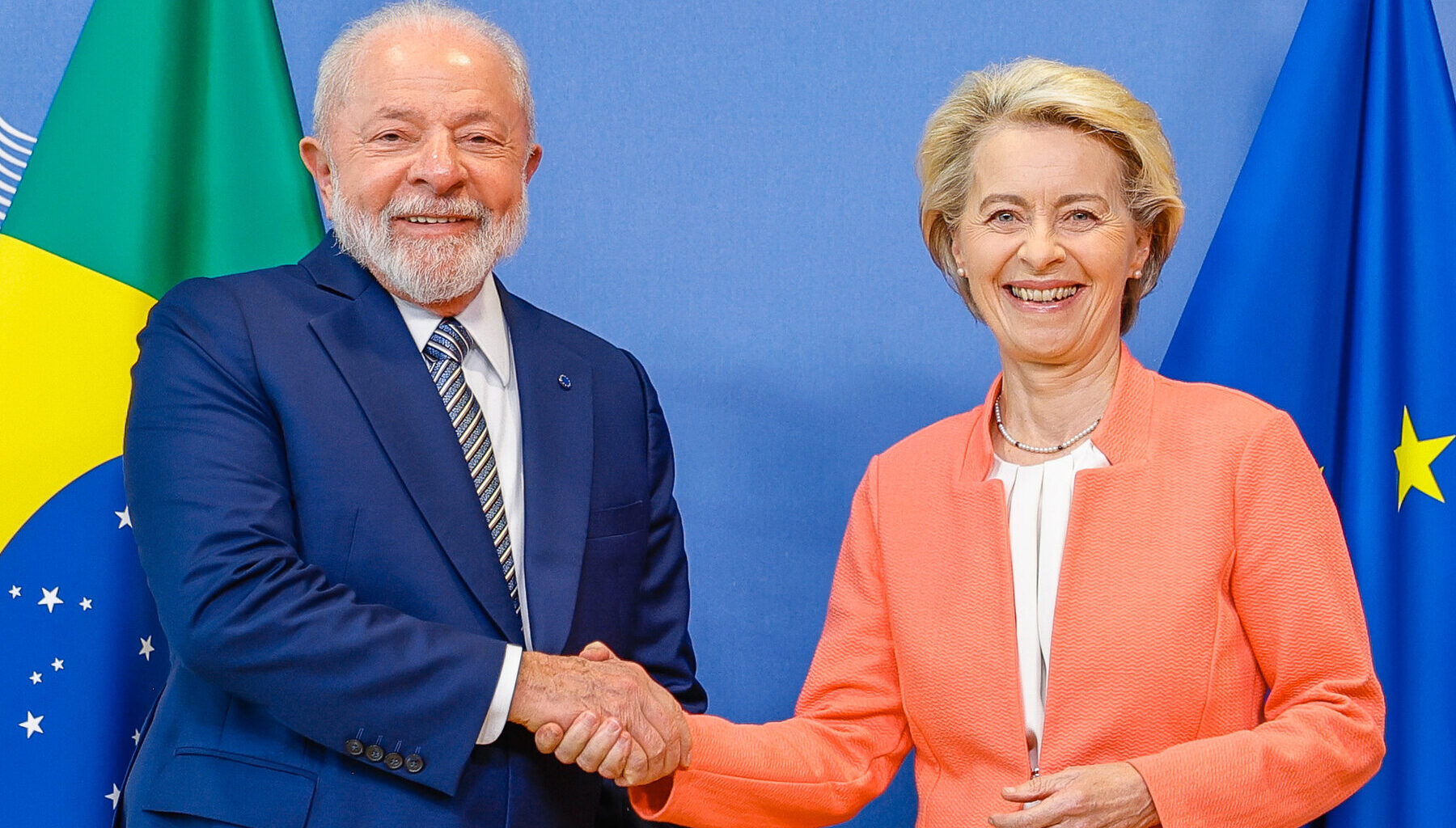
The EU, through its comission is engaged in a race against the clock to salvage a trade deal with the Mercosur bloc. Credit: Palácio do Planalto – CC BY 2.0 via Flickr.
The EU, through its comission is engaged in a race against the clock to salvage a trade deal with the Mercosur bloc, exploring a package of last-minute concessions for the agricultural sector designed to secure Italy’s crucial support.
After more than 25 years of negotiations, the deal, which would create the world’s largest free trade zone, was recently stalled following a postponement of the final vote due to hesitation from Rome and outright rejection from Paris. Now, Brussels is analyzing what additional offers can be made to Italian Prime Minister Giorgia Meloni to make the agreement politically palatable amidst widespread farmer protests.
According to European sources, the Commission is considering new subsidies for farmers and a proposal to increase the share of funding assigned to agriculture in the EU’s upcoming multi-annual financial framework.
The EU needs Italy to save the Mercosur trade deal
The diplomatic math requires a qualified majority. With Poland having already declared it will vote against the pact, and France maintaining a hardline refusal, the Commission cannot afford to lose Italy. Germany and Spain remain staunch supporters of the agreement.
“The Italian government is ready to sign as soon as the necessary answers are provided to farmers, who depend on the decisions of the European Commission,” Meloni’s cabinet stated earlier this month, suggesting a deal is possible if specific domestic concerns are met.
Economically, Italy stands to be one of the primary beneficiaries of the deal. Italian exports to Brazil, Argentina, Uruguay, and Paraguay, including machinery, electrical equipment, and vehicles, currently face tariffs as high as 35%. The agreement would slash duties on roughly €3.7 billion (US$3.9 billion) in annual exports, as well as eliminate tariffs on chemical and plastic products.
The trade deal with Mercosur is viewed as a Geopolitical necessity by the EU
The push to finalize the agreement is driven by shifting global dynamics. The protectionism of the incoming U.S. administration under Donald Trump and Europe’s heavy reliance on China have accelerated the EU’s need for reliable new commercial partners.
The proposed bloc would cover 720 million people and account for more than 20% of global GDP. For the EU, it promises access to critical raw materials and the elimination of over €4 billion (US$4.6 billion) in customs duties annually.
However, delays have consequences. In an interview with Latin American newspaper El Pais, Judith Arnal said, “The EU has lost trade share in Latin America to China.” Arnal, a researcher at the Elcano Royal Institute, also noted that the U.S. has declared the region a priority in its National Security Strategy, increasing the pressure on Brussels to prove it remains a capable global negotiator.
The EU aims to sign the deal by the end of January
The Commission, led by Ursula von der Leyen, aims to sign the document before the end of January. This timeline follows a diplomatic fiasco two weeks ago, which forced Brazilian President Luiz Inácio Lula da Silva to cancel a planned signing ceremony in Foz de Iguazu during the Mercosur summit.
“Without the political will and courage of its leaders, it will not be possible to conclude a negotiation that has lasted for 26 years,” Lula said, warning that the South American bloc is already intensifying talks with the United Arab Emirates, Canada, and India.
European officials fear that further delays could push these resource-rich nations closer to Beijing.
Stricter clauses are set to be introduced by the EU
To appease opponents in France and Italy, Brussels has introduced stricter clauses, including enhanced phytosanitary audits and controls on pesticide residues. Additionally, the European Parliament and member states have agreed on binding safeguards. If imports from protected sectors surge or cause prices to drop by 8% in a single country, tariffs could be reimposed.
Despite these measures, the deal faces a fragile path forward. A coalition of approximately 150 Members of the European Parliament (MEPs), spanning from the far right to the left, has threatened to refer the agreement to the European Court of Justice (ECJ) to determine if it complies with the EU’s founding treaties, a move that could freeze implementation for up to two years.
A failure to ratify the deal after reaching a political agreement would be a significant blow to Europe’s credibility. According to Arnal, it would confirm the image of an EU that “promises much and delivers little,” potentially hindering future negotiations with the Global South.