
Strange as it may seem, most Ukrainians pay little attention to the headlines swirling around their country – the fantastical boasts from Donald Trump, clench-jawed threats from Vladimir Putin and earnest pledges from European leaders as they scramble for relevance.
Ukrainians do not wake up – if they have slept during yet another night of air-raid alerts – and quickly read the latest pronouncements from any of the above, but instead check whether the latest Russian attacks have cut off their light, heat or water, or potentially killed or injured loved ones living in other regions or serving in the military.
When they get around to reading the world news, they don’t much like what they see.
The combined efforts of Ukraine, the European Union and several big European states stopped the momentum of an initial 28-point draft peace plan, quietly hatched by US and Russian envoys, that proposed meeting all of Moscow’s main demands.
 US president Donald Trump greets Russian president Vladimir Putin in Alaska in August. Photograph: Andrew Harnik/Getty Images
But it is still not clear whether Trump – who bragged about being able to end the war in one day and talks up the moneymaking potential of a rapprochement with Russia – now accepts that any deal must satisfy Kyiv and Europe, or believes that only he and Putin will ultimately decide the fate of Ukraine and European security.
His long-standing admiration for Putin and other autocrats, his eagerness to repair US-Russia relations, his reluctance to put pressure on Moscow and his habit of blaming Ukraine and its president, Volodymyr Zelenskiy, for hampering peace efforts, make Ukrainians deeply distrustful of Washington.
Yet they also know their country still relies on the US for crucial components of its war effort.
For all Ukraine’s progress in producing drones – which have hit military and industrial targets well more than 1,000km inside Russia – there is no substitute for top-line US air defence systems or for the intelligence that spy satellites and other US resources can provide.
Nato members in Europe are now buying billions of dollars of US weapons for Kyiv, but there is no guarantee Trump will not suddenly halt deliveries, cancel intelligence sharing or interfere with the Starlink satellite internet service that their army relies upon, if he wants to put yet more pressure on Zelenskiy to sign a deal.
Privately, senior EU sources recognise any decision by Washington to cut off the flow of US intelligence would be devastating and severely undermine Ukraine’s ability to defend itself.
Ukraine’s relations with the US are fractious and unpredictable at a time when it needs maximum support from its allies on the battlefield, as well as at the negotiating table.
 Volodymyr Zelenskiy, Ukraine’s president, and US president Donald Trump during a fractious meeting at the White House in February: Photograph: Jim Lo Scalzo/EPA/Bloomberg
Russia has lost about a million soldiers to death and injury since 2022, according to western intelligence, but its offers of high pay, big signing-on bonuses and other financial incentives are still attracting an estimated 30,000 recruits every month.
With plentiful supplies from Russia’s vast arms industry, its allies Iran and North Korea and so-called dual-use items from China, Moscow’s invasion force continues to grind forward along several stretches of the 1,200km front line in eastern Ukraine.
The small city of Pokrovsk and the town of Siversk in Donetsk region may fall to Russia in the coming weeks, opening routes towards Kramatorsk and Slovyansk, larger cities that are home to most of the 250,000 or so civilians who still live in Kyiv-run parts of the province. Ukraine’s weary, outnumbered and badly stretched forces also face continuing battles in parts of Kharkiv, Sumy and Dnipropetrovsk regions.
Putin has vowed to take all of Donetsk through force or Ukraine’s withdrawal, and the Kremlin bristled at reports that revised US proposals foresee the area around Slovyansk and Kramatorsk becoming a demilitarised “free economic zone” rather than Russian land.
Sources who have been directly briefed by Zelenskiy on the ongoing negotiations say the Ukrainian leader is likely angling for the creation of some type of demilitarised zone in the talks.
Yet Kyiv says it cannot simply hand over heavily fortified territory that would make swathes of northern and central Ukraine vulnerable to future Russian attack, especially in the absence of ironclad security guarantees from the West and peacekeepers on the ground.
Moscow says it will never accept western troops in Ukraine, just as it will never allow its neighbour to join Nato. And the Kremlin insists Russia and the US will decide on all these issues – through talks that should remain secret – treating Ukraine as a western puppet state and Europe as a hindrance that Trump will ultimately ignore.
Putin’s regime is still confident it can get what it wants from Trump because, even though Kyiv and other European capitals appear to have partly reshaped US peace proposals, the US leader remains unchanged.
He is still vain and capricious, impatient for a deal and the riches he thinks will flow from access to Russia’s natural resources and other economic opportunities.
He is also disdainful of the mainstream, liberal Europe that backs Kyiv, and what he seems to regard – egged on by Russia – as the obstacles that Zelenskiy and European leaders keep putting in the way of “more winning” for the self-styled “president of peace”.
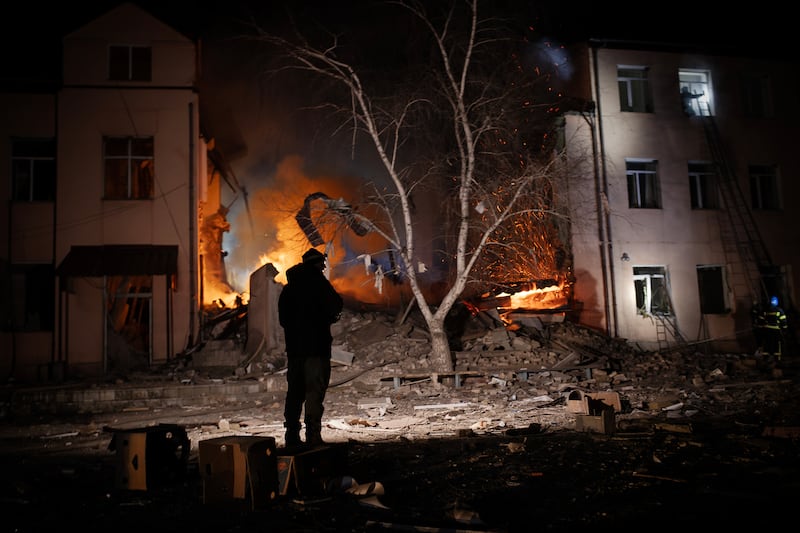 The site of a bombing in Sloviansk, Ukraine, in February 2024. Photograph: Tyler Hicks/New York Times
But what Trump treats as petty problems are in fact the fundamental elements of a potential deal, which could decide whether Europe’s biggest war since 1945 really ends, resumes after a pause or keeps rumbling on.
How will the West ensure Russia never attacks Ukraine again? What will be the status of occupied territory? What will become of Kyiv-controlled parts of Donetsk region and its residents? How will any peace deal be secured and monitored?
Who will run the Russian-occupied nuclear power station sitting on the front line in Zaporizhzhia? Who will pay for the rebuilding of Ukraine, which the United Nations and World Bank said earlier this year would cost more than $500 billion (€427 billion)?
Who will answer for the well-documented war crimes committed by Russia’s invasion force? And what of the arrest warrants issued by the International Criminal Court for senior Russian officials who ordered attacks on civilian infrastructure in Ukraine, and for Putin himself over the abduction of thousands of Ukrainian children?
Russia is banking on Trump to simply make uncomfortable questions disappear, and facilitate its near pain-free reintegration into the world economy.
Through state media, Putin is sending the same message to Russians: total victory is inevitable, either on the battlefield or at the negotiating table. There is no sense of a nation being prepared to moderate maximalist expectations whipped up by the Kremlin.
Polling by the Kyiv International Institute of Sociology showed this week that 72 per cent of Ukrainians were ready for a deal that included some compromises and froze the front line – but 75 per cent saw as “completely unacceptable” any plan that gave land to Russia or limited Ukraine’s army without including strong security guarantees.
 Danish prime minister Mette Frederiksen, European Council president Antonio Costa and European Commission president Ursula von der Leyen at the end of the EU Council Summit in Brussels on December 19th. Photograph: Olivier Hoslet/EPA
One of the big question marks that hung over 2025 was whether Kyiv’s allies in Europe would be able to fill the shortfall opened up when the Trump administration curtailed financial and military aid to Ukraine. The US is still sending weapons and equipment, but now on the condition someone pays for them.
The leaders of the EU’s 27 member states gave a definitive answer in the early hours of December 19th, emerging from a Brussels summit having agreed on a €90 billion loan for Ukraine.
The EU will borrow money as a bloc, backed against its €1.2 trillion budget, rolling over the debt for years, similar to the way governments do. Ukraine would only pay back the money if Russia paid reparations for the destruction its invasion had caused.
The loan represents a significant departure for the EU. Berlin and other fiscally conservative capitals have long opposed the union taking on joint debt, but previously made an exception for a recovery fund in the fallout of the Covid-19 pandemic.
The departure seemed extremely unlikely just three weeks before, when ambassadors from each member state met in the Europa building, where their prime ministers and presidents would later gather for the key summit.
The 27 largely unknown senior officials are an important axle in the European policymaking machine, bridging the Brussels-based institutions and national governments.
 A Ukrainian artillery crew fires an M777 howitzer at Russian targets at the Kurakhove front line in eastern Ukraine in February. Photograph:Tyler Hicks/New York Times
Two options were put on the table by the European Commission, the union’s powerful executive led by Ursula von der Leyen.
A €90 billion loan could be funded by joint borrowing, or instead be backed by Russian central bank assets frozen inside EU financial institutions by sanctions introduced in the early weeks of the war.
The commission predicted Ukraine would begin to run out of money in the second half of 2026, risking a possible collapse on the battlefield.
The Hungarian ambassador representing Viktor Orban’s far-right government made it clear they would not go for an EU loan.
Given that option would require the sign-off of all national capitals, it seemed to die in the room.
The plan to use Russia’s frozen assets only required a weighted majority to be approved, so that’s where EU officials focused their energy.
The Belgian government feared it would be exposed to Russian retaliation, given most of the assets were on ice in Euroclear, a Belgian depository housing government bonds. The commission and German chancellor Friedrich Merz – a big backer of the plan to tap the Russian state cash – failed to convince the Belgians.
In the days before EU leaders met in Brussels, a small circle of officials and diplomats started to consider what to do in the event Belgium’s prime minister Bart De Wever could not be persuaded to lift his opposition. The other leaders would not push ahead over the objections of Belgium.
A back channel was opened up to Budapest, sounding out Orban again on the idea of an EU-backed loan.
A workaround was constructed, relying on emergency powers laid out in the union’s treaties, that meant Hungary would be exempt from covering any costs associated with the loan.
Orban told fellow EU leaders he would not veto the plan, once Hungary wasn’t on the hook in any way.
Populist governments in Slovakia and Czech Republic, who are also lukewarm on the idea of aiding Ukraine, joined Hungary.
The result was a 3am deal that will go a long way to shoring up Ukraine’s finances for the next two years. The EU loan puts Kyiv in a more secure position in the twisting negotiations the US has been running, to broker a deal between Russia and Ukraine.
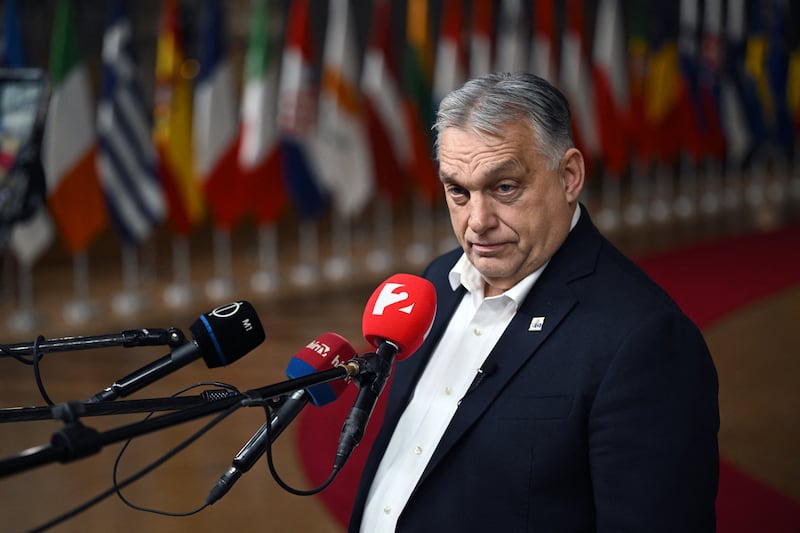 Hungary’s prime minister Viktor Orban. Photograph: Nicolas Tucat/AFP via Getty Images
In private discussions, some European leaders doubt Putin has any serious intention of supporting a peace deal where Moscow would agree to make concessions.
Europe’s strategy, which has stayed the same since Trump’s summit with the Russian leader in Alaska, has been to convince the White House that Moscow is the real obstacle to a truce, and that Putin will only compromise when put under serious pressure.
Jamie Shea, a former senior Nato official, said one of the worst scenarios would be an unstable truce that hamstrung Ukraine and allowed Russia to regroup and plot a further attack. “The Russian army will still be in good shape and reconstitute quickly,” he said.
[ How Russia recruits Ukrainians to attack their own countryOpens in new window ]
A freeze in the conflict could look similar to a 2014 deal intended to end the fighting in the Donbas between Ukraine and Russian-backed separatist forces, which did not hold, he said.
For any truce to be successful it would need to create the conditions “for a 30-year stalemate” in the east, he said, before pointing to Cyprus and East Germany during the Cold War as two examples.
Shea, who served as Nato’s deputy assistant secretary general for emerging security challenges, told The Irish Times the problem was western support for Ukraine had given Kyiv “enough to not lose, but not enough to win”.
“Ukraine is still in the fight and no one would have predicted that four years ago,” he said. However, the “Russian steamroller” is inching forward.
“For the Europeans, if they want Ukraine to keep fighting, in the interests of a solution that’s in line with justice and European values … they will have to, in terms of financial support, do a hell of a lot more,” he said.