Italian researchers have reached a significant milestone in the hunt for dark matter, demonstrating a new “tunable” system capable of searching for elusive particles at higher frequencies than ever before.
The researchers have successfully deployed a high-frequency haloscope to probe a previously unexplored mass region above 40 microeV.
“A search for cosmological axions has been performed by scanning a frequency region of 38 MHz centered at about 10.2 GHz, corresponding to an axion mass region above 40 microeV,” said the researchers in a new study.
This specific range is of high interest to the scientific community following recent theoretical predictions that suggest axions in this mass window are strong candidates for the universe’s “missing” mass, as reported by phys.org.
Using specialized haloscopes
This research was conducted using two specialized haloscopes located at the Laboratori Nazionali di Legnaro (LNL) and the Laboratori Nazionali di Frascati (LNF).
The primary objective of the experiment is to identify axions, which are hypothetical light particles theorized to exist since the early stages of the universe.
These particles are significant to modern physics because they offer a potential solution to two distinct problems. First, they provide a theoretical explanation for why certain nuclear interactions do not violate time symmetry. Second, they are considered a leading candidate for dark matter.
The recent study by the QUAX collaboration utilized a high-frequency haloscope designed to operate above 10 GHz. This frequency range allows the team to probe an axion mass region above 40 microeV. Because the exact mass of an axion is unknown, experimental systems must be capable of scanning a wide range of values to ensure a thorough search.
“The novel version of the apparatus allows for frequency tuning of the resonant detection system with uniform axion sensitivity over a broad range,” added the study.
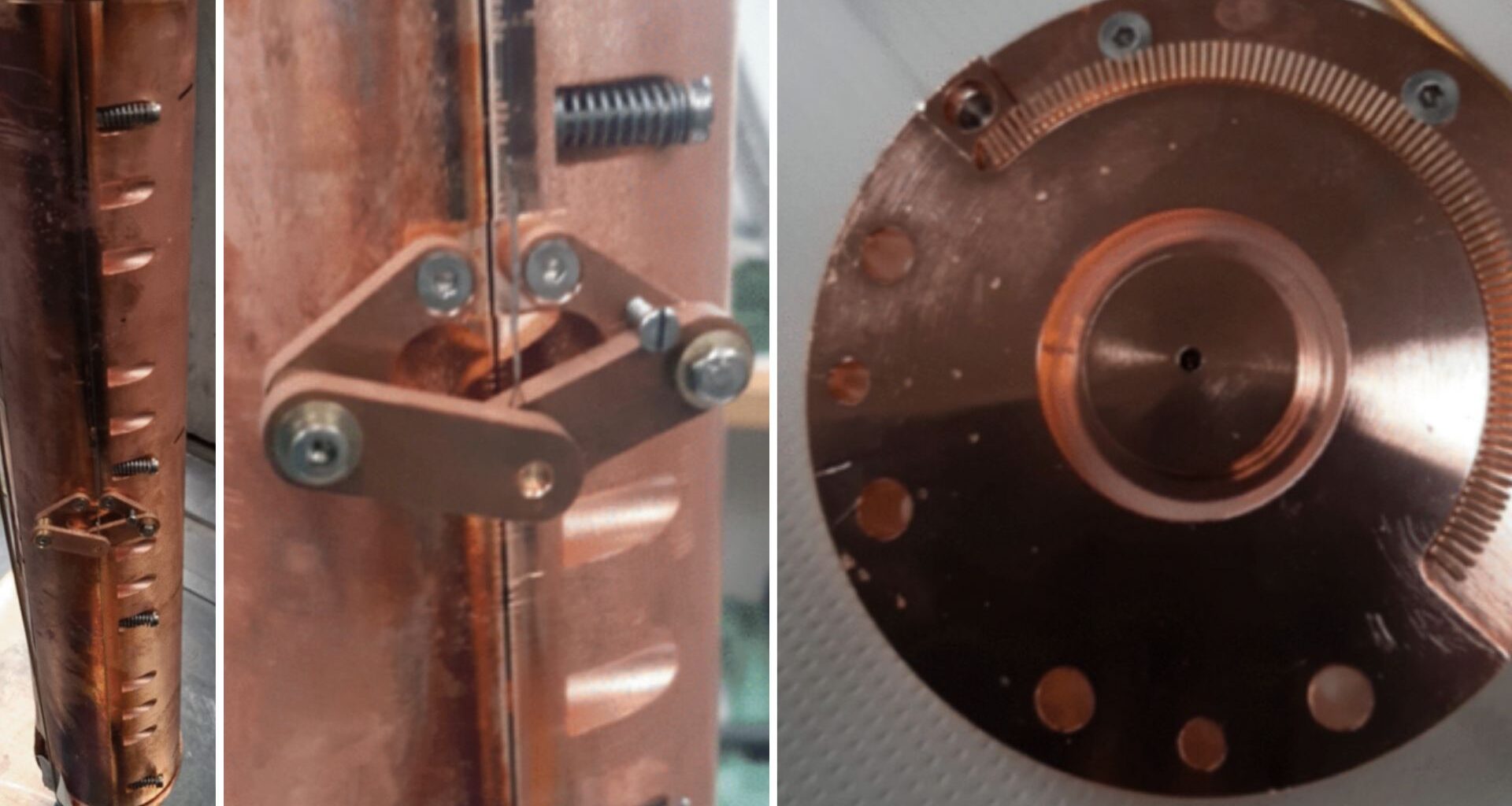
The detection process relies on a microwave cavity made of copper that is immersed in a strong magnetic field. According to the theory of axion-photon coupling, axions interacting with virtual photons from a magnetic field can convert into real photons. These real photons appear as a very low power excess at a specific frequency.
To capture this faint signal, the researchers use a detection chain that includes a properly coupled antenna and a quantum-limited amplifier. This equipment is designed to distinguish potential axion signals from background thermal and electronic noise.
Tunability is critical feature
A critical feature of the system is its tunability. The researchers can change the frequency of the copper cavity by adjusting its aperture. For every change in the aperture, the team monitors the system to compare pure noise levels against the possible presence of a signal.
While the most recent search did not detect a signal consistent with axion conversion, the experiment confirmed that the system is capable of scanning different frequencies with high sensitivity.
Future plans include increasing the sensitivity of the haloscopes and expanding the mass range being probed. The researchers aim to incorporate more advanced cavities and achieve full automation of the system.
If an axion trace is eventually identified, it would provide the first direct evidence of dark matter.