Mass Hockey: One of the most noble things in youth sports, is a coach or volunteer who keeps coaching or volunteering after their own kids have moved on from a particular age or the game. You have that template in your dad. What did it, or does it now, mean to have seen him still in hockey when all his kids were adults, some with kids of their own?
Kelleher: He had that love for all sports, all those sports I mentioned, and he did it for so long with all of us.
I don’t think he would’ve known what to do if he wasn’t coaching after that. It was such a big part of his life and my mom’s life.
He used to say, “When I coach these kids, I see you and your brothers’ faces out there.” It was something that was always huge for him. And you talk about communities and hometowns, and Belmont was his community. He was rare and he was uniquely dedicated to his community.
It was just his way of giving back and doing good by all generations of Belmontonians.
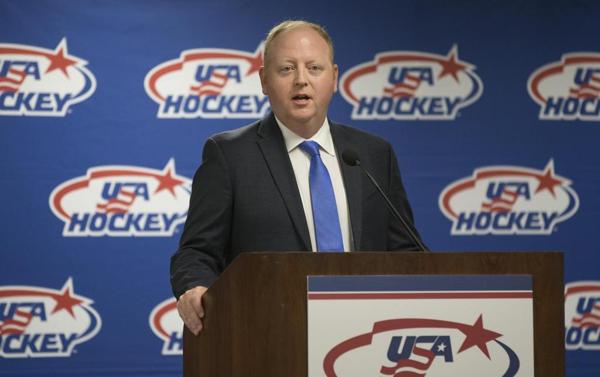
Mass Hockey: Now you’re in this spot of significant influence within the game [Kelleher was named Executive Director in 2017]. Do you have a philosophy or an operating system on how you approach your role?
Kelleher: It goes back to loving the game at the core, remembering, as we’re at the World Juniors, that the international competitions and those things are really enjoyable, but, more, that parents are bringing their kids to rinks all over the country.
To me, that’s what gets me out of bed or makes me excited to be a part of USA Hockey – the volunteers and all the people who do that.
And when we’re at the World Juniors, coming up in the Olympics and Paralympics, when I talk about these things, I say these players didn’t just show up at this platform, this event or this place.
Somebody tied their skates when they were six. Somebody drove them to the rink. A neighbor coached them. All of that stuff is really what makes it so great. There’s that connectivity that everybody who is a part of the game feels. And so it’s cool to be in the role that I get to have, just to try to make sure we never lose sight of that connectivity from the grassroots of Learn to Play to the World Juniors and international hockey.
Mass Hockey: This past calendar year for USA Hockey has been pretty spectacular. A quick look back: breaking 93-year-old droughts at Men’s Worlds, a Rivalry Series sweep for the women, the 4 Nations was a hit and in sled hockey Team USA won the 2025 Para Hockey Cup in early December. What has it been like to be the biggest fan for that international hockey over the past few months?
Kelleher: It certainly is a culmination for all these tremendous athletes, first and foremost. And we’ve had success along the way, certainly on our women’s and sled sides and in the World Juniors we’ve had success.
And that has been great – coaches, athletes, people behind the scenes, so many of them, and such great depth of programs and people doing things the right way for the betterment of kids and players and athletes – but the thing we’ve really talked about is that on the men’s international side we have to win a world championship and, ultimately, have to win an Olympics and we have to have best-on-best, as well. And we haven’t quite done that.
The 4 Nations was a great event right up until it wasn’t a great event at the very end. But it was incredible for our game across the country with the excitement and enthusiasm around it. We’ve been pushing the past four or five or six years, really focused on how we win the Men’s World Championship. We made a plan on that.
John Vanbiesbrouck and I enlisted Billy Guerin to be really the GM of our men’s national team program over the past three years [Guerin, born in Worcester and raised in Wilbraham, is also General Manager of the Minnesota Wild]. That means 4 Nations and Olympics and World Championships in between. As an organization, it was a sticking point, a sore point. We’ve done so much and we’ve won a lot of different things, but we haven’t won at the highest level on the men’s side.
We made a big step on the men’s worlds, for a little bit of relief, and it was a great year in 2025, the most successful international one in our history, and now we have to do it again.
We have to ramp it up, and the stage gets bigger and the lights get brighter when you talk about the Olympics and Paralympics. But we feel like we’re positioned in our men’s and women’s and sled programs to do that.
And our expectation, and I’ve said this many times publicly, is that our plan is to go to Italy and we want to come home with three gold medals. We are capable, and we believe we can do it. And I think sometimes we have to speak it out loud and not be shy to say that’s what we’re going for.