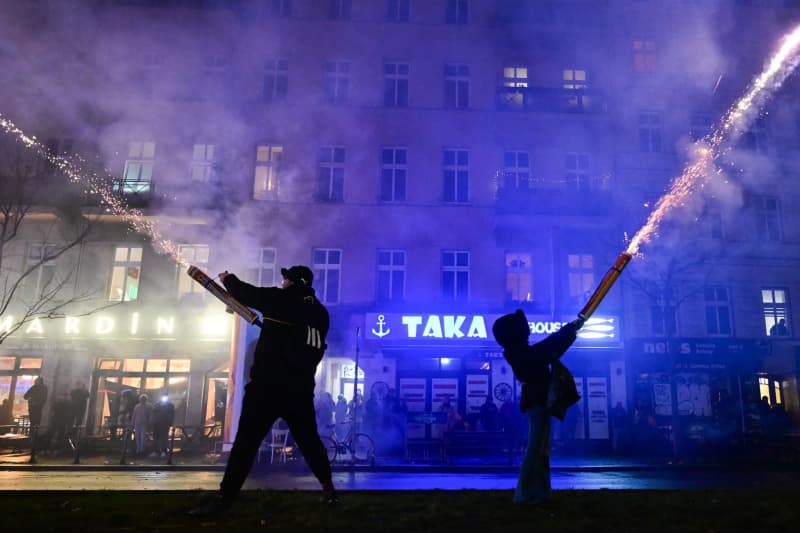
Germany’s New Year celebration was largely peaceful compared to previous years, although at least two people died and many were injured, and revellers in some places threw fireworks at police officers and the emergency services.
Additional police were on duty in many places, with concerns about potential violence in several cities, including Berlin, following attacks on emergency services on New Year’s Eve in previous years.
In Berlin alone, where 4,300 police officers were on duty, there were more than 400 arrests by 1 am on Thursday (0000 GMT). A total of 21 police officers were slightly injured by blast trauma after being shot at with firecrackers or by resistance from suspects, the police said in a later update on New Year’s Day.
In the eastern city of Leipzig, where riots broke out in previous years, police and emergency workers were attacked with fireworks.
In the western city of Bielefeld, two 18-year-old men died after suffering fatal facial injuries in separate accidents involving home-made fireworks.
Many people suffered injuries, some of them serious, like a 23-year-old who lost his left hand due to an exploding firecracker near the north-eastern city of Rostock.
Berlin welcomed 2026 with a seven-and-a-half-minute fireworks display at the Brandenburg Gate and countless private firework celebrations. Up to 25,000 tickets had been available for the main event.
The capital’s traditional New Year’s Eve party featuring live performances was cancelled after the city government said it would no longer fund it, and was replaced with a DJ party at the Berlin landmark.
Meanwhile in Hamburg, thousands of people welcomed in 2026 at public broadcaster ZDF’s New Year’s Eve show in rainy weather. For the first time, the show did not take place in front of the Brandenburg Gate in Berlin but on a floating stage on the Elbe in front of the Westfield shopping centre in the northern port city.
At midnight, there was a spectacular fireworks display, which was set off by tugs behind the stage.
Ten police officers were injured in Hamburg and were unable to continue working, the police reported on Thursday.
In Munich, organizers said that around 10,000 people celebrated the arrival of 2026 at a large New Year’s Eve party on the main Ludwigstrasse thoroughfare. Everything was very peaceful, said Katrin Strauch from event agency Gral. “There were no incidents, nothing at all.”
Those who welcomed the New Year outside were best advised to dress warmly. In parts of Germany, the German Weather Service advised caution due to snow and slippery conditions. In the north, it was expected to become increasingly stormy on Thursday morning.
Berlin New Year’s celebrations calmer than in past
Berlin Police spokesman Florian Nath told dpa in a preliminary assessment that police had “no reports of serious injuries” among officers or revellers.
“Nor did we have any serious incidents or property damage like last year.”
Police officers were however attacked with fireworks, 21 of them suffering minor injuries.
The police were partially successful in countering the dynamics of criminal perpetrators who moved among the crowd of peaceful revellers, they said. The concept of a large firework-free zone worked particularly well at the large central plaza of Alexanderplatz, they added.
A demonstration and party at the Victory Column in the middle of the Tiergarten park were peaceful. Instead of the 16,000 participants who had registered, only a few hundred showed up, according to the spokesman.
The celebration at the Brandenburg Gate also passed without incident.
Police in Leipzig attacked with fireworks
In Leipzig, police and emergency services were attacked with fireworks, according to a police spokesman. Among other measures, the police erected barriers in the Connewitz district, which is known for riots.
However, the incidents and fires in Leipzig were not limited to the known areas; There were also several fires in Leipzig city centre, where rubbish bins were set alight, the spokesman said.
In recent years, there have been regular riots in Leipzig on New Year’s Eve.
Fire brigades stretched
Fire brigades were also in constant operation, with fires reported in several federal states during the night. Roof trusses were set on fire, as were rubbish bins, hedges and cars.
Several roofs caught fire in the city of Hagen in the state of North Rhine-Westphalia. The fire initially spread from a burning tree to a house, said a police spokesman. From there, the flames ignited the roofs of two other objects in a building complex. The buildings burned down completely. It is now being investigated whether the fire was caused by a firework.
A fire in the roof of a historic building on the square in front of the cathedral in the central city of Erfurt spread to two adjacent houses. According to the fire brigade, a New Year’s Eve firework likely triggered the fire.
Discussion of firework ban
This year, as in the past, many groups, from health professionals to environmentalists, called for a ban on fireworks in the run-up to New Year’s Eve.
Doctors’ representatives, police officers and animal rights activists all suggested a general ban on the use of private firecrackers and rockets due to the number of injuries caused.