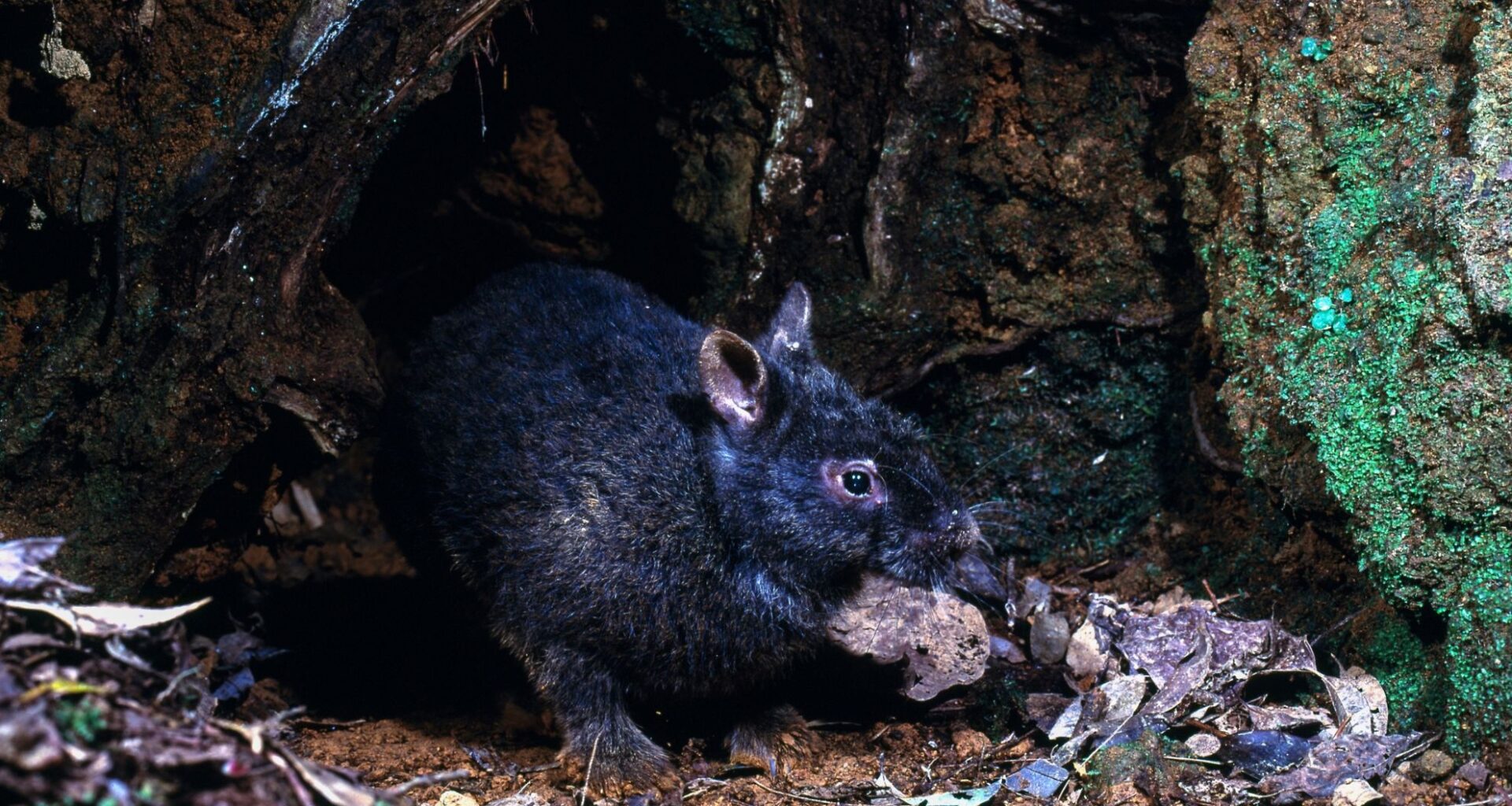
Endemic to Amami Ōshima and Tokunoshima in the Ryukyu Archipelago, Pentalagus furnessi, often dubbed a “living fossil”, is the sole surviving member of a primitive rabbit lineage. It’s also one of the most endangered lagomorphs in the world, its population continuing to shrink despite its status as a protected species in Japan.
Unique in both appearance and ancestry, the Amami rabbit is one of the few mammals to have survived isolation, predators, and habitat change since the Pleistocene era. Conservationists, scientists, and local authorities have been trying to curb its decline, but rising threats, especially invasive species and forest exploitation, are testing the limits of these efforts.
A Rabbit from the Miocene, Hiding in the Undergrowth
With its coarse black-brown fur, short legs, tiny eyes, and unusually small ears, the Amami rabbit doesn’t look like your average bunny. Its build is squat and robust, with thick, strong claws that it uses to dig burrows along steep forested slopes. According to a review by Fumio Yamada, the animal’s anatomy includes a low, flat skull, narrow incisive foramina, small auditory bullae, and uniquely structured teeth that display the most complicated enamel crenulation of any leporid.
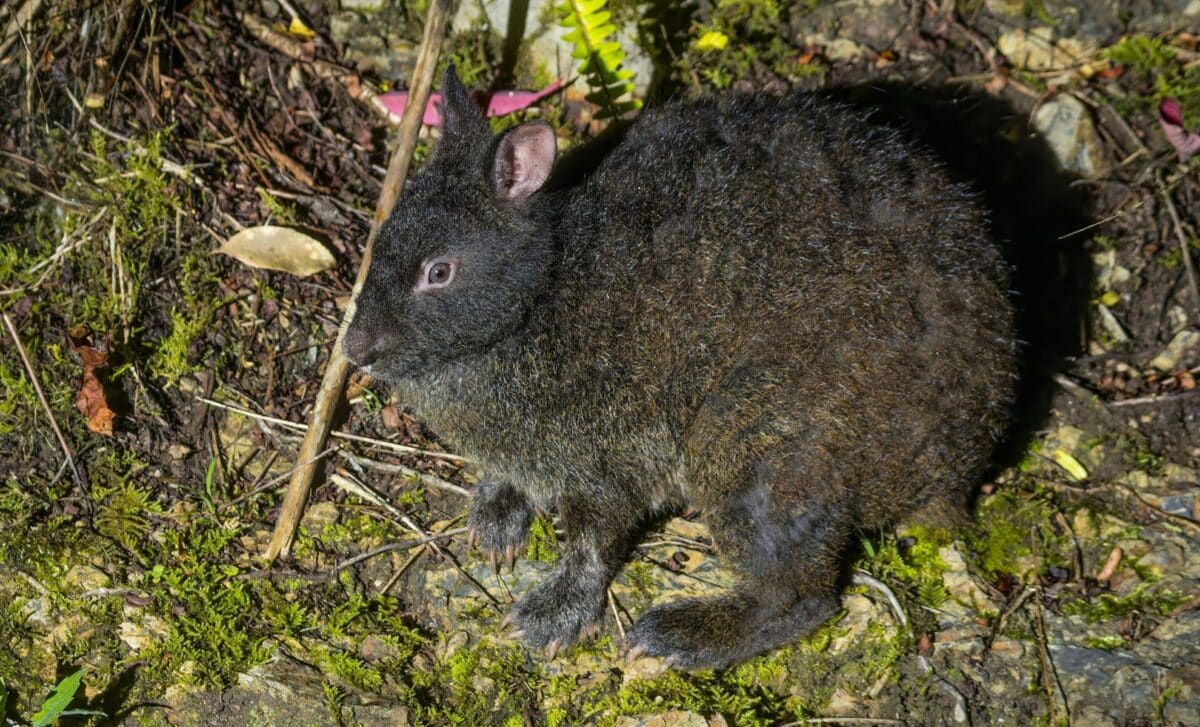 Profile view of the Amami rabbit Pentalagus furnessi, a nocturnal species endemic to the Amami Islands, globally endangered.© Shutterstock
This anatomy links the rabbit to its possible ancestor, Pliopentalagus, an extinct genus from the late Miocene to late Pliocene, known from fossils in China, Japan, and Europe. As reported in the Review of the Biology and Conservation of the Amami Rabbit, the Pentalagus furnessi lineage may have diverged as early as the Middle Miocene, placing it among the earliest radiating leporids. Fossil molars found on Tokunoshima further support the rabbit’s long-standing presence on these islands.
Though fossils tell part of the story, the rabbit’s present existence is just as compelling. It remains strictly nocturnal, vocalizes like a pika, and avoids heat stress by emerging only when temperatures fall below 24°C. “Rabbits appeared at the entrances of their burrows before they became active, and made calls that could be heard loud and clear in small valleys,” wrote Yamada. This behavior, combined with their rugged environment, reveals a species still finely tuned to the rhythms of the old-growth forest.
Fragile Home, Shrinking Population
The Amami rabbit requires a precise combination of forest conditions: a mosaic of old and young woods, dense undergrowth, and cool, shaded valleys. These forests once covered most of the islands, but widespread logging, agriculture, and residential development have drastically reduced their range. According to population estimates from Sugimura and Yamada (2004), the number of individuals on Amami Ōshima dropped from around 6,100 in the 1990s to 2,000–4,800 by 2003. On Tokunoshima, where forest cover is more fragmented, only about 400 rabbits are thought to remain.
The rabbit’s habitat isn’t just shrinking, it’s being fragmented. On Amami Ōshima, the forest cover still makes up 86% of the land, while on Tokunoshima, that number is only 44%. The rabbits rely on thick valleys and scarp rocks to dig their L-shaped burrows, which range from 30 cm to nearly 2 meters in length. These burrows are essential for shelter and breeding, yet they are often placed near forest roads and exposed edges, making the rabbits more vulnerable to external threats.
Despite being designated a natural monument in 1921 and upgraded to a special natural monument in 1963, conservation action lagged behind the pressures of economic development. According to Yamada, even after hunting was prohibited, habitat destruction continued nearly unchecked until the late 1990s, when monitoring and protective programs began taking shape.
Under Siege from Predators They Never Evolved to Face
Perhaps the most severe blow to the Amami rabbit came not from humans, but from a small, carnivorous mammal introduced with good intentions. In 1979, the small Indian mongoose (Herpestes javanicus) was released on Amami Ōshima to control venomous snakes, but instead, it found a new prey: native species, including the Amami rabbit.
Diet analysis conducted by Yamada and colleagues in the early 2000s showed that 8% of mongoose pellets contained remains of the rabbit. “There has been no clear evidence that the mongooses prey on snakes,” Yamada noted, underlining the failed intent of their introduction. Mongoose populations quickly spread into the mountainous forests, where they hunted a wide range of invertebrates, amphibians, birds, and mammals.
To combat this, Japan’s Ministry of the Environment began a mongoose eradication program in 2005. While progress has been made, the rabbit remains at risk from feral cats and dogs as well, both of which have adapted to forested regions. Combined with habitat loss, these invasive species have contributed to the rabbit’s placement on the IUCN Red List as an Endangered species.