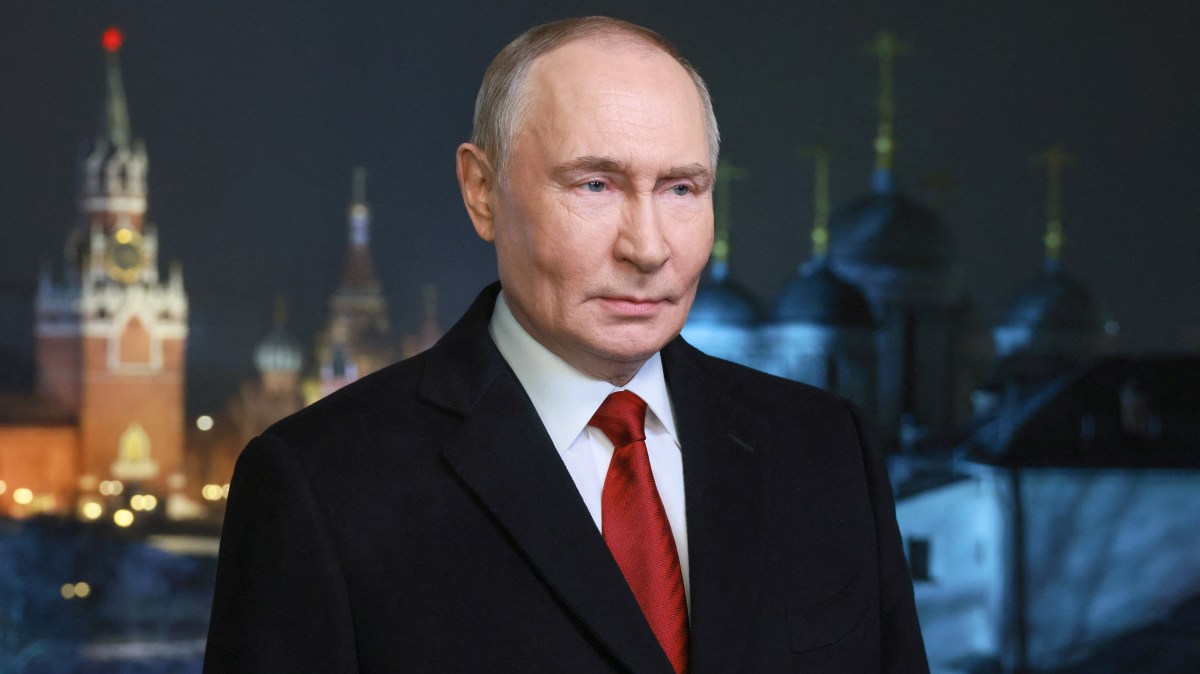
When the Kremlin clock tower rang in the new year, President Putin marked 26 years in power, bringing him closer to overtaking Joseph Stalin, the Soviet dictator, as Russia’s longest-serving ruler since the tsarist era.
Yet Putin, who likes to think of himself as a historian, will be keenly aware that another, more awkward, date is approaching. On January 12, Russia will have spent 1,418 days trying in vain to defeat Ukraine on the battlefield — exactly as long as it took the Soviet Red Army to vanquish Nazi Germany’s troops.
Stalin’s soldiers fought their way from the Volga river to the heart of Berlin, but Putin’s army is still bogged down in the Donetsk town of Pokrovsk, an advance of around 30 miles since the full-scale invasion of Ukraine started, in 2022.

The impact of the conflict on Pokrovsk in June
KOSTIANTYN LIBEROV/GETTY IMAGES
For Putin, who has made the Soviet Union’s victory over Hitler’s forces a cornerstone of national ideology, his own army’s underperformance is an unwelcome reminder that his war machine, modernised and equipped over the years with energy revenues from western countries, is not as well-oiled as he had been led by military officials to believe.
However, neither the massive casualties the Russian army has incurred for such modest progress, nor the growing economic difficulties caused by western sanctions, show any sign of persuading Putin to compromise on his ultimate aim of forcing Kyiv back into Moscow’s orbit.
According to Roman Badanin, the editor-in-chief of Proekt, a Russian investigative journalism website banned by the Kremlin, Putin is now — like Stalin during the Second World War — playing a direct role in military planning while trapped in an echo chamber of his own making.
• From Ukraine to Gaza, 2026 is likely to be a turbulent year in geopolitics
“Everyone with even a slightly critical perspective has disappeared from his circle,” Badanin said. Those who remained, he added, include “clearly deranged” people such as Mikhail Kovalchuk, head of the Kurchatov nuclear research institute.
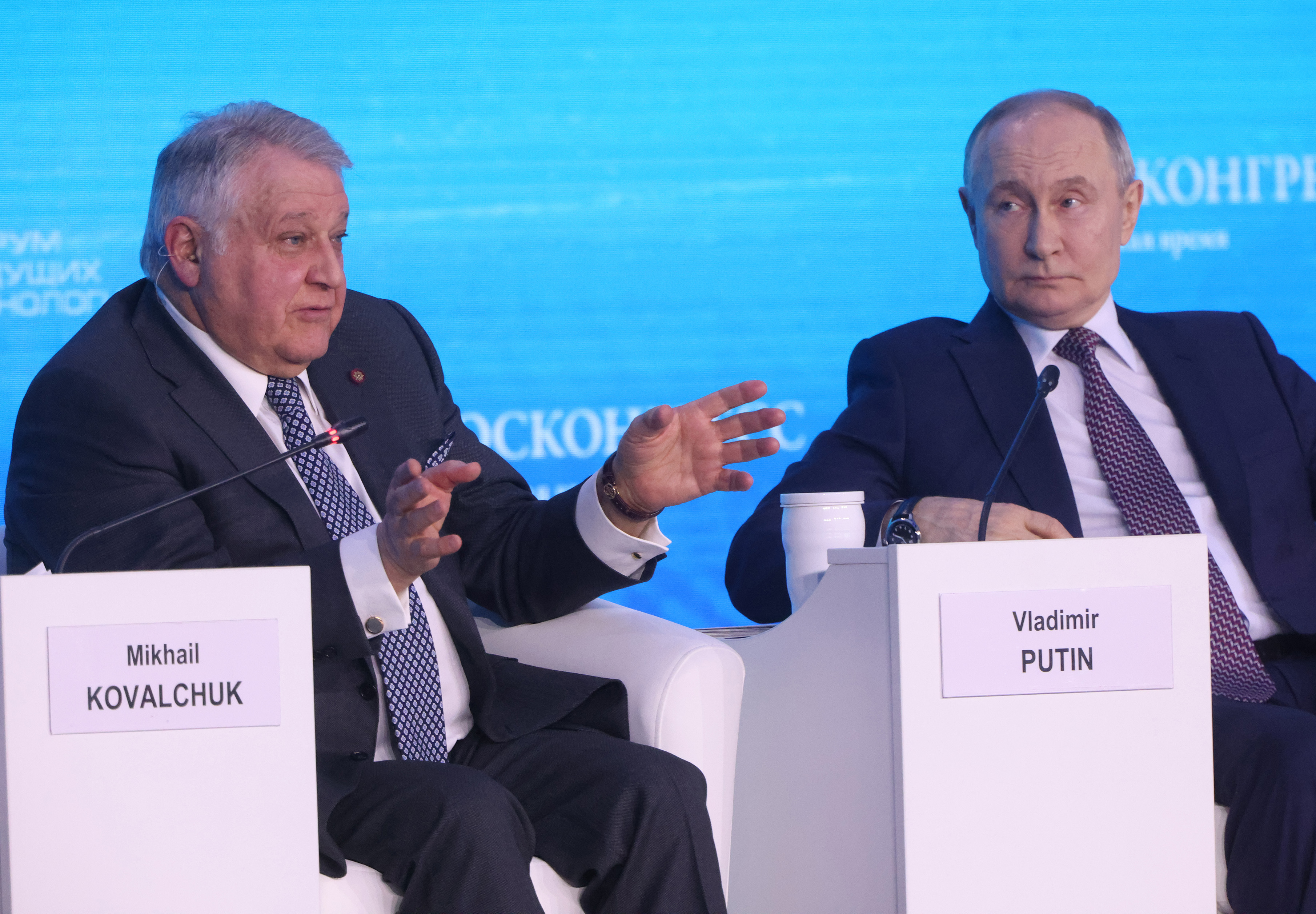
Mikhail Kovalchuk with Putin in February 2025
GETTY IMAGES
Kovalchuk, who has been described as one of Putin’s closest associates, recently told teachers in Moscow that the West was planning to unleash a virus to kill off most of humanity, leaving a tiny elite whose needs would be serviced by robots. Badanin said: “If you mainly talk to such people, of course, your worldview changes in a bizarre way.”
• Russia deploys ‘unstoppable’ hypersonic missiles to Belarus
As the US tries to strongarm Ukraine into withdrawing its troops from the Donetsk region in exchange for an end to the invasion, Putin has refused to budge on the demand he made in June 2024 that Kyiv give up the entirety of four regions in the east and south of Ukraine, including key cities that it still controls.
In a televised new year message to Russian troops on Thursday, Putin said: “We believe in you and our victory!”
He had ordered them to advance in the northern Sumy and Kharkiv regions of Ukraine, and praised their efforts to capture the city of Zaporizhzhia.
However, some Russian opposition figures and analysts say that Putin sees the capture of Ukrainian land as a secondary issue. In speech after speech, he and his senior officials have spoken about the need to eliminate the war’s “root causes”, a byword for the pro-western government in Ukraine.
Mikhail Kasyanov, who was prime minister under Putin between 2000 and 2004 and has lived in Latvia since Russian bombs started falling on Kyiv, told The Times in an interview: “Putin doesn’t need territory. He has set himself the goal of destroying Ukraine’s independence and he can’t back down.”
Kasyanov also said that the Trump administration’s efforts to achieve peace were crippled by its misunderstanding of the nature of the war. He said that the US viewed it as simply a conflict between “two regional leaders who need to be reconciled”, rather than as an all-out crusade by Putin to impose his will on Ukraine.
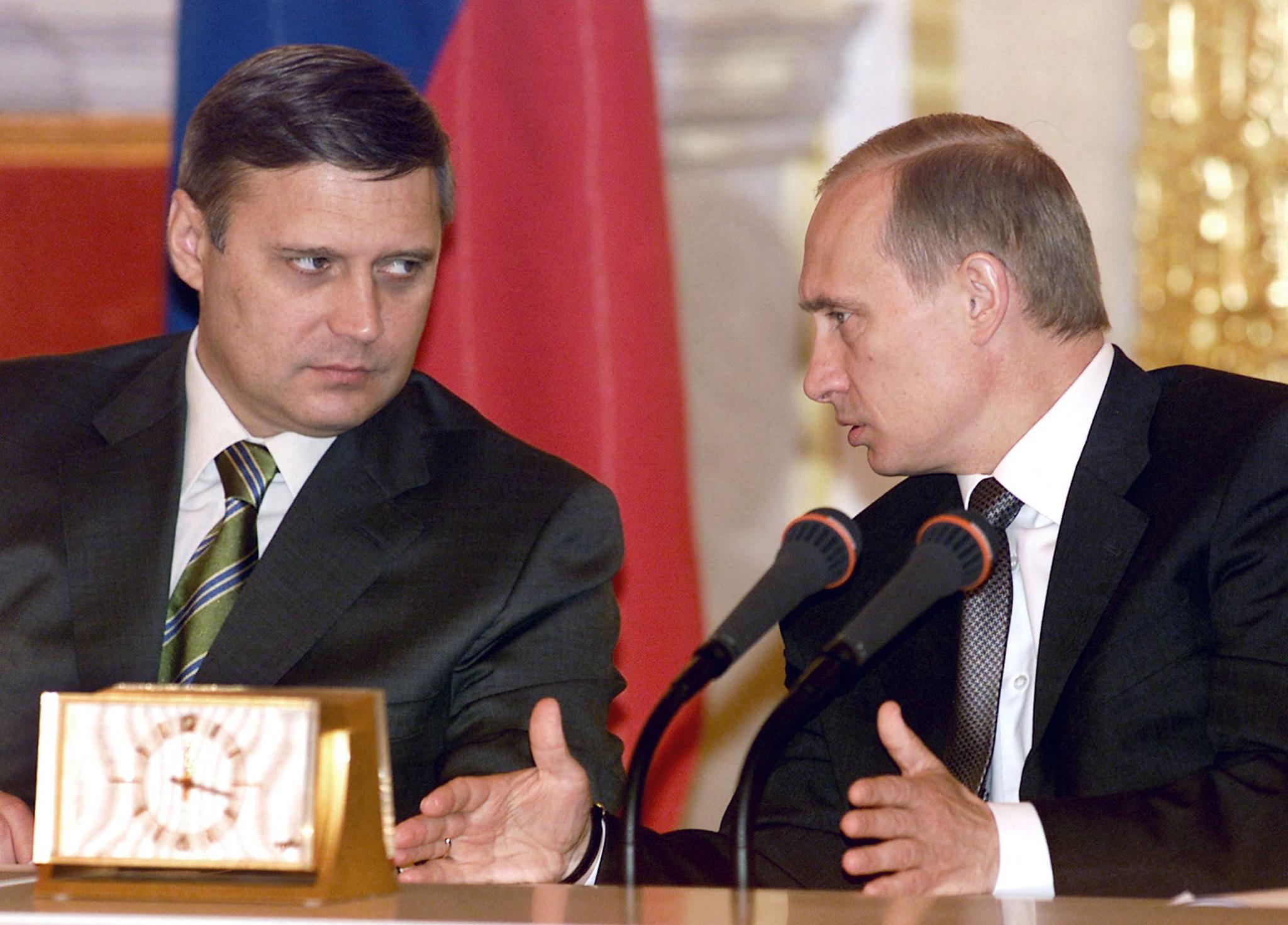
Mikhail Kasyanov and Putin in 2001
MAXIM MARMUR/AFP/GETTY IMAGES
Tatiana Stanovaya, a political analyst from Moscow and an expert on Putin, said that even if Ukraine ceded land to Moscow, Putin would not be satisfied with leaving any part of Ukraine as “independent, strong and combat-ready”.
“Putin wants a peace settlement on his own terms,” she said. “But if that doesn’t work out, he is prepared to continue fighting. For him, the rapid seizure of territory is not a matter of principle.
“His idea is that Russia is forced to take more land because Ukraine is not capable of making a deal. But taking territory is leverage, not a goal. And so it doesn’t matter to him that Russia’s army only got as far as Pokrovsk.”
Stanovaya, who has been designated a foreign agent by the Kremlin, portrayed Putin as “a prisoner of his own delusions” who was obsessed with trying to ensure that Ukrainian politicians who were “friendly” towards Moscow eventually come to power in Kyiv.
“There is a strong rational core in Putin,” she said. “He can be a very explicit pragmatist. But he also has a clearly irrational core, which we see when he wants something that he will never obtain.”
She also said that Putin was convinced that Ukrainians were “waiting” for Russia to take control of their country and that his armed forces were going out of their way to avoid unnecessary civilian casualties.
“He is not ashamed of this war. He’s surrounded by people who nurture this conviction in every way possible. No one can come to him and say, ‘Look at the destruction’, because he’ll be perceived as a traitor. I understand how awful this seems, but if we want to understand how Putin sees things, this is how.”
Shortly before President Trump of the US and President Zelensky of Ukraine met in Florida on December 28, Sergei Ryabkov, a Russian deputy foreign minister, said: “We would like to see Ukraine become a country that is friendly towards Russia. I think Ukraine will eventually come to this. We just need to work hard to bring this moment closer.”

President Trump and President Zelensky in Florida
JIM WATSON/AFP/GETTY IMAGES
Putin’s irrationality has not only resulted in the Kremlin turning down a US-backed peace deal that was favourable to Moscow. It also means that the economic downturn is unlikely to lead to peace in the immediate future.
Although western sanctions took time to bite, they are now having an effect. Oil and gas revenues slumped by just over 20 per cent in 2025, even as the Kremlin’s spending on the military and state security is set to rise to 16.8 trillion roubles — £152 billion — equivalent to 38 per cent of the state budget.

Putin inspects weapons during Russian-Belarusian military drills in September 2025
SERGEY BOBYLEV/AP
Although restaurants in Moscow are still packed, the economic uncertainty has created fear of a return to the social instability that swept Russia in the 1990s. In a nationwide poll, “anxiety” was voted the word of 2025, state media reported in December.
Sergei Novikov, a Kremlin official, said last year that about half of all Russian soldiers who had returned home, including violent criminals who had been given pardons in return for six months at the front, had failed to find legal employment. “There is no data on how they are earning a living,” he said.
The central bank, thought to be nervous about a new crimewave, is planning to provide firearms training for some of its employees, public procurement records showed in November.
For Putin and his inner circle, though, ensconced in their luxurious residences, the economic struggles of the Russian people are an acceptable sacrifice for victory in Ukraine.
• Inside Putin’s secret clifftop palace in Crimea
Alexandra Prokopenko, a former adviser to the Russian central bank and now an analyst at the Carnegie Russia Eurasia Center think tank, said: “Putin has demonstrated a willingness to accept economic stagnation and declining living standards indefinitely. The Kremlin has prioritised war spending over everything else and shown it can manage unrest. Economic pain is a constraint, not a dealbreaker.
“Putin isn’t worried enough about protests — he’s worried about appearing weak. Social discontent is real, but it’s fragmented and directionless. There is no internal pressure on the Kremlin. If economics mattered, he’d already be negotiating.”
Putin’s confidence in his ability to keep waging war in Ukraine has also been boosted by in-fighting among the exiled opposition movement and the crushing of almost all political dissent within Russia. Although parliamentary elections are scheduled for September, they are unlikely to be a real opportunity for Putin’s political opponents to weaken his grip on power.
There are occasional signs of simmering discontent, however. Last month, Alexander Sokurov, an acclaimed film-maker and a member of the Kremlin’s human rights council, told Putin that his intolerance of opposition views was a “serious blow” to the lives of Russia’s most talented people, and that such policies were leading the country into a “dead end”.
Trump and his envoys may misunderstand Moscow’s motives for the war in Ukraine, or may simply not care, but James Rodgers, author of The Return of Russia, an upcoming book about Russia’s relations with the West since the 1990s, believes that Putin is certain the White House has come round to his way of thinking and is likely to be planning accordingly.
“Putin is counting on that remaining the case in the coming year,” Rodgers said. “He thinks things are going his way. Putin wants a world in which Moscow and Washington decide on European security matters. with European countries themselves, especially Ukraine, having little or no say in the matter.
“As we know from Putin’s frequent references to his country’s history — as far back as medieval chronicles — he’s thinking about much more than the next deal.”