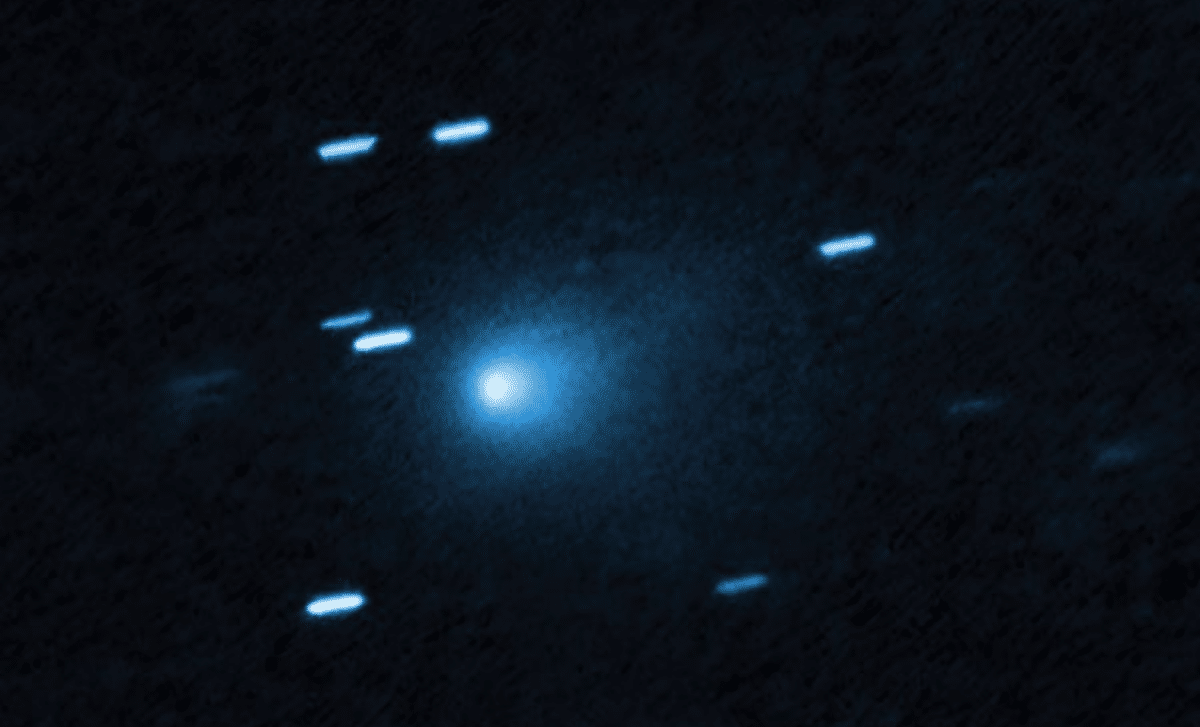
A new radio investigation of the interstellar object 3I/ATLAS has attracted significant attention from astronomers and SETI researchers, prompting one of the most sensitive technosignature searches ever conducted, as detailed in a recent study published on the arXiv preprint server. The results offer a compelling update on the decades-long search for signs of alien intelligence.
Heightened Speculation Meets Cold Data
When 3I/ATLAS was discovered on July 1, 2025, it immediately sparked excitement among scientists and space enthusiasts. Only two other interstellar objects (1I/ʻOumuamua in 2017 and 2I/Borisov in 2019) have ever been observed entering our solar system, making every new ISO a scientific event. This one was no exception.
From the start, online speculation surged, with theories suggesting 3I/ATLAS might be more than a comet, perhaps even a probe from an alien civilization. Its visible coma and rounded, non-elongated nucleus pointed clearly to a cometary identity, but the possibility of hidden artificial characteristics kept the buzz alive. For scientists, the object’s rarity alone was enough to justify a deep investigation.
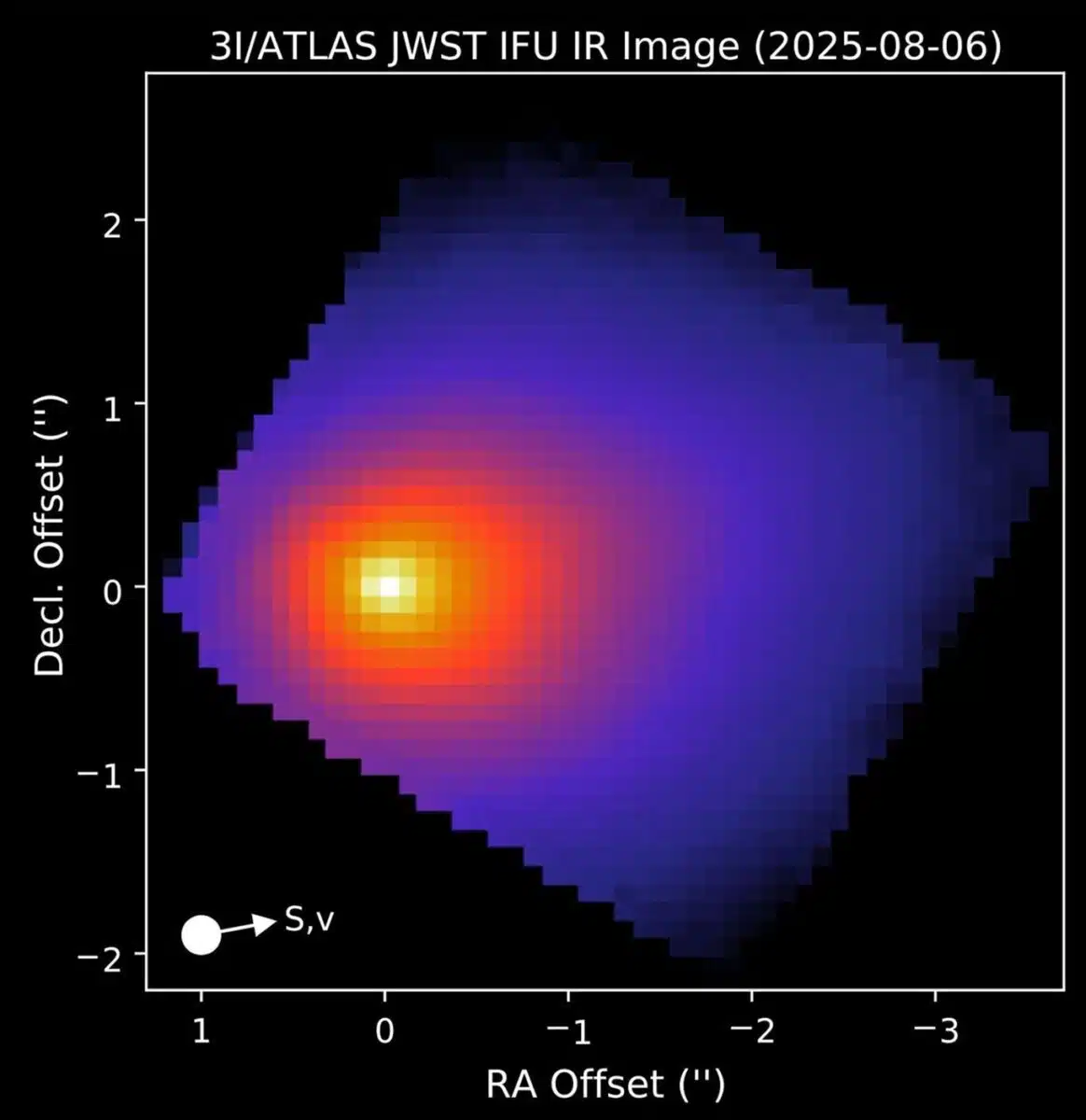 NASA’s James Webb Space Telescope observed interstellar comet 3I/ATLAS Aug. 6, with its Near-Infrared Spectrograph instrument. Credit: NASA
“There is currently no evidence to suggest that ISOs are anything other than natural astrophysical objects. However, given the small number of such objects known (only three to date), and the plausibility of interstellar probes as a technosignature, thorough study is warranted,” said the authors of the new study.
Breakthrough Listen Brings In the Big Dish
That thorough study came on December 18, 2025, just one day before 3I/ATLAS made its closest approach to Earth. As part of the Breakthrough Listen project, astronomers used the 100-meter Green Bank Telescope in West Virginia to carry out what they describe as the most sensitive radio search to date for a technosignature from an interstellar object.
The team scanned 3I/ATLAS across four different radio bands, covering 1 to 12 GHz, a prime range for interstellar communication due to its minimal background noise and strong propagation through space. The raw results initially revealed more than 471,000 candidate signals.
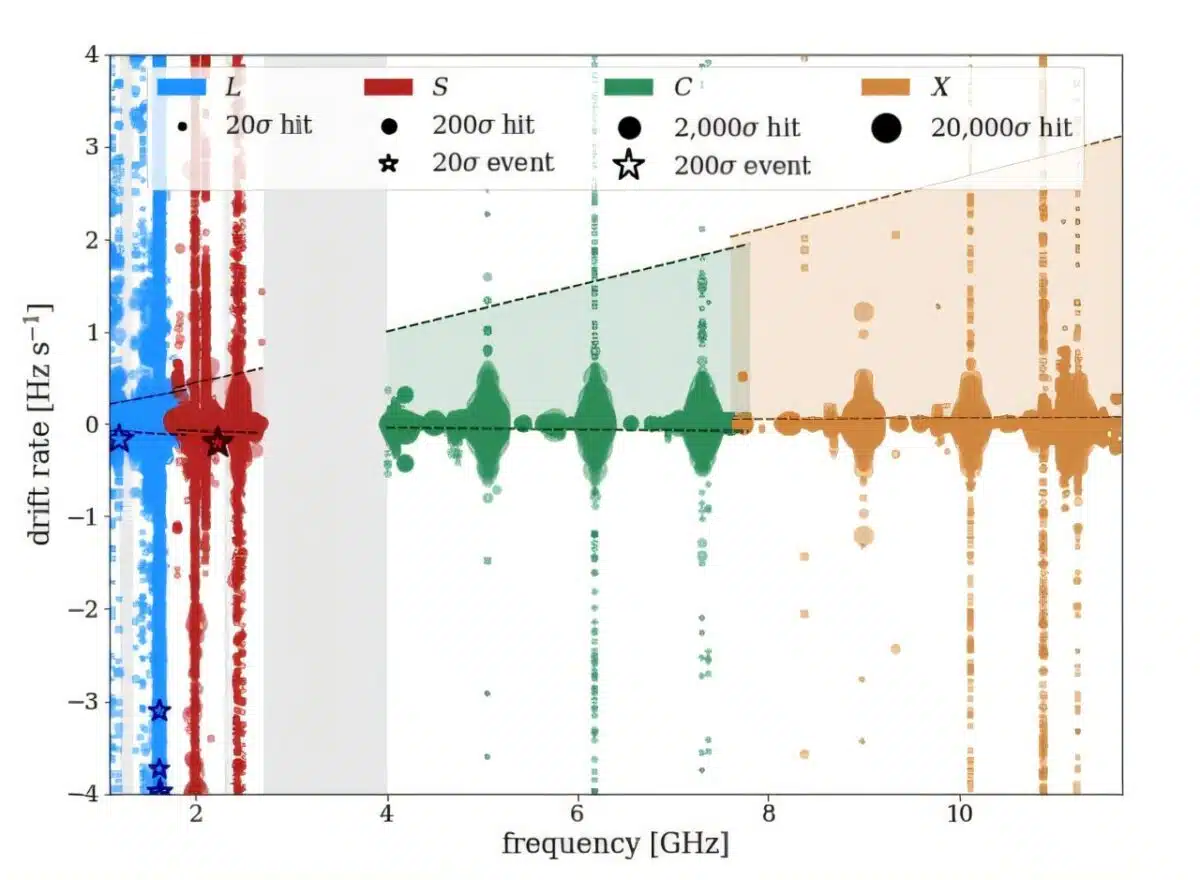 Distribution of hits (circles) and events (stars) over frequency and drift rate. The marker size gives the S/N. The gray-shaded regions show ranges not sampled, including narrow notch filter regions in the L and S bands. The color-shaded regions give the range of drift rates expected from Earth’s orbital motion and rotational motion and 3I/ATLAS’s rotation at each of the four observing bands. These regions do not perfectly align between bands due to 3I/ATLAS’s radial acceleration changing during overhead time between observations. No events lie in the expected drift rate regions. Credit: arXiv (2025). DOI: 10.48550/arxiv.2512.19763
But after applying filters for sky localization and checking against known radio interference sources, only nine signals remained. Further analysis revealed that all nine were false positives, caused either by terrestrial interference or detected during off-target scans. No alien transmission was found.
The findings, detailed in a new paper published on the arXiv preprint server, set a clear threshold: there are no isotropic continuous-wave transmitters above 0.1 watts at the location of 3I/ATLAS. By comparison, a modern cell phone emits roughly 1 watt of power. Had an alien device been broadcasting at that level, the telescope would have detected it.
What the Data Actually Tells Us
The takeaway is not just that 3I/ATLAS isn’t an alien spacecraft, but that if it were, and it was transmitting at even low levels, we likely would have picked it up. The Green Bank scan was exceptionally sensitive. It provides a new standard for future ISO monitoring and a proof-of-concept that such technosignature searches can work in real time.
Beyond alien speculation, the data provides scientific value in understanding how to better distinguish genuine cosmic signals from interference. Every new ISO gives scientists a one-time window to test theories, tune instruments, and push detection thresholds even lower.
The public release of the full dataset from this scan also opens the door for independent verification and follow-up analysis. In a field where skepticism is vital, transparency helps ensure that nothing is overlooked, and that potential breakthroughs won’t be missed in the noise.
The Broader Search for Alien Technology Continues
3I/ATLAS might not be the messenger from the stars some hoped for, but the tools and methods used to study it represent a new era in technosignature hunting. The Breakthrough Listen initiative continues scanning the skies for narrowband radio signals, laser pulses, and other signs of intelligent life.
Future interstellar objects will almost certainly be detected, and each one will bring a fresh opportunity. With projects like the Square Kilometre Array and improvements in AI-driven signal processing, the odds of catching something truly extraordinary, if it exists, are improving.
In the meantime, astronomers remain focused, realistic, and ready. The universe may be silent for now, but we’re listening harder than ever.