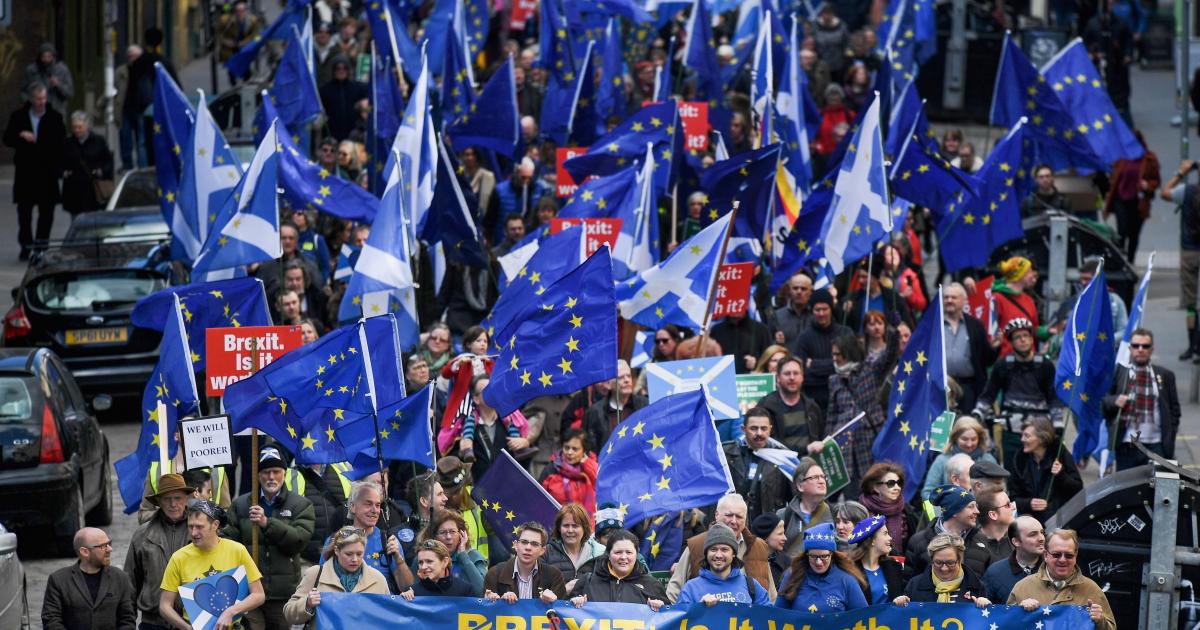
It was enormously frustrating to watch Labour continue to embrace the damage from the Conservatives’ hard Brexit through 2025.
We saw so much fuss last year over trade deals that are truly inconsequential relative to what the UK has lost with Brexit.
The much-trumpeted free trade deal with India, trade arrangements with the US, and agreement with the European Union to mitigate to a small extent the Brexit frictions – all are relatively inconsequential for sure. The EU agreement has the largest impact of the three but even this effect is tiny in the context of the hard Brexit damage.
Labour’s “red lines” of not rejoining the EU, single market or even the customs union mean the enormous toll on the UK economy from the loss of frictionless trade with the huge bloc and the ending of free movement of people between the UK and European Economic Area is set to continue indefinitely.
This is a huge drag on UK growth and grim for living standards which have been under so much pressure for so long now.
All of that said, and it is crucial to realise that the ongoing hard Brexit damage is absolutely the key point when it comes to Labour and its policymaking on Europe, we should not overlook the EU-related matters on which Sir Keir Starmer’s administration is taking a different approach.
The most heartening progress on these came very late in 2025: the UK’s agreement to rejoin the EU’s Erasmus+ scheme, which enables young people to study and train abroad.
Young people have certainly been among those most adversely affected by the Tories’ hard Brexit and by Labour’s red lines, which continue to take away that wonderful opportunity and freedom that was there in the past to live and work anywhere in the EEA.
In the run-up to hard Brexit being visited upon us at the end of 2020 by former Conservative prime minister Boris Johnson, the UK’s determination to exit Erasmus+ appeared to be so much about playing to the gallery.
This aspect was entirely in keeping with the all-encompassing patriotic tub-thumping of Mr Johnson and his chief Brexit negotiator, former Scotch Whisky Association chief executive Lord David Frost.
Read more
It all seemed to chime with the blue passports and the Global (rather than European) Health Insurance Card dominated by the Union Flag: window-dressing for the sake of it.
The Johnson administration decided the UK would set up a different exchange programme, the Turing Scheme, named after English mathematician Alan Turing.
There is no doubting the genius of Mr Turing.
However, the Turing Scheme put in place by the Conservatives has looked very much like the poor relation of the Erasmus+ scheme, which provided such valuable opportunities for so many young people in the UK for so long.
Thankfully, Labour, which still seems so constrained by political pragmatism when it comes to Brexit and appears terrified of upsetting those red-wall voters who swept Mr Johnson to victory in the December 2019 general election, has now moved to rejoin the Erasmus+ scheme.
On December 17, when it announced the agreement to rejoin, the UK Government highlighted just how many people would benefit.
It said: “Erasmus+ offers opportunities around education, training, youth, culture and sport for participants of all ages. Over 100,000 people in the UK could benefit from the scheme in the first year alone. Data shows that studying abroad can boost the career prospects of students, especially from disadvantaged backgrounds.
“The programme will create educational and training opportunities for British apprentices, further education students and adult learners, as well as those in higher education.”
The UK Government added: “The agreement to join Erasmus+ in 2027 fulfils a key commitment made at the UK-EU summit in May and will open up world-class opportunities for young people across the country.”
We must bear in mind that rejoining Erasmus+, while hugely welcome for the young people who will be able to take advantage of the programme and important for skills, is not going to shift the macroeconomic dial in a significant way.
The UK’s “reset” agreement with the EU last year does deliver much greater benefits than the free trade deal it reached with India, about which so much noise was made.
However, the boost to UK gross domestic product from the EU agreement is estimated at only about 0.3% by 2040 by the UK Government (the boost from the India free trade deal is put at 0.13% on the same timeframe).
What Brexit is costing is clearly the most important comparator here, and especially so given Labour’s red lines ruling out the two things that would make a real difference to the UK economy on this front: regaining frictionless trade and free movement of people.
Steve Lynch, director of international trade at British Chambers of Commerce, said last week: “Trade is the fastest route to growth, yet firms tell us it is becoming harder, not easier, to sell into our largest market.
“[The] reset was presented as a turning point, and wins like rejoining Erasmus+ help, but businesses need much more.”
The abstract of The Economic Impact of Brexit working paper published in November by the US-based National Bureau of Economic Research states: “This paper examines the impact of the UK’s decision to leave the European Union (Brexit) in 2016. Using almost a decade of data since the referendum, we combine simulations based on macro data with estimates derived from micro data collected through our Decision Maker Panel survey. These estimates suggest that by 2025, Brexit had reduced UK GDP by 6% to 8%, with the impact accumulating gradually over time.”
The authors of the working paper are Nicholas Bloom of Stanford University, Philip Bunn of the Bank of England, Paul Mizen of King’s College London, Pawel Smietanka of the Deutsche Bundesbank, and Gregory Thwaites of the University of Nottingham.
In spring 2023, the then chairman of the Office for Budget Responsibility, Richard Hughes, said of Brexit’s effect: “We think that in the long run it reduces our overall output by around 4% compared with had we remained in the EU.”
Whatever estimate people prefer, what is crystal clear is Brexit has had and continues to have an enormous impact on the UK economy. The diehard Brexiters might carry on arguing that it has not but the numbers from the experts speak for themselves, as does the day-to-day reality for businesses and households on which the folly has had and continues to have such a huge effect.
It would be great to think that 2026 might be the year in which Labour finds some real courage on Brexit, building on the Erasmus+ re-entry, and thinks again about those colossally damaging red lines.
This is perhaps unlikely, but we must continue to hope that common sense will prevail over political fear on this hugely important matter.