
Researchers working to explain the higher-than-expected optical performance of transparent ceramics have turned to a controversial new concept, known as “zentropy theory.”
Described as a blend of quantum mechanics, thermodynamics, and statistical mechanics, zentropy theory suggests that systems tend toward entropy unless an external energy source is applied to counteract the inevitable systematic decay.
The team behind the new study suggests the newly proposed concept could enable the creation of cutting-edge electronic devices based on transparent ceramics. This material would allow engineers to build devices currently considered impossible due to material constraints, paving the way toward new applications in energy technology, sensing, optics, high-speed communications, and medical imaging.
Zentropy Theory and Transparent Ceramics
In most cases where transparent materials are needed, engineers use glass, plastics, or other widely available options, depending on the application. Still, some operational environments have proven too extreme for glasses or plastics, leaving engineers searching for more versatile and robust options.
One emerging group of materials capable of withstanding extreme temperatures without losing their transparency or structural integrity is transparent ceramics. According to the research team behind the new study, transparent ceramics can control light with “exceptional efficiency,” well beyond theoretical predictions.
“Transparent ceramics’ electro-optic properties — the ability to change how they bend or transmit light when a voltage is applied — performed far better than predicted,” they explained in a statement announcing the newly published study.
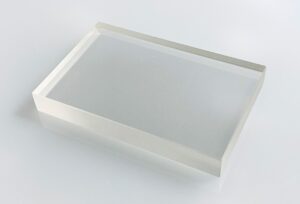 An image of a transparent ceramic manufactured by Konoshima corporation for industrial and commercial applications
Ceramics also offer other material advantages over other optical alternatives. For example, the team notes that they are far cheaper to manufacture than single-crystal materials, more scalable, and “allow precise control of composition.” Still, the researchers note, ceramics used in optical applications must be transparent.
“The challenge is that ceramics must be transparent, so the light can pass through them smoothly without distortion, before they can function as electro-optic materials,” explained study co-author Zi-Kui Liu, a Penn State professor of materials science and engineering.
Fortunately, new manufacturing techniques have allowed for the creation of relatively inexpensive, transparent ceramics. Even more encouraging, tests showed that the material’s “unexpectedly robust performance” makes it an ideal replacement for glass or plastics in more extreme applications. However, scientists couldn’t immediately explain how transparent ceramics consistently outperformed theoretical predictions by such a large margin.
“There was no existing theory in the ferroelectrics community that could explain these results,” Liu explained.
Keeping Chaos at Bay with Small Amounts of Energy
To unlock the advanced material’s performance and open up potential commercial applications, Haixue Yan, a reader in materials science and engineering from Queen Mary University of London, explored several different ideas. That search effort led him to Liu’s relatively new zentropy theory idea. According to a statement announcing the new approach, zentropy theory suggests that systems trend towards disorder “if no energy is applied to keep the chaos at bay.”
When researching how the theory may apply, the team said they were encouraged by ‘hints’ in previous studies that transparent ferroelectric single crystals with dense domain walls “could show unusually strong electro-optic behavior,” remarkably similar to the results they were seeing with transparent ceramics.
After examining the material more closely, the researchers found that the exact mechanism found in transparent crystals was present. A closer analysis under a microscope also found that the material contained tiny pockets of light polarization, only a few atoms wide. The teams said these “mini domains” of particles, similarly aligned to create transparency, helped explain the transparent ceramics’ unexpected performance.
“These very small polar features have extremely fast relaxation times,” Liu explained. “They can adjust their electronic polarization almost instantly under an applied field.”
More Tests Confirm Underlying Zentropy Theory Effect
Anxious to see whether zentropy theory could explain the material’s performance when energy is applied, the researchers mapped the various tiny structural states that atoms can adopt and then performed calculations to determine how these minuscule fluctuations could “add up” to influence the material’s optical performance. The approach is the same one used to unlock the optical properties of ferroelectrics, photonics, and other optical applications.
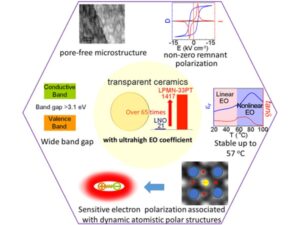 Zentropy, according to the research team behind the new work, could help explain why recently developed transparent ceramics control light far better than expected, a discovery that could lead to faster, smaller, and more energy-efficient optical technologies used in communications, sensing, and medical imaging (Image Credit: Zi-Kui Liu/Phases Research Lab).
According to the team, the analysis revealed that the material’s internal structure breaks down into tiny, fluctuating units, as they previously observed under a microscope. This variability under low-energy conditions also meant that the transparent ceramic could respond to an electric field almost instantaneously, “producing the ultrahigh electro-optic response seen in the experiments,” as predicted by zentropy theory.
“By breaking the larger system into smaller atomic units, the energy barrier for polarization changes becomes much lower,” Liu explained. “That allows the response to be extremely fast.”
Reshaping ‘Key Optical Devices’ with Transparent Ceramics
When discussing potential uses for transparent ceramics properly characterized by zentropy theory, the research team said that practical devices made with this robust material could “reshape key optical devices,” ranging from fiber-optic internet infrastructure to self-driving car guidance systems and precision medical diagnostics. Specifically, the researchers said that transparent ceramics could replace lithium niobate as the standard material for these applications.

“Applying electricity changes how lithium niobate bends light, but only by an amount so small,” they explained. “It is like nudging a ruler by the width of a few atoms.”
Conversely, the transparent ceramics developed for this study demonstrated performance far beyond that of lithium niobate. Yan said this level of performance, combined with the material’s other favorable properties, “could pave the way for a new generation of electro-optic devices that are smaller, faster, more energy efficient, and lower cost.”
“Potential applications include optical modulators, optical switches, communication components, sensors, and integrated photonics,” the researcher explained.
Although the transparent ceramic used by the researchers was developed in a lab, they said they are already working to scale the production to prove its commercial viability. They are also working to evaluate the long-term reliability of transparent ceramics while developing safer, lead-free versions for industrial applications.
“With progress in these areas, we are optimistic that practical devices could follow in the near future,” Liu said.
The study “Dynamic Atomistic Polar Structure Underpins Ultrahigh Linear Electro-Optic Coefficient in Transparent Ferroelectric Ceramics” was published in the Journal of the American Chemical Society.
Christopher Plain is a Science Fiction and Fantasy novelist and Head Science Writer at The Debrief. Follow and connect with him on X, learn about his books at plainfiction.com, or email him directly at christopher@thedebrief.org.