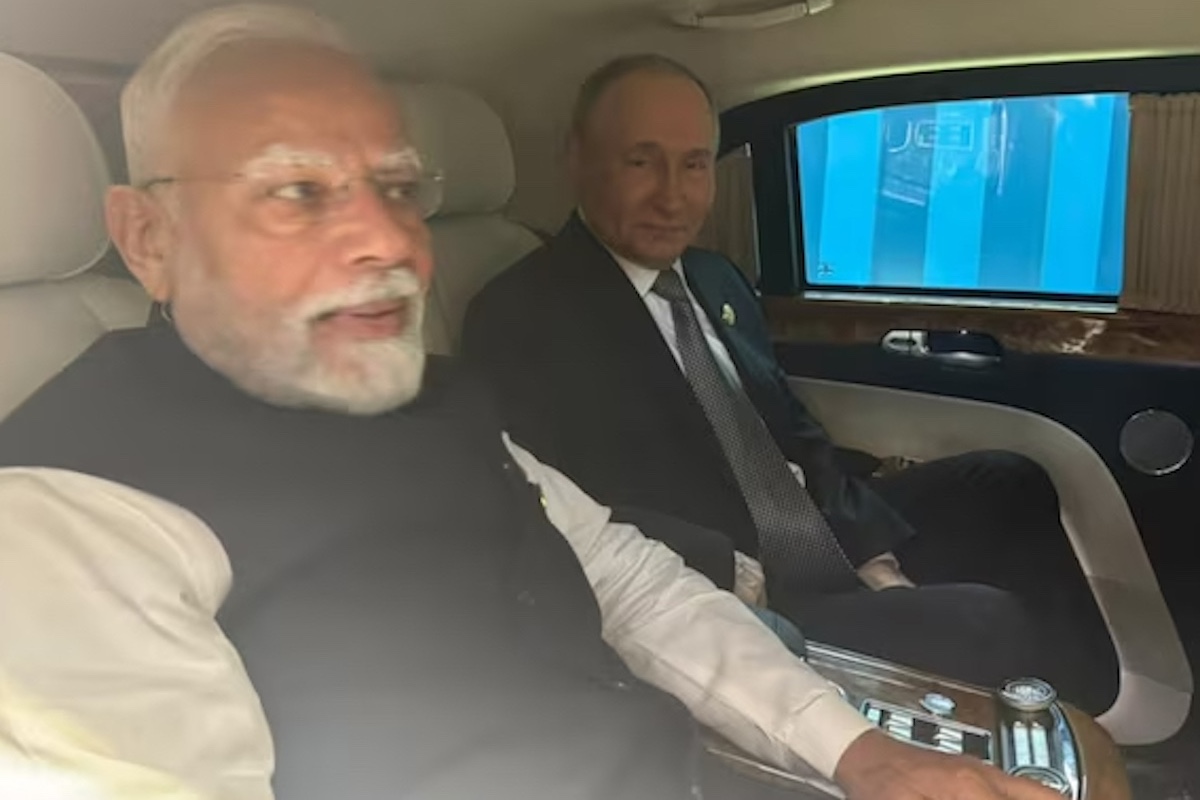
India and Russia are boosting trade and transport links with key projects like the Vladivostok-Chennai corridor, aiming for US$100 billion in trade by 2030, a 40% increase on current levels.
At the same time, India’s maritime vision aligns closely with Russia’s plans, focusing on port development and logistics. Both nations are expanding these routes in anticipation of significant growth in global sea trade.
At the Indian-Russian trade forum held on December 5, following a meeting between the two countries’ leaders, agreements were signed confirming their intentions to develop bilateral trade, transport links and infrastructure. Key projects include the North-South and East Maritime Corridors, notably the Vladivostok-Chennai route.
The significance of this meeting cannot be overstated, especially considering India’s ambitious plans to implement infrastructure projects worth over a trillion dollars.
Trillion-dollar plan
India’s complex and ambitious plans for developing transport, logistics infrastructure and trade align with Russia’s initiatives. Two major programs—Maritime India Vision 2030 and Maritime Amrit Kaal Vision 2047—are shaping a unified $1 trillion maritime investment roadmap to transform India’s ports.
The focus is on opportunities in port and cargo terminal development, multi-modal terminals and shipbuilding. Seaborne trade has shown remarkable improvement in container port throughput.
For example, India’s first deepwater multipurpose seaport at Vizhinjam is planned to have an annual capacity of up to 5 million TEUs. This marks the first phase of a broader $1 trillion investment plan, which emphasizes port and multi-purpose cargo terminal development.
Meanwhile, analysts at the Eurasia Development Bank (EDB) estimate that container traffic along the International North-South Transport Corridor (INSTC) could reach between 325,000 and 662,000 TEUs by 2030.
Total investment in ongoing or scheduled infrastructure projects within the INSTC amounts to $38.2 billion. Although current economic volumes transported through the INSTC may appear modest, their role could be significant for the future of India’s “Great Logistics Leap.”
The East Maritime Corridor (EMC), connecting the Russian port of Vladivostok with the Indian port of Chennai, represents another vital development. International maritime trade is growing, driven by stronger demand, technology adoption and emerging players such as Vietnam and India. Sea trade is projected to account for around 83% of global trade by 2050.
In this context, the EMC is crucial for both Russia and India, whose bilateral trade currently totals nearly $70 billion. Importantly, this volume has grown significantly over the last five years.
The two countries are actively working to include Thailand, Vietnam and Indonesia as intermediate stops on the route, recognizing the strategic value of growing trade with these nations.
Given these developments and forecasts, India’s plan to develop its port infrastructure is logical. With India’s economic growth projected to continue growing significantly—potentially becoming the world’s second-largest economy by 2050 with a GDP between $25 trillion and $30 trillion—and its strategic geographic location, India is well-positioned to play an important role in the EMC and other international transport corridors.
Sea of Uncertainty
India’s roadmap and Russia’s transport strategy for seaport infrastructure take into account major trends such as competition, growing throughput and sustainability. The world is rapidly changing, with shifts in geopolitics, trade patterns, technology and climate pressures. However, a massive, long-term bet based on current trends carries inherent risks.
Emerging players like Vietnam, Thailand and Indonesia are also investing heavily, which could lead to overcapacity in regional transshipment hubs or intense price competition. Moreover, current container port leaders such as Singapore and Shanghai continue to advance their development and technology. Catching up requires more than infrastructure; it demands excellence in efficiency, digitalization and service.
Building infrastructure is only the first step. Ultimate success will depend on operational excellence, seamless multi-modal connectivity and overall efficiency. This is where Russia could share some of its technological expertise with Indian counterparts.
At the same time, climate change poses challenges. Around one-third of the world’s 3,800 ports could become unusable by 2050, by some estimates. Ports such as Shanghai, Houston and Lazaro Cardenas in Mexico could be inoperable with only a 40-centimeter rise in sea levels.
Other key ports, including Rotterdam, are already under pressure. This situation creates an opportunity for well-planned Indian and Russian ports in the Far East to gain strategic importance.
Single asset approach
Given these facts and risks, the memorandums of understanding signed by Presidents Vladimir Putin and Narendra Modi could become a political and economic breakthrough—if both Indian and Russian initiatives are carefully refined in terms of integration, investment and technology.
A vertical integration structure should be established. Instead of focusing on individual sectors such as seaports or railways alone, comprehensive cross-vertical financing and management models should be used. A “single asset” approach—combining transport, energy, and digitalization as one investment case—will enable projects to be truly sustainable.
Another strategy to secure initiatives and investments is the use of vertical foreign direct investment (FDI) schemes. Backward vertical FDI, upstream closer to raw materials or production inputs, can reduce supply risks and gain control over essential inputs.
Forward vertical FDI, downstream closer to customers or end markets—in Southeast Asia, Latin America, or along the Northern Sea Route—can secure throughput. This approach is actively used by China in the region, exemplified by the Belt and Road Initiative’s infrastructure projects.
In both examples, India and Russia can be mutually beneficial partners and achieve much greater results together. Flexibility is required to account for short- and long-term factors, but coordinated action is paramount.
The signing of the MoUs is a positive first step on a long path toward joint prosperity. The road ahead will be long, but the effort promises worthwhile rewards.
Dmitry Plotnikov is a board member of the DELO group