Travellers report ‘horrific’ queues due to EES checks in Spain, with Portugal postponing the system after severe delays at Lisbon
British passengers have been warned their holiday plans could be thrown into disarray when post-Brexit border checks ramp up this month, after Portugal suspended the new measures after weeks of severe delays at Lisbon airport.
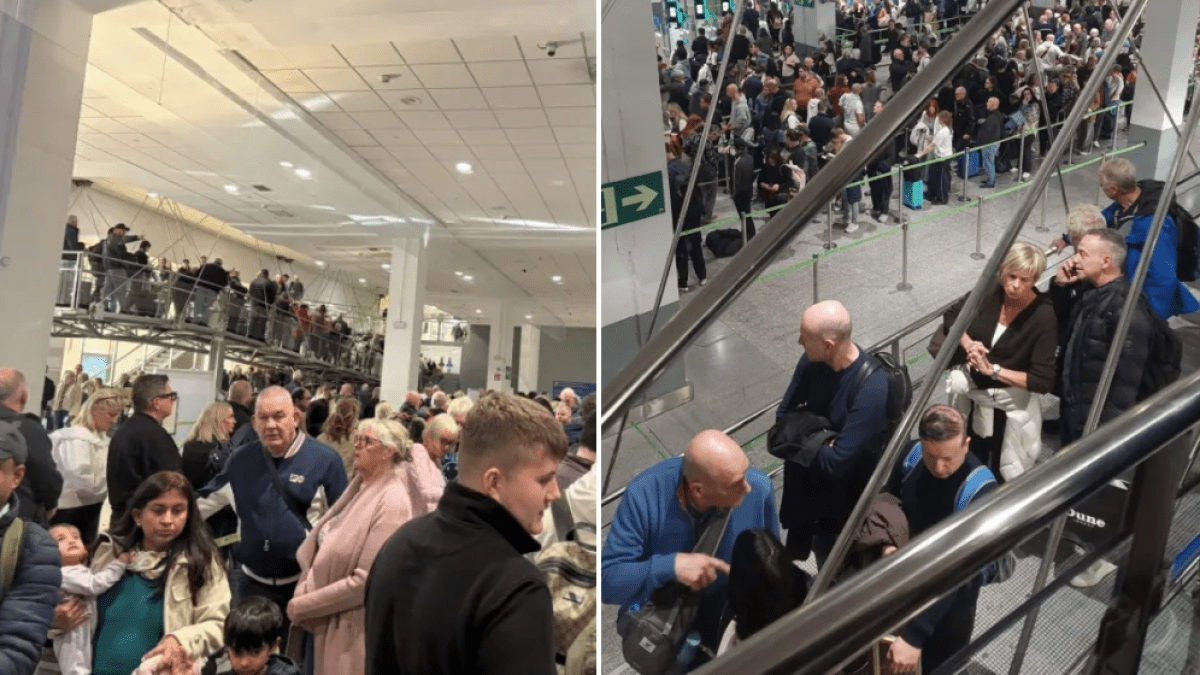
Holidaymakers have already reported “horrific” airport queues of up to six hours as a result of the entry/exit system (EES), which launched in October.
The congestion has become so severe that Portugal’s government has suspended EES at Lisbon Airport, following chaotic scenes in the run-up to Christmas, The i Paper can reveal.
Abta, the UK travel agent trade association, has flagged a “greater risk” of hold-ups once the biometrics checks on passengers increase from 9 January, with one industry analyst warning the move could be “a disaster”.
New FeatureIn ShortQuick Stories. Same trusted journalism.
Airports Council International (ACI) Europe, the trade body which represents over 600 airports, has demanded an urgent review of EES and flagged regular outages at borders, problems with self‑service kiosks, and a lack of border guards at airports.
Travellers from the UK told The i Paper of recent EES queues of almost two hours at Málaga Airport, with kiosks for facial and fingerprint scans not working.
Holidaymakers who travelled to the Spanish airport over Christmas and November raised concerns for passenger safety during peak 2026 holiday periods once the new checks are fully in force for all non-EU travellers.
Earlier this week, the Portuguese government suspended EES computer checks for three months at Humberto Delgado Airport in Lisbon after severe delays. It came after “worsening of constraints in the arrivals area” for passengers from outside the Schengen Area, the Ministry of Internal Administration said.
One of Europe’s busiest hubs, Lisbon passengers have reported queues of up to six hours without access to water, food or toilets since EES was rolled out.
The European Commission claimed the decision was not related to any issues with “the functioning of EES” and that Portugal had indicated the suspension was necessary to “accommodate restructuring work within the airport’s border area”.
Minha mãe, com quase 70 anos, está há 6 horas na fila do controle de passaporte do Aeroporto de Lisboa. Sem comida, sem água, sem banheiro, junto com centenas de outros, incluindo idosos e crianças.
Escárnio completo em um aeroporto que se propõe a ser um hub para a AL na UE. pic.twitter.com/IXmf2ywEU4
— Emiliano Abad (@emilianoabad) December 28, 2025
EES, which has been phased in since October, is replacing passport stamping for all non-EU citizens, helping Brussels track compliance with its 90-day visa-free travel rule.
From 9 January, the proportion of non-EU nationals, including British passport holders, that must undergo the new facial and fingerprint scans will climb from one in 10 to 35 per cent.
By 10 April, 100 per cent of arrivals must submit their biometrics for travel to the Schengen areas.
Luke Petherbridge, director of public affairs at ABTA, said that given the scale of EES, with 29 countries introducing a new border process for millions of passengers, the travel body was “cautious” about the next phase of the roll-out.
“To date, there have been isolated reports of delays but for many ports and airports the system has been implemented smoothly,” he told The i Paper. “However, as the numbers increase there is a greater risk of queues and delays.”
He urged EU countries to stand down the system, or apply contingency measures such as limiting the number of checks to avoid lengthy wait times when larges queues start to build.
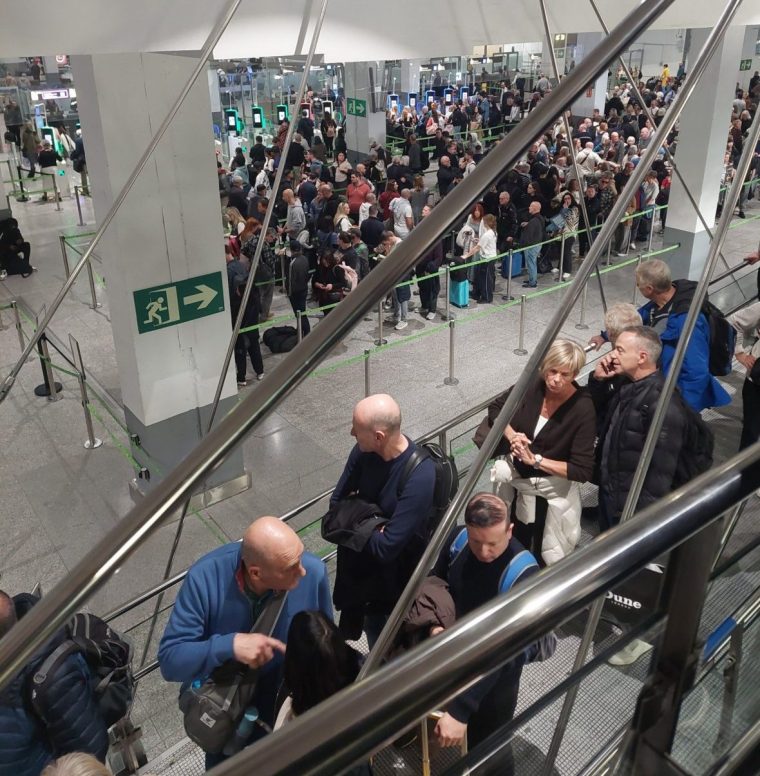 A passenger who travelled to Málaga in November described chaotic scenes as passengers queued for EES checks (Photo: John Calladine)
ACI Europe said border officials were battling a 70 per cent increase in processing times owing to EES, with waiting times of up to three hours at peak periods.
If issues were not resolved, increasing the number of people checked to 35 per cent of passengers would lead to more congestion and potential “serious safety hazards”, it cautioned.
In a message to passengers over Christmas, Ryanair warned of longer queues at Spanish passenger control due to EES and blamed delays on Spanish national police.
Aviation expert Saj Ahmad, chief analyst at StrategicAero Research, said pausing the checks at Lisbon could see other European airports follow suit. He said: “I wouldn’t be surprised at all. If the big players like France, Spain, Italy or Germany follow suit, it’s very likely the planned roll-out of EES (would) come to an abrupt halt.”
The European Commission insisted EES has operated “largely without issues” with no “significant queues” apart from in limited cases.
No member state “has reported or confirmed the claim that border-control processing times at airports increased by up to 70 per cent”, the Commission said, adding that concerns about the 35 per cent registration threshold had been “disproven”.
‘Arguments were breaking out’
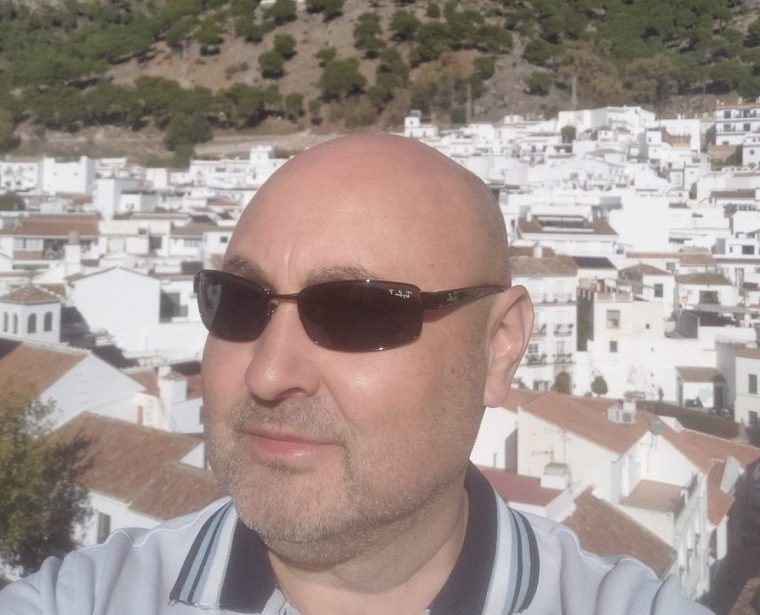 John Calladine warned that the full roll-out of EES in 2026 will be a ‘disaster’ during peak travel periods (Photo: John Calladine)
John Calladine, 51, from Leeds, experienced “horrific” queues at Málaga airport due to EES checks when he arrived on 22 November, with passengers, many of them elderly, stuck in queues for at least an hour.
“They kept us upstairs in a holding area and wouldn’t let us go any further as they were saying the downstairs area of passport control was full and couldn’t take any more passengers,” he said.
“They ended up scrapping the new system and just waved everyone through to stamp their passports as it was taking too long. Arguments were breaking out as they were directing people into different areas and people thought others were queue jumping. It wasn’t a pleasant experience.”
He fears medical emergencies could be “very possible” during peak travel periods once EES is fully operational, after witnessing people pushing during the disruption. “It will be a disaster,” he said, adding the queues were the worst he had seen in 15 years of travelling to Málaga.
‘They were stopping people to avoid trampling’
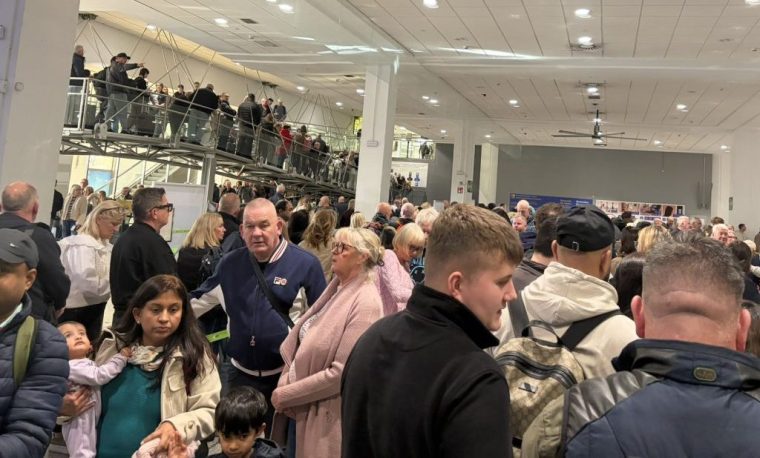 British holidaymakers arriving at Malaga on 29 December queued for almost two hours (Photo: Rob Debenham)
Rob Debenham, 59, from London, who travelled to Málaga from Gatwick on 29 December, queued for about 1hr 40mins due to the new checks – first at the scanning machines and then at passport control.
“The EES [machines] were not working. We stood for a good 20 minutes with the same nine people in front of us, not a single person moved in that time,” he said.
“We got to the back of a massive queue and stood for an hour and 20 minutes, and in the end, we got to the passport control. The Spanish border police were doing what the electronic machines were meant to be doing.
“I think there were at least six UK flights arriving within 30 minutes of each other in Málaga on that morning.
“They were stopping people at the top of the ramps that run down to the passport hall, so that they could avoid any trampling or any crowd health and safety issues.”
 Rob Debenham said queues at Málaga airport were the worst he has seen there
He said the queues were the worst he had seen at Málaga in around 25 trips over the last three years.
Travellers to Geneva airport, Europe’s busiest ski destination, previously told The i Paper they were stuck in two-hour EES queues.
At Dover, one of three locations where “juxtaposed” border control is on UK soil, EES checks for car passengers were postponed in November after guidance from French border officials and have yet to start.
It is understood the hold-up is due to issues with French border control IT systems.
It isestimated EES checks at Dover will take up to six times longer than the current system, with LeShuttle at Folkestone also pausing car registrations.
Before EES launched, aviation economist Oliver Ranson carried out analysis of which airports would be most at risk of collapse when it went live.
Athens, Bucharest, Milan Malpensa, Budapest, Berlin, Vienna, Rome Fiumicino, Amsterdam, Copenhagen and Prague were the 10 airports most in danger of gridlock, he found.
He analysed airport flight patterns to determine which airports would be unable to cope leading to cancelled flights, rather than where only long delays were likely.
Ranson’s analysis, published in October, remains unchanged, he said, adding the system was beyond airports’ control and was “all down to governments”.
He added: “It’s not just the system that matters. It’s all the infrastructure around the building which determines what they can and cannot handle.”
The next pinch point for EES would be the February half-term holidays, he added, with ski destinations as well as city breaks likely to be affected.
Your next read

“I’d expect the disruption to be all over Europe, wherever the government and the staff at the airport enforce the rules very strictly,” he said.
Ahmad added: “Its clear there isn’t enough residual redundancy built in where IT failures has meant a return to manual processing, which requires labour.
“Once the cap rises to 35 per cent, the problems are simply going to magnify and there will be yet more chaos for travellers. Going up to 35 per cent has disaster written all over it.”