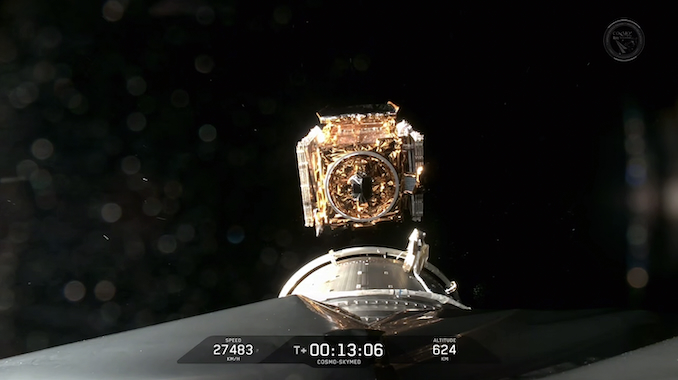
 The Cosmo-SkyMed Second Generation Flight Model 3 satellite deploys from SpaceX’s Falcon 9 rocket on Jan. 2, 2026. Image: SpaceX via livestream
SpaceX rang in the new year with a Falcon 9 rocket launch Friday evening from Vandenberg Space Force Base in California.
Aboard was a 1,700-kg (3,748 lb) Earth observation satellite with dual civilian and military use for the government of Italy. The Cosmo-SkyMed Second Generation Flight Model 3 (CSG-FM3) satellite is the third out of four such satellites set to deploy into low Earth orbit.
The Falcon 9 rocket lifted off from Space Launch Complex 4 East at 6:09 p.m. PST (9:09 p.m. EST / 0209 UTC), flying on a southern trajectory upon departing the pad.
The launch was originally scheduled on Saturday, Dec. 27, but was scrubbed about 38 minutes prior to liftoff due to a hydraulic issue with the launch pad hold down clamps. A second launch attempt on December 28 was also cancelled as SpaceX said it needed more time to resolve the pad issue.
SpaceX launched the mission using Falcon 9 booster tail number, 1081. This was its 21st flight after launching missions including Crew-7, PACE and TRACERS, all for NASA.
Nearly 8.5 minutes after liftoff, B1081 completed a touchdown at Landing Zone 4. This was the 31st landing at that site in total and the 554th Falcon booster landing to date.
The CSG-FM3 satellite was deployed roughly 13 minutes after leaving the launch pad.
 An artist’s rendering of the mission patch for the Cosmo-SkyMed Second Generation Flight Model 3 mission. Graphic: SpaceX
“The Cosmo-SkyMed program is one of the most outstanding examples of cooperation between Defense, the Italian Space Agency, and national industry,” said Italian Defense Minister Guido Crosetto in translation of a post on the social media site X. “It is a model of public-private synergy that shows how innovation, research, and development can integrate with security and defense needs, generating strategic value for the Country.”
According to the European Space Agency (ESA), the satellite designed for a five-year life span and will operate in a circular Sun-synchronous orbit at an altitude of 620 km (385 mi).
It uses a synthetic aperture radar (SAR), operating in X-band, allowing it to capture images through clouds and in darkness. The satellite constellation receives funding both from the Italian Space Agency as well as the Ministry of Defense.
Prior to the launch of the CSG-FM3 satellite, there were four operational satellites in the constellation: two first-generation and two second-generation spacecraft. These satellites were manufactured by Thales Alenia Space.
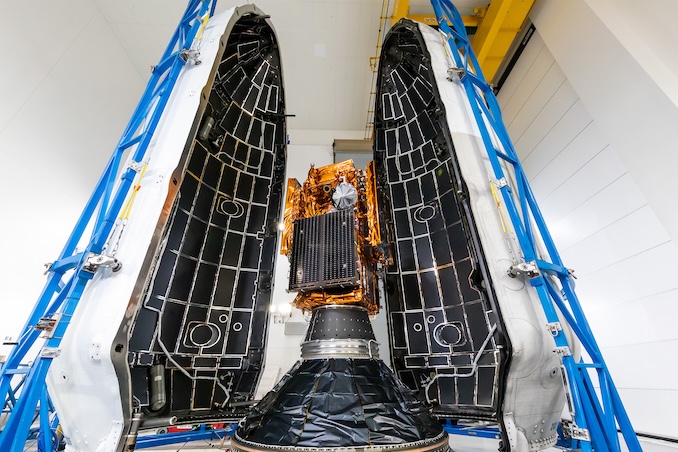 The Cosmo-SkyMed Second Generation Flight Model 3 spacecraft is pictured prior to being encapsulated within a pair of SpaceX’s Falcon 9 payload fairings. Image: SpaceX