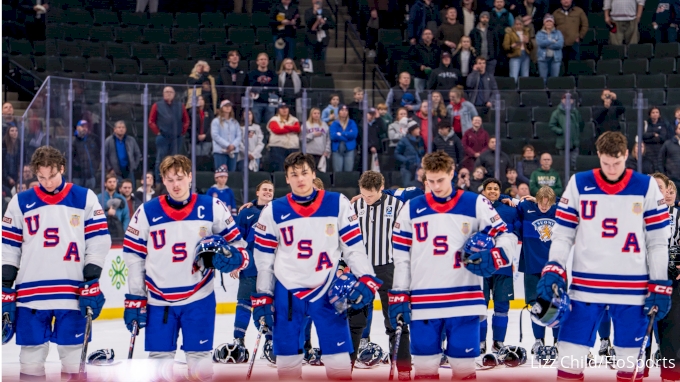
ST. PAUL – Team USA played their best game of the World Juniors to date, but fell one goal short on home ice against Finland and saw their tournament come to an end prematurely. There will be no three-peat and USA remains gold-less on home soil in this event following the 4-3 overtime defeat.
It is a disappointing end to a tournament that never really felt like it got going for the U.S. with a number of injuries, poor performances and inconsistent play. Perhaps it was fitting that the night they had seemed to find their best that it didn’t go their way.
Oftentimes there will be second-guessing and finger-pointing after any tournament that ends before the semifinals. The standard that has been set by U.S. teams in recent years does make an early exit seem a bit more crushing, but you also need a few more things to go right for you than the U.S. was able to muster.
There are always things here and there that could have been done differently, injuries and other things play a role, too, but you won’t find the U.S. players making excuses for themselves. In the end, it was a one-goal loss to a good opponent and a few bounces here or there could have changed the outcome.
Here’s a look at a few of the things that may have contributed to Team USA’s early exit.
Lineup Continuity Never Materialized
Team USA never played a single game with the same lineup in this tournament. Going back to pretournament, they never had the same group. The coaching staff really had no choice but to tinker. Sometimes it was because of injury, other times performance, but there was never any continuity.
USA could not keep anyone on the top line’s left wing. James Hagens (BOS) and Brodie Ziemer (BUF) constantly had new linemates. They started with Will Horcoff (PIT), then Teddy Stiga (NSH), and lastly Will Zellers (BOS). None of it really worked.
Injuries would keep shuffling things, too. The loss of Max Plante (DET) can’t be understated. After the game, Bob Motzko said they thought there was a pretty good chance he would play in the semis had they made it. Losing a returning player who plays in all situations is tough to replace. When you consider they lost Trevor Connelly (VGK) just before the tournament and had to deal with the Cole Hutson (WSH) injury, and prime penalty killer Brendan McMorrow (LAK) got hurt in the third period of the quarterfinal, it was a battle of attrition the whole way, too.
Some of it was on them, some of it was out of their control.
Because of the lack of continuity, the power play units had to constantly be shuffled as well. Losing Hutson for two games forced a lot of movement. It wasn’t a surprise to see him return in the quarterfinal and USA’s power play clicked a little bit better.
No team has ever survived the World Juniors with a poor power play. At least not in recent memory. The U.S. ranked seventh in power-play efficiency. If that doesn’t gel quickly in a tournament, it’s hard to recover.
Additionally, their PK allowed five goals on 15 disadvantages to rank sixth in the tournament. I thought the power play was decent and they had continuity there, but they still got stung a few times when shorthanded.
It also didn’t help that USA couldn’t get consistent performances out of even its best players. James Hagens (BOS) was up and down, Teddy Stiga (NSH) had a hard time finishing his chances throughout the tournament, Cole Eiserman (NYI) struggled with turnovers and even when Plante was healthy, he had some tough moments in the tournament.
In the final game, USA had probably its best performance top to bottom and then it wasn’t quite enough. It’s going to be a tough pill to swallow, especially on home ice.
Defensive Depth Wasn’t Good Enough
Losing Cole Hutson is devastating, but losing him when you don’t have the depth to make up for it was worse. Him coming back in was a big plus, but it was difficult for Team USA to have a lot of confidence in pairings outside of their top guys.
USA’s only two defensemen with plus ratings were Hutson and Kleber. Everyone else was even or a minus. It was a known trouble spot coming in and it certainly was that. Both Chase Reid (2026) and Luke Osburn (BUF) averaged over 20 minutes as well when they were pressed into more duty with Hutson. They played well, but seemed like an odd fit as a pairing as both are more offensive minded. They were out for a few ugly goals against over the course of the tournament, but also were important of generating offense at the other end. In an ideal world, those guys would have had someone more stable defensively for the other to play more their role.
Team USA’s distribution of ice time went heavily to those four and there was some clear reluctance to play the bottom pairing and extra defensemen as much as they ended up having to.
Goaltending Took Too Long To Solidify
If there’s one thing Team USA can be criticized for, it’s not figuring out their goaltending soon enough. Nick Kempf (WSH), who started the game against Finland and played quite well in the contest, only had one start prior to Friday’s quarterfinal. I’m not sure he was ever able to get into a rhythm.
USA gave Caleb Heil (TBL) two starts and then started 17-year-old Brady Knowling (2026) against Sweden in a game with first place on the line while missing their best defenseman and No. 2 center. Maybe they didn’t want to put Kempf in that same situation unprotected, but I don’t get how he was ever supposed to get his game going with so few starts.
USA played all three of its goalies, which sent the message to everyone else that if you have to play three, you might not have one.
I thought Kempf had done enough over his time in the NTDP and even amid a tough season at Notre Dame to be the No. 1 for this team. The lack of decisiveness on the goaltending situation feels like it was a bit of a miss. Kempf probably should have seen the crease more than he did.
Outlook for 2027
I wish I had better news for USA Hockey fans about the World Juniors in 2027, but there is going to be a lot of talent to replace on this team and we’re looking at one of the weaker age cycles USA has had in years.
Chase Reid, LJ Mooney, Asher Barnett, Brady Knowling, Cole McKinney and Will Horcoff are the only players that are eligible to return next year. Only six Americans went in the first round of last year’s NHL Draft, three of which are not eligible to play in next year’s tournament, and there will only be a few more this year.
On top of that, Team USA hasn’t won gold at the World Under-18s in any of the last two years and will not be favored to win it this year.
After back-to-back golds then failing to medal on home ice, USA Hockey is going to have its work cut out for it the next few years to put more competitive teams on the ice. It only gets tougher from here.
2026 World Juniors Medal Round Schedule, Semifinals and FinalSunday, January 4
- 4:30 p.m. ET – Sweden vs. Finland
- 8:30 p.m. ET – Canada vs. Czechia
Monday, January 5
- 4:30 p.m. ET – Bronze Medal Game
- 8:30 p.m. ET – Gold Medal Game
Follow FloHockey’s Coverage Of The 2026 World Junior Championship
FloHockey will be on site for complete coverage of the 2026 IIHF World Junior Championship in St. Paul and Minneapolis, Minnesota. You can expect game-by-game coverage of both Team USA and Team Canada from FloHockey’s experts, interviews with key players and coaches and much more. Follow FloHockey’s WJC coverage here.
NHL Prospect Coverage On FloHockey
The best, and most complete, coverage of the NHL minor league hockey and NHL Draft is found on FloHockey. Don’t miss the latest new prospect guides, rankings and more from Chris Peters and the FloHockey staff.
Join The Hockey Conversation On FloHockey Social