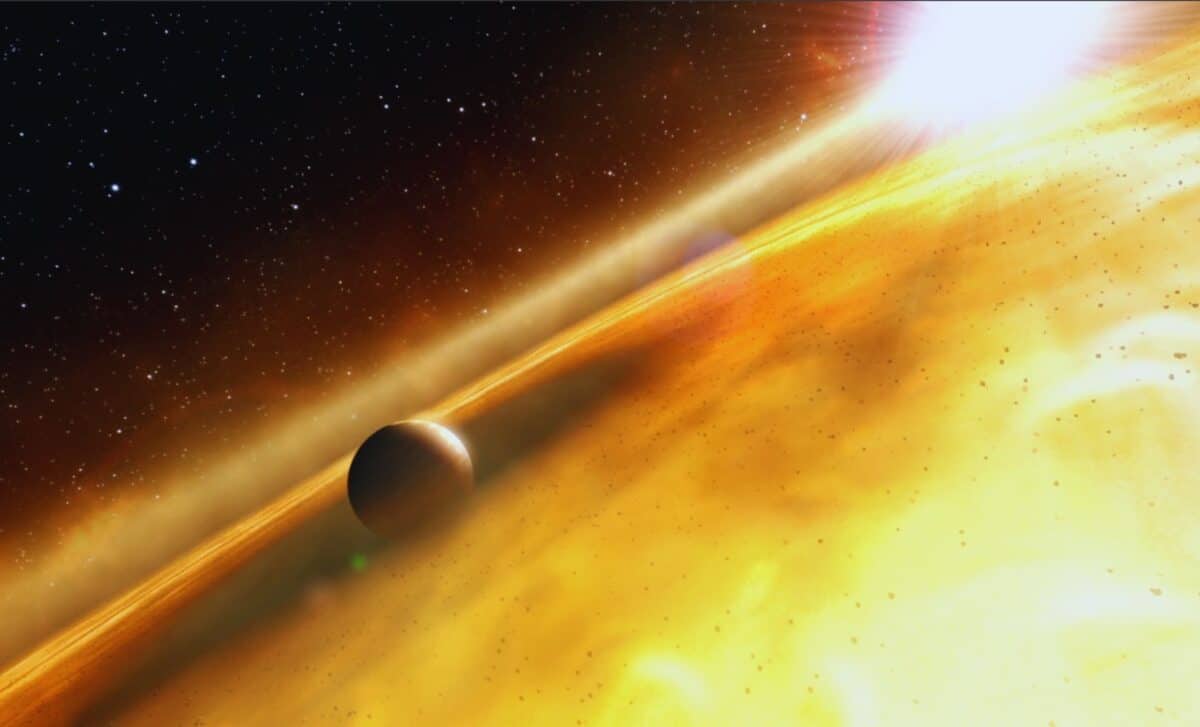
Astronomers observing the starFomalhaut, located just 25 light-years from Earth, believed they had detected a planet, later named Fomalhaut b, reflecting its host star’s light. Over time, that light mysteriously faded from view. Even more puzzling, another bright object appeared nearby, leaving researchers to reconsider what they had been seeing for nearly two decades.
The discovery,recently published in the journal Science, has turned planetary formation models on their head. Instead of a new world, the object was likely the result of a violent impact between two asteroid-sized bodies, scattering a glowing cloud of debris across the system. The unexpected appearance of a second, similar light source adds further weight to this interpretation.
A Planetary Illusion Shattered By Dust And Violence
As mentioned in a NASA’s report, what astronomers initially identified in 2008 as a young planet has now been revealed to be something far less stable, and far more chaotic. The object dubbed Fomalhaut b matched the signature of a reflective world, prompting years of observation. But by 2023, the bright spot had disappeared entirely, prompting new analysis.
As stated by Paul Kalas, an astronomer at the University of California, Berkeley, the event was unlike anything seen in our solar system.
“It’s absent in all of our previous Hubble images,” Kalas said, “which means that we just witnessed a violent collision between two massive objects and a huge debris cloud unlike anything in our own solar system today.”
A second bright source appeared nearby in more recent images, now identified as cs2. Its resemblance in brightness and location to the first object, cs1, supports the conclusion that both are expanding clouds of dust, not distant worlds.
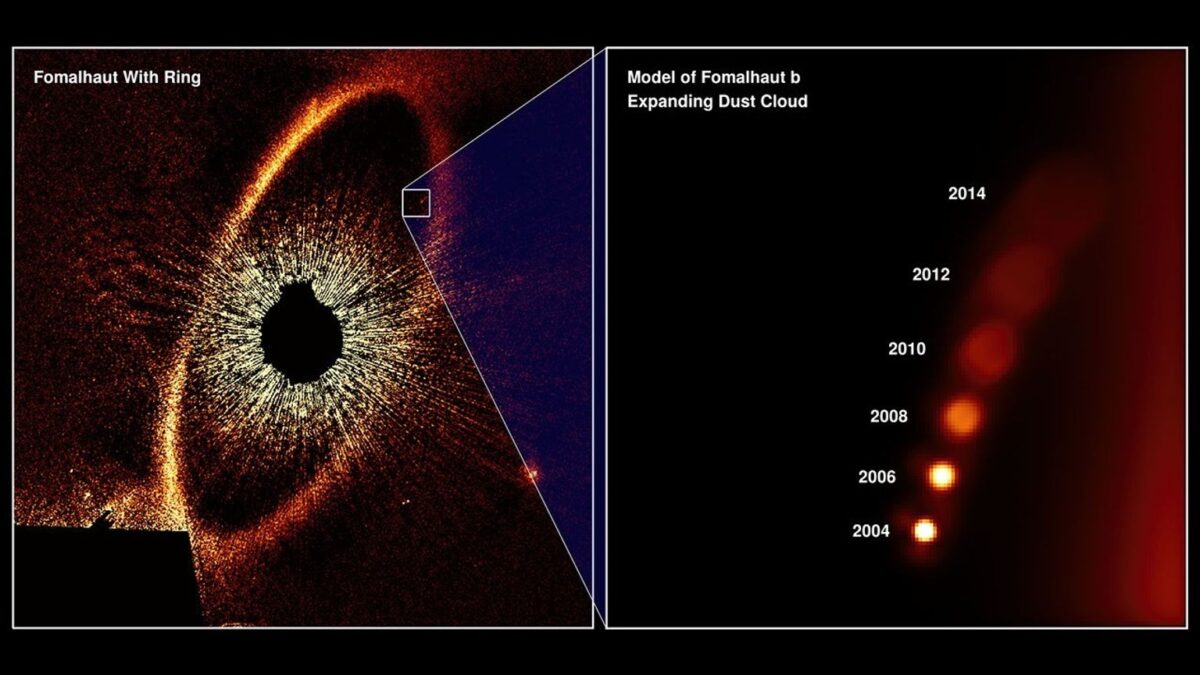 Hubble captures protoplanetary collision in the Fomalhaut star system. Credit: NASA, ESA, and A. Gáspár and G. Rieke (University of Arizona).
Evidence Of Rare Impacts Caught In Real Time
Planetesimal collisions are considered extremely rare, with theoretical models predicting one every 100,000 years or more in systems like Fomalhaut’s. Yet in just two decades, researchers have now observed two distinct events in the same region of space.
“Catching these events in real time gives scientists a rare window into how planets form,” noted Jason Wang, an astrophysicist at Northwestern University and co-author of the study.
Wang performed one of four independent analyses to confirm the findings, each of which identified a transient light source near the star. According to the study online on December 18, 2025, these unexpected observations suggest the Fomalhaut system is far more active than previously thought.
“I crunched the numbers to show that the four independent analyses all confidently detect a new source around the vicinity of the star,” Wang added.
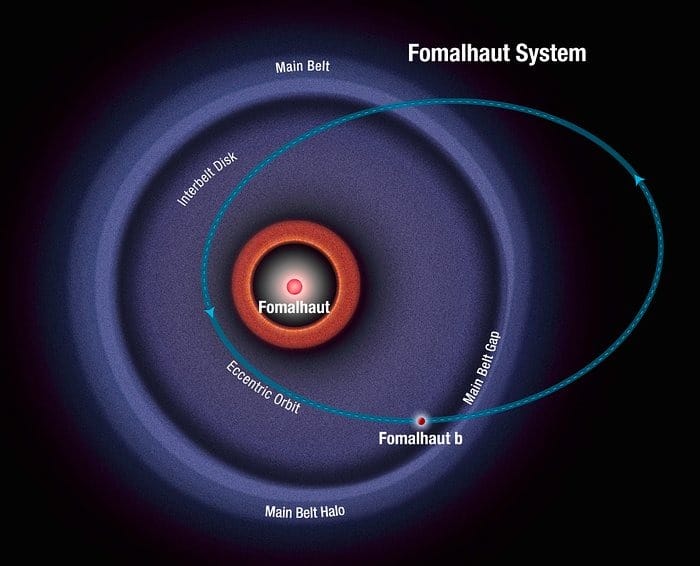 This diagram illustrates the orbit of exoplanet Fomalhaut b, based on recent observations from the Hubble Space Telescope. Credit: NASA, ESA and A. Feild (STScI).
A New Roadmap for Detecting Distant Worlds
Beyond reshaping ideas about planetary formation, the Fomalhaut findings also carry practical warnings. Both cs1 and cs2 closely mimicked the appearance of exoplanets, raising concerns for upcoming missions designed to detect heavenly bodies using reflected light.
“This is a cautionary note for future missions,” Kalas said, referring to upcoming observatories like the Giant Magellan Telescope. “Fomalhaut cs2 looks exactly like an extrasolar planet reflecting starlight.”
With Hubble no longer capable of collecting reliable data on the system due to its age, attention now turns to the James Webb Space Telescope. In Wang’s view, the team has secured time on Webb’s Near-Infrared Camera (NIRCam) to analyze cs2. Unlike Hubble, Webb’s instruments can reveal the size, composition, and temperature of dust grains, even detecting ice or water, if present.