
Welshman Peter Thomas is renovating two old properties in France, and is watching developments between the UK and EU closely
A British expat who owns two old properties in France and hasn’t been back in the UK since the Brexit referendum says he will buy a home in Wales after the UK rejoins the EU, which he is increasingly confident will happen.
Peter Thomas, 53, a former marketing and communications officer from Ferryside in Wales, who has worked at fintech startups across Europe, moved to France with his Flemish wife Lies Wittens in 2023, after 16 years in Portugal.
The couple splits their time between an ancient stone windmill near Vitré, Brittany, which they paid just €40,000 for in 2012, and a 700-square-metre medieval complex with a tower in the village of Saissac, bordering the Pyrenees, which they purchased for €100,000 in 2018.
“I am a totally convinced European,” Thomas, who currently renovates properties, told The i Paper. “The EU is my home. I have worked, studied and travelled all over the continent. From being a penniless student, the EU enabled me – from the wilds of west Wales – to find love, culture, travel, adventure and an interesting series of varied careers.”
 Peter Thomas and Lies Wittens in France. The couple splits their time between Vitré, Brittany, and Saissac (Photo: Peter Thomas)
Thomas, who also has Portuguese citizenship, added that: “For me, being an EU citizen is not simply a piece of paper, but a deep part of my very soul. Brexit was an absurd outbreak of isolationist idiocy.”
The Welshman hasn’t set foot back home since the Brexit vote. However, he believes the UK will soon move closer to the EU, as he says many of the elderly voters who ticked “Leave” in 2016 have passed away and polls suggest there is a majority in favour of entering “a kind-of Norway-adjacent close alignment with the EU”.
If the UK were to rejoin the EU, Thomas said he would buy a small coastal property in a Welsh-speaking part of Pembrokeshire or Ceredigion.
“I now speak eight languages, but my Cymraeg has become rusty, re-learning it again in old age would be fun,” he said.
For now, though, the couple are pursuing their French dream.
They lived for a long time in Portugal but ultimately felt they wanted to be closer to the rest of Europe and preferred the “overall joie de vivre of France to the melancholy saudade of Portugal” and its overtourism and fast-ageing population, Thomas said.
Frequent wildfires were also starting to be a problem, with a few coming close to their farm in Marvão in central Portugal.
 Peter Thomas and his dogs with his stone windmill in the background (Credit: Peter Thomas)
In France, they like the Celtic aspects of Brittany, with its ancient megaliths, cosy pubs, stone-built villages and “deciduous forests”. While Occitanie, and particularly Saissac, has a cosmopolitan, artistic vibe, a close proximity to Spain and a strong pâtisserie tradition.
Even so, Thomas says the windmill in Vitré, surrounded by woodlands filed with roe deer, is a “crazily impractical, totally quixotic” property: a tall stack of five, small circular rooms linked by rickety staircases and trapdoors with a medieval vibe. They spent €18,000 to repair the roof, add a kitchen, a deck, a shed for bicycles and garden tools, as well as to upgrade the drainage system.
When it comes to the renovations of the property in Saissac, sitting atop a ravine and picked for its stunning views of the Pyrenees, the couple have encountered “hidden structural issues”, including the need to replace 14 eight-metre-long main beams, putting in place a new roof structure and removing 60 tonnes of accumulated building rubble.
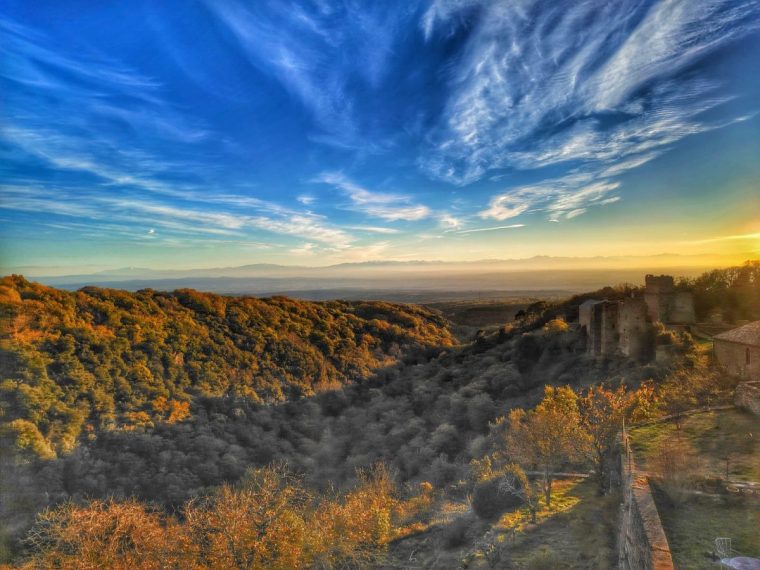 The view over the Pyrenees from the couple’s property in Saissac (Credit: Peter Thomas)
The work will be completed in 2028, and will have cost upwards of €400,000.
“The challenge has been to reveal the original, noble spaces, expose the mostly 17th-century wooden coffered ceilings, and open up large, 100-square-metre rooms on each of the three main floors,” said Thomas.
As in most medieval French villages, the property is the result of many centuries of building. The cellar has three-metre-thick walls and was likely the base of a watchtower for the village’s 14th-century fortified ramparts. Several houses were built on top of the foundations from the 16th to the 19th centuries, with the current structure a “labyrinthine” stretching across three living units.
Even so, Thomas says they have no regrets about taking on such large projects. The Saissac house is a “daily joy”, he said, with its views and access to nearby culture.
Your next read

If they were to buy a place in Wales, the couple would still keep both French properties and would split their time between them. But until that happens, the couple continue to enjoy their French life, with the fantastic food, farmers’ markets, scenic dog walks and plenty of châteaux and historic monuments nearby.
“An advantage of having two houses [in France] is visiting the lovely regions that link them,” said Thomas, highlighting Lot, Aveyron, Vendée and Loire.
“It’s a very, very special part of Europe,” he added.