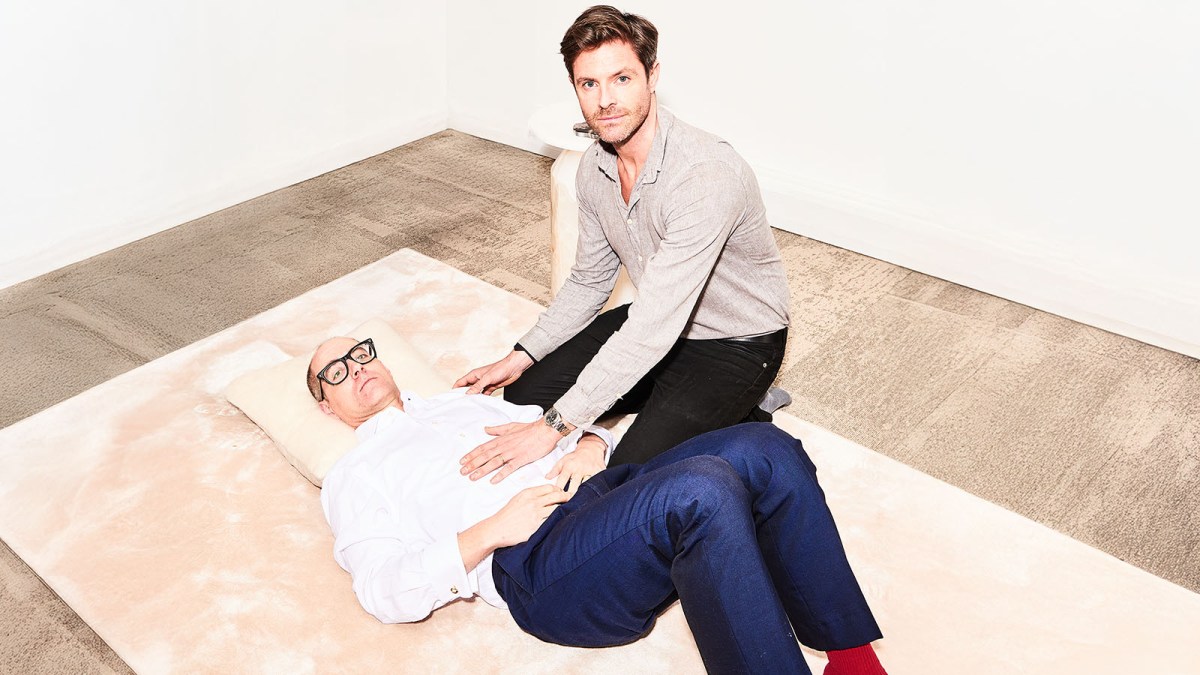
Could you completely de-stress yourself by lying on your bedroom floor for 40 minutes and, well, breathing? That is the promise of breathwork — a form of therapy that seems, to a cynic like me, the emperor’s new clothes, but which promises to reduce anxiety, depression and improve your heart rate and blood pressure.
Until I had undergone a couple of sessions, I presumed it was the worst form of Gwyneth Paltrow woo-woo wellness — and, yes, the founder of Goop is a fan. How can breathing in and out possibly improve both your psychological as well as your physical health?
I have become, however, a firm fan after experiencing the strangely powerful therapy, guided by Rob Rea, who admits breathwork is hard to explain to sceptics. “My dad is 84. And he’s like, ‘Rob, how are you selling air?’” he tells me, laughing.
• How to live well in 2026, from the new dating scene to better sleep
But that is what he does — it’s just that his air is slightly different. A former model (he has dazzlingly blue eyes) and banker, he now teaches breathwork to a range of clients, whom he, understandably, doesn’t want to publicly name but include a billionaire owner of one of Europe’s biggest businesses, Hollywood actors, sports stars and Royal Ballet dancers. The billionaires and household-name actors tend to pay for one-on-one therapy over a four-month period, paying £5,000 for fortnightly sessions and regular WhatsApp catch-ups. Those with more modest budgets can join one of his monthly group classes above an Indian restaurant in Islington, north London, for £30.
So how does it work? Rea, 41, explains that breathing is the only brain and body function that is both conscious and unconscious. Breathwork, therefore, is “controlled manipulation of your breath in order to create some sort of physiological state change”.
It is the equivalent, he says, of jumping into an ice bath. “People use it, primarily, as a stress resilience tool. It is called hormetic stress.” Plunging into very cold water for two minutes “stimulates a response within your physiology to essentially upgrade its software”. A short burst of intense stress teaches the body to adapt to longer-term stress far better.
Breathwork is similar. It is breathing in a very artificial but very measured way to — depending on the type of breathwork — reduce the carbon dioxide in your lungs or reduce the oxygen. The result should be that you are more able to cope with stress and it should also alter your perception. For those that find they are stuck in a rut, either in a relationship or work, breathwork can be a way of “unblocking”.
Like yoga, breathwork comes in many stripes and flavours. For my one-on-one session, Rea guided me through “experiential breathwork”, which is a fairly intense experience. The first time I did it, I ended up sobbing quite hard, in spite of, or because of, my efforts to keep a stiff upper lip. The second time, I didn’t cry but saw different colours and bright lights through my closed eyes and, according to my wife, entered a zen-like state of calmness for the next 48 hours.
• Read more expert advice on healthy living, fitness and wellbeing
For me, this was highly unexpected. I was once hypnotised by Paul McKenna and spent the entire session — despite trying to fall under his spell — thinking about what I was going to have for dinner. Breathwork, however, sends me into a trance.
After burning a twig of palo santo incense, Rea gets me to lie down on my bedroom floor, while he explains that he is going to get me to deeply breathe in for four seconds through my mouth, and then sharply exhale through my mouth for one second. In a matter of minutes, my fingers and toes start to tingle. Soon I am getting hot and cold, feeling high and, later, seeing colours. This is partly because I am expelling more carbon dioxide than normal, which has the effect of oxygenating my blood.
He gently intones his instructions — he has a warm Belfast accent — while playing music, which I know (despite my altered state) is meant to be steering me. I get Ludovico Einaudi during the gentle bits when I am instructed to hold my breath and “feel how love feels in your body”. During the more rousing moments, some of the Gladiator theme tune is played.
But though I know he is deliberately moving my physiological and psychological buttons up and down, as if he’s at a studio mixing desk, I don’t resent it. At the end of the 40-minute session, I am barely able to talk or move, but also blissfully at peace.
Breathwork is sometimes termed “somatic therapy” — body and mind working together. And I wonder if the physical aspect of the intense breathing is more suited to men, who might be coy about fluffier therapies? “I’d say a lot of my male clients have reached a certain point in their career where they’ve had a lot of success, and then they’re like: is there more to eke out?” He thought people would seek him out when they had anxiety or depression, “but mostly it’s that they are looking for a breakthrough or transition”.
He insists that there’s no need to do full-blown 40-minute one-on-one sessions to enjoy the benefits of breathwork. As little as three minutes a day can work.
Probably the most basic exercise is called “box breathing” — a method popularised by the US navy Seals to help them keep their cool under fire, and a simple way to calm you down in moments of stress.
Imagine you’re drawing a box, with your breath, mirroring the four sides of a square, by inhaling for a count of four, holding for four, exhaling for four and holding for another four. Repeat.
• Night-time anxiety: what to do if you wake up in a panic
Another very simple exercise you can do at home is called “coherent breathing”, or HRV breathing, an exercise designed to improve your heart rate variability, a key fitness marker. A high HRV suggests a healthy balance between stress and recovery. Rea explains the exercise: “This is literally a 5.5 seconds inhale, a 5.5 seconds exhale. It’s been clinically proven to bring most of your bodily function into coherence, as in your heart rate, your blood circulation, your brain waves.” Why the 0.5? “It’s essentially that little moment of pause in between the inhale and the exhale.”
Rea is in the process of launching an app that will guide people through various exercises, but there are already quite a few on the market from the very general meditation apps Calm and Headspace, which incorporate a handful of breathwork exercises, to the specialist ones such as Breathwrk and Othership.
Whatever method you use, from an expensive personal tutor wafting incense in your bedroom to a basic app, improving your HRV is crucial, Rea says. “People with a higher HRV have a better immune system. They’ve got a less fixed, more open mindset, they’re better problem solvers, more curious, more open.”
I shall be spending 2026 breathing more. Or at least more consciously.