Discussions on formations are often sore subjects when broached with Ruben Amorim. The Manchester United manager has never quite grasped the English fascination with his back-three dogma that he famously said even the Pope could not convince him to move away from.
Around United’s academy, the idea that younger age groups must mirror the first team for long-term benefit has been dismissed as a non-issue. They continue to stick to 4-3-3.
Even so, when news of a potential formation change leaked out ahead of the Bournemouth game last month, United launched an internal inquiry to discover the mole. Chief executive Omar Berrada was particularly unimpressed.
And Amorim is not alone in having his ideology picked apart. Up in Scotland, Wilfried Nancy is facing similarly fierce scrutiny at Celtic as he persists with his 3-4-3 system on the eve of the Old Firm clash with Rangers.
Eddie Howe, who was beaten by Amorim’s tactical tweak to a back four on Boxing Day, is another now feeling the heat around his system and its current failings.
‘If you have too many Plan Bs it means your Plan A is flawed and your players are thinking what’s next, rather than trying to deliver Plan A to the best of their ability,’ a ticked off Howe said on Friday.

The powers-that-be at Manchester United are understood to be concerned by how easily Ruben Amorim’s tactics are picked apart
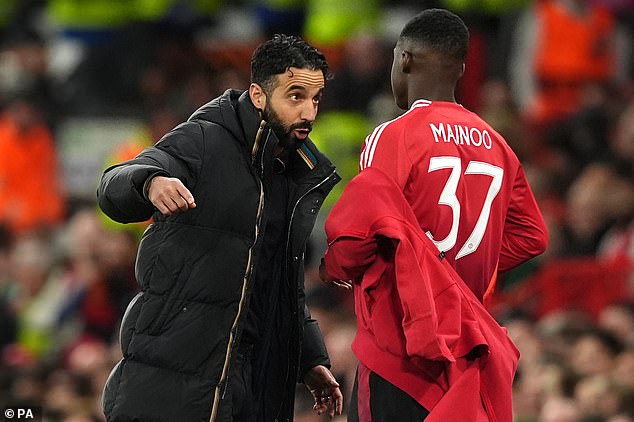
Players appeared to be confused by Amorim’s tactics against Wolves when United were held to a 1-1 draw by the club bottom of the Premier League
But back to Manchester United, Amorim, the back three versus back four discourse and the grinding down of patience.
Privately there has been grumblings from powers-that-be for a while about how the team is functioning. One such instance, a story that has not previously been told, involves Christopher Vivell, United’s head of recruitment.
Following the 1-1 draw away to Fulham in August – one of the six league games where United took a 1-0 lead but failed to see out a victory this season – the 39-year-old, according to sources, was irritated at how United’s system was so brazenly explained and exploited.
‘We knew how they defend and we know they like to squeeze from the back five,’ Fulham boss Marco Silva calmly explained that day. ‘And if you don’t give bodies for them to squeeze from the back five you can create superiority in the middle.
‘We know they play with two in the middle, we tried to overload with our three plus Alex (Iwobi). It was as simple as that.’
Iwobi added in his TV interview: ‘We knew that we would be able to get behind their two midfielders and that their centre backs would want to jump – we exploited that today.’
Vivell was understood to have been so surprised at the comments that he sent them to the WhatsApp group of United’s senior leadership and is said to have outlined the need to evolve to a less predictable system.
Wolves boss Rob Edwards smirked on Tuesday night when he said: ‘I don’t know how many games Ruben has managed, but it is overwhelmingly in favour of him going for a back three.’ Those comments are unlikely to have been warmly received by United chiefs, either.

Wolves boss Rob Edwards hinted that Amorim’s tactics were obvious after his side got a draw at Old Trafford
United have had a history of managers caving on their beliefs and so Amorim has won some credit behind the scenes for resetting standards and not wavering on his 3-4-2-1 system. He was appointed in the knowledge that he would bring it to the Premier League with him, after all.
Louis van Gaal abandoned a back-three system after three games while Ralf Rangnick scrapped his early 4-2-2-2 experiment after it became abundantly clear players couldn’t – or didn’t want to, depending on who you ask – pull off his complex ideas. Erik ten Hag drifted away from an ideology that built up his reputation at Ajax and all three of those managers got the sack.
With Amorim there has been patience, particularly from the hierarchy and the matchgoing supporters. The ‘struggle’ he has routinely referred to has been stomached, even if difficult for some to swallow.
So when, ahead of the 4-4 humdinger against Bournemouth, he spoke of variability and evolving the style and system, there was palpable relief. Excitement, even. Then, four days after United’s 4-2-3-1 led to a 1-0 win over Newcastle, to go back to a back five and two defensive midfielders against a Wolves side that had just two points left a bitter taste.
Even the most staunch defenders of the manager are growing weary at the lack of attacking intent. Many left Old Trafford feeling United limped to the draw with Wolves. It’s one win in five at home against Everton (8th), West Ham (18th), Bournemouth (15th), Newcastle United (13th), and Wolves (20th). Six points from a possible 15.
Tuesday’s draw at home to Wolves was marked frequently by Amorim shaking his head while frantically trying to get players to move into different positions.
He lamented the decision-making of experienced players such as Manuel Ugarte and Lisandro Martinez, while his touchline demeanour, often incredibly animated, felt more fraught than usual. He looked like the manager that was in charge for the first time away to Ipswich Town in November 2024.
And, in truth, this mishmash team United have to assemble right now – there are eight players out via a mixture of the Africa Cup of Nations and injury and no guarantees that any are back to visit Leeds this weekend – bore a striking resemblance to the confused bunch that stumbled to that 1-1 draw at Portman Road.

The decision-making of Manuel Ugarte against Wolves seemed to particularly upset the United manager
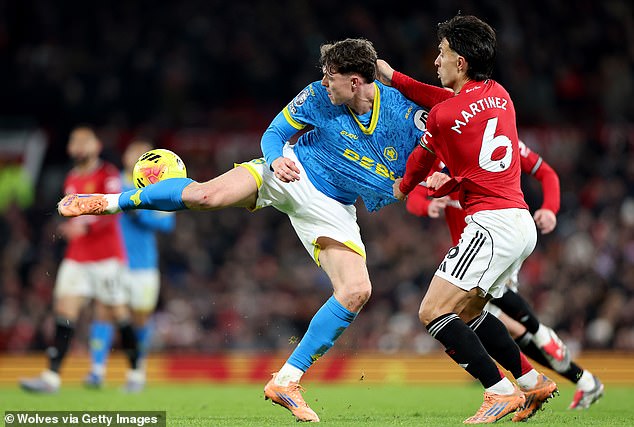
Lisandro Martinez also felt Amorim’s wrath as United limped to a draw against a Wolves team who had two points all season
‘My players were thinking too much during the game. You can feel it,’ Amorim said that day at Ipswich, adding that they looked ‘a little bit afraid’. Against Wolves, 401 days later, there was similar confusion among the players, unsure exactly what positions they needed to be occupying. In other moments there was a lack of bravery in both the press and on the ball to play it forward.
Amorim looked exasperated. Fans were fuming. Without Bruno Fernandes in the dressing room as an Amorim wingman it is understood the players have been casting more quizzical looks at the manager’s instructions.
There is blame on the players when the value of the starting XI versus Wolves was more than £325m more than the cost of Edwards’ side. But Amorim can be critiqued for a system that doesn’t play to individual strengths.
Academy players Jack Fletcher, who typically plays centrally as a No 10 at younger age groups, was being asked to progress the ball next to Casemiro as a No 6, having earlier been playing on the right wing.
Bendito Mantato, on for his senior debut, has often played left back for the Under 21s. He was also pushed onto the right wing in the final stages. Patrick Dorgu, who thrived in that role against Newcastle, regressed against Wolves when back at his usual left wing-back.
Jason Wilcox’s dialogue with Amorim is continuous, whether it be at Carrington, on flights between matches, or on the platform at Stockport train station, United’s director of football is routinely passing his thoughts on. In recent weeks it has become increasingly apparent through Amorim’s comments that those conversations are more fraught.
On Friday afternoon, the smiles, shoulder taps and wise cracks were nowhere to be seen. His comments on little chance of new recruits in January only added to the belief of strained relations.
While in charge at Man City it was Wilcox who was largely responsible for embedding a game style across every academy age group right to first team. It has brought rich success.
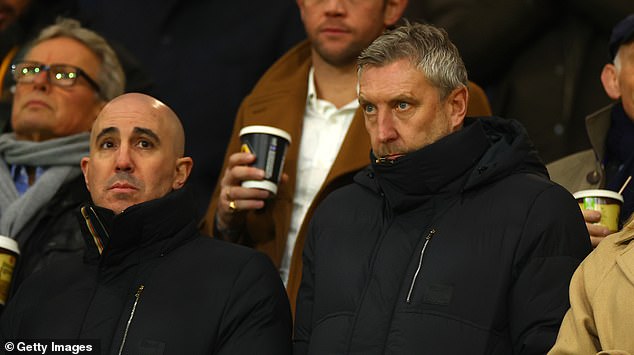
Chief executive Omar Berrada (left) and director of football Jason Wilcox look glum as they watch the Wolves draw. Wilcox’s role is interesting as his dialogue with Amorim is continuous

Academy player Jack Fletcher (right), who typically plays centrally as a No 10 at younger age groups has been asked to progress the ball next to Casemiro as a No 6
Last season Wilcox, Amorim, former head of academy Nick Cox, and Darren Fletcher, decided that mirroring the 3-4-2-1 system lower down the age groups was not necessary, even if that would speed up adaptation for those youngsters who are being required to step up.
Numerous parents of academy players mused that not switching wasn’t exactly a glowing endorsement.
‘Our approach has to be about equipping the individuals because I’m trying to equip those individuals to be able to win a game in the future, not trying to win us a game right now,’ Cox told me last year.
‘I don’t want to get too detailed, but the formation is a small sliver of the consideration. It’s more about the principles, so if you look at the teams, the principles are the same.
‘The formation is different, but we think that the formation pretty much translates to being dropped in at first-team level.’
The arrivals of Benjamin Sesko and Senne Lammens triggered a move to more direct build-up play. Out of possession Amorim has also routinely shown a system closer to 4-4-2 from the start.
Mystery is hard to come by in the Premier League given each club has an army of analysts both for open play and for set-pieces. Opponents typically know your every move.
‘We need to work on the variability of the way we play, especially in the build-up,’ Amorim explained recently. ‘I need to find different ways to take all the juice from the team, from the squad.’

The arrival of Benjamin Sesko has triggered a move to more direct build-up play

Without Bruno Fernandes through injury, Amorim has fewer loyal defenders in the dressing room
Mystery is good – provided it works. Going into games where teams are genuinely unsure what they are facing can provide a serious advantage, just as it did against Sunderland and Newcastle. On Sunday, Daniel Farke and Leeds cannot say with 100 per cent certainty how Amorim will line up.
Players, it’s understood, are largely open to working on multiple systems. Luke Shaw, Mason Mount and Ayden Heaven have publicly advocated for Amorim’s original 3-4-2-1. Others are eager to switch to a back four. But there are only so many storms and struggles fans are willing to navigate before they start looking to find another captain to steer the ship. Progress needs to become much more apparent on the pitch.
‘I am doing things my way and some guys do things in another way,’ Amorim said previously. ‘But it will change. I hope I will have the time to change, (if I do) it will change.’
Amorim has that chance right now, albeit shorthanded with his star men out. Now United must hope Amorim 2.0 brings clarity. And most crucially of all, results.