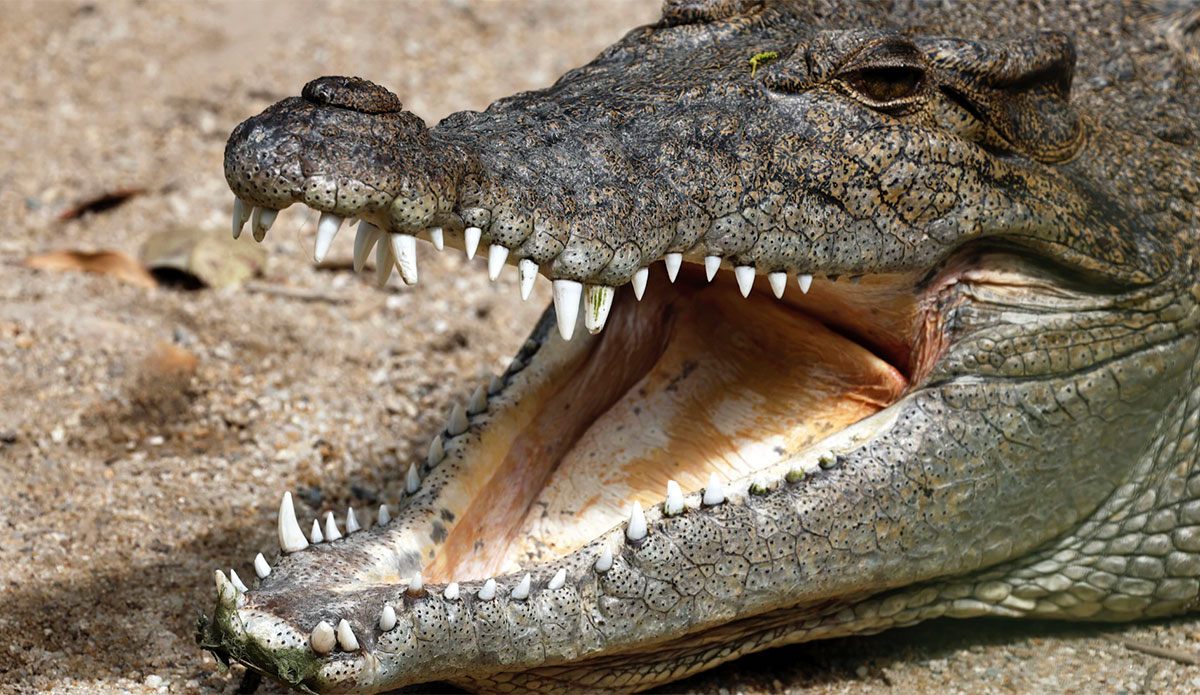
Saltwater crocodiles can swim well for short bursts, but when it comes to long distance, they’re pretty shit. Photo: Unsplash

Saltwater crocodiles are pretty incredible creatures. They’re the world’s largest reptile. They’ve got a bite force of around 3,700 PSI (we humans can only muster a piddly 160 PSI), and despite the fact that they actually kind of suck at swimming long distances, they’ve managed to spread themselves all over the Indo-Pacific region. Researchers looking into how, exactly, they managed to do such a thing found something surprising: saltwater crocodiles can surf. Well, kind of.
Saltwater crocodiles are found generally in estuaries, mangrove swamps, deltas, and floodplains. They can live in saltwater of fresh, brackish or clear. Given the fact that they live anywhere from India to the Philippines, Papua New Guinea to Northern Australia, and everywhere in between — distances that don’t make sense given their swimming ability — researchers were confused.
“Of all the amazing things animals can do, the ability of certain species to migrate significant distances across formidable geographical barriers is one of the most remarkable,” wrote the authors of a study from 2010.
As it turns out, saltwater crocodiles have learned to use ocean currents, essentially “surfing” their way across vast distances. Using sonar transmitters attached to 27 adult crocodiles in Australia’s Kennedy River, scientists were able to track the movements over the course of a year.
According to IFLScience, “the crocs would begin their long-distance travel within an hour of the tide changing… When the tide died down again, they’d haul themselves onto a riverbank and wait for the tide to change.”
It wasn’t out of the ordinary for the tagged crocs to swim over 30 miles. They would swim for about six-ish miles while the currents were working in their favor, rest while they weren’t, and then continue on again when the tides changes. When the researchers looked at crocodiles in the open ocean, they found similar behavior.
“The estuarine crocodile occurs as island populations throughout the Indian and Pacific ocean, and because they are the only species of saltwater living crocodile to exist across this vast area,” explained study author Dr Hamish Campbell from University of Queensland, “regular mixing between the island populations probably occurs. Because these crocodiles are poor swimmers, it is unlikely that they swim across vast tracts of ocean. But they can survive for long periods in salt-water without eating or drinking, so by only traveling when surface currents are favorable, they would be able to move long distances by sea.”
It was a real lightbulb moment; an answer to a question that had baffled researchers. “This not only helps to explain how estuarine crocodiles move between oceanic islands, but also contributes to the theory that crocodilians have crossed major marine barriers during their evolutionary past,” they wrote.