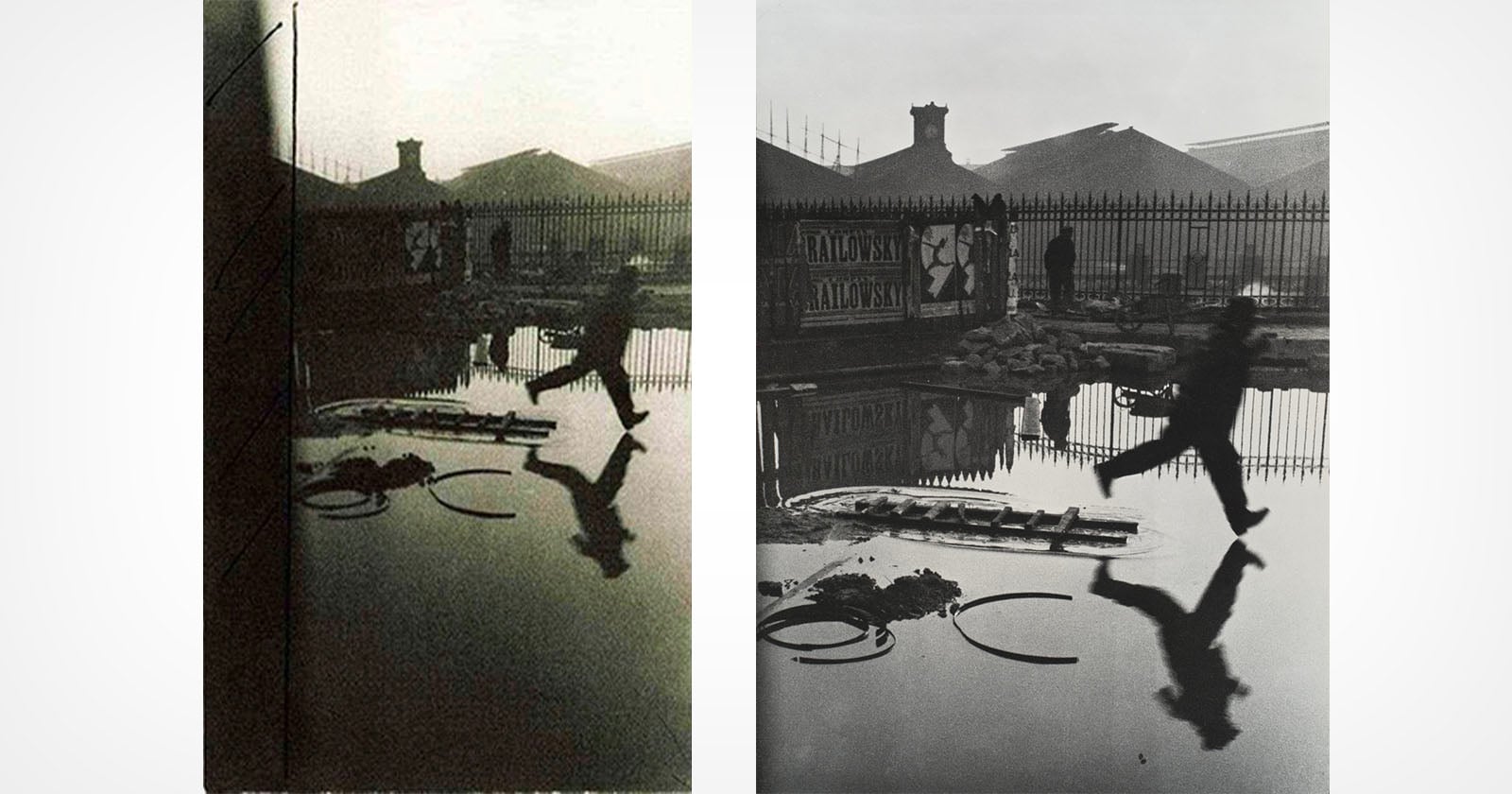
It is arguably the most famous street photograph ever taken. Shot in 1932, Behind the Gare Saint-Lazare embodies Henri Cartier-Bresson’s mantra, the decisive moment. However, the iconic photographer had to break his own strict rules to make it happen.
In a fascinating video by art history page The Gaze, narrator Matthijs Van Mierlo reveals that Cartier-Bresson cropped the iconic images — something that he rallied against throughout his career, believing the photographer should get it right in-camera.
“The photographer shot it without really looking,” explains Van Mierlo. This is because when he arrived at the photograph’s location — which, as the title of the photo suggests, is behind the Gare Saint-Lazare train station in Paris — Cartier-Bresson was confronted with a fence that was blocking his view.
However, there was a small gap in the fence through which Cartier-Bresson could just about squeeze his lens. But the viewfinder on the Leica 1 camera he was using protrudes so that he couldn’t actually look through it, rendering him blind.
“The planks were like this,” Cartier-Bresson explains in an archive interview while intimating the fence. “And I could just fit the lens through.”
Nevertheless, Cartier-Bresson evidently liked the scene and waited patiently for the decisive moment, presumably watching the scene from outside his viewfinder. Upon developing the film, Cartier-Bresson discovered that the famous frame contained a chunk of the wooden fence in the shot on the left-hand side of the image, which he decided to crop out, as well as a chunk of the bottom.
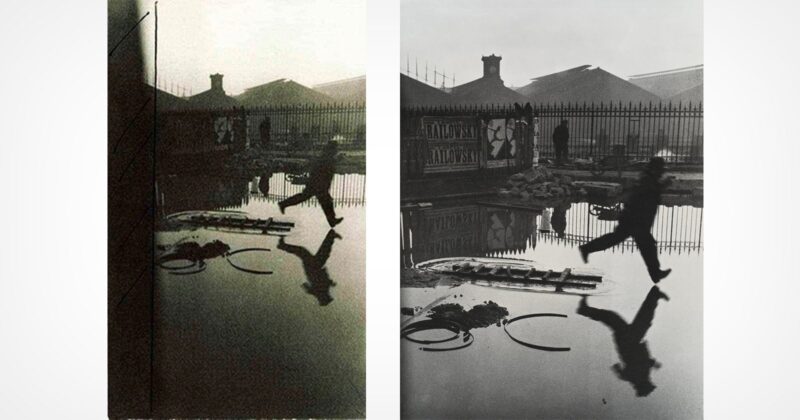 The uncropped version, left.
“The space between the planks was not entirely wide enough for my lens, which is the reason the picture is cut off on the left,” Cartier-Bresson has said.
“Behind Gare Saint-Lazare became an icon of street photography,” adds Van Mierlo. “A fraction of a second perfectly captured with wonderful leading lines, little ripples of movement, and amazing reflections that are about to be broken.”
Cartier-Bresson humbly called the photo “luck.” But that is difficult to believe when his decisive moment philosophy would essentially lay the foundations of street photography and he would go on to make many more famous images.
Image credits: Photographs by Henri Cartier-Bresson