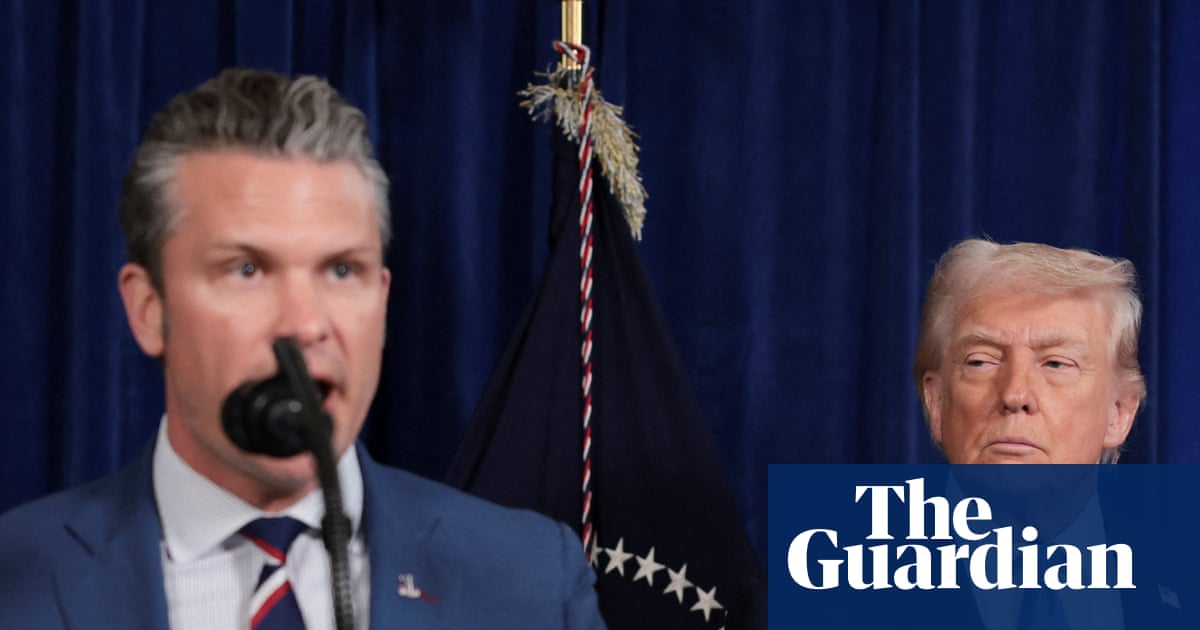
Donald Trump said on Saturday morning that US troops had carried out a “large-scale strike” on Venezuela and captured its president, Nicolás Maduro, and his wife, Cilia Flores. The couple has now been indicted in New York on terrorism and drugs charges. Trump has accused Maduro of running a “narco terrorist organisation”.
However, the legality of the operation has been called into question – with even some of Trump’s allies suggesting it violated international law.
The Guardian spoke to leading experts in the field of international law to ask for their view on the unfolding events in Venezuela.
Is the US operation in Venezuela justified under international law?
The experts the Guardian spoke to agreed that the US is likely to have violated the terms of the UN charter, which was signed in October 1945 and designed to prevent another conflict on the scale of the second world war. A central provision of this agreement – known as article 2(4) – rules that states must refrain from using military force against other countries and must respect their sovereignty.
Geoffrey Robertson KC, a founding head of Doughty Street Chambers and a former president of the UN war crimes court in Sierra Leone, said the attack on Venezuela was contrary to article 2(4) of the charter. “The reality is that America is in breach of the United Nations charter,” he added. “It has committed the crime of aggression, which the court at Nuremberg described as the supreme crime, it’s the worst crime of all.”
Elvira Domínguez-Redondo, a professor of international law at Kingston University, described the operation as a “crime of aggression and unlawful use of force against another country”. Susan Breau, a professor of international law and a senior associate research fellow at the Institute of Advanced Legal Studies, agreed that the attack could have only been considered lawful if the US had a resolution from the UN security council or was acting in self-defence. “There is just no evidence whatsoever on either of those fronts,” Breau said.
How is the US likely to defend its actions?
The US may try to argue that it attacked Venezuela in self-defence, to counter the alleged threat from the “narco terrorist organisation” it accuses Maduro of leading. Both the UN charter and its own domestic laws make some provision for the use of military force in self-defence.
However, Robertson said: “There is no conceivable way America can claim, although no doubt it will, that the action was taken in self-defence. If you are going to use self-defence you have to have a real and honest belief that you are about to be attacked by force. No one has suggested that the Venezuelan army is about to attack the United States … The idea that [Maduro] is some sort of drug supremo cannot prevail against the rule that invasion for the sake of regime change is unlawful.”
 Trump says US is ‘going to run’ Venezuela after overnight strikes – video
“You would have to prove those drug traffickers were threatening the sovereignty of the United States,” Breau added. “The United States is going to argue vigorously that drug trafficking is a scourge and it’s killing many people, and I agree. But a lot of international law experts have been looking at this and there wasn’t even clear evidence that those drug traffickers were from Venezuela, let alone that they were governed by Maduro in any sense.”
What sanctions could the US face for its actions?
The UN security council can impose sanctions on countries in an attempt to maintain peace. These can include trade restrictions, arms embargos and travel bans. However, five members of the council – the US, China, Russia, the UK and France – have a veto on this, meaning any action taken against the US is unlikely to come into force.
“Sanctions have to be imposed by the security council and America is a member with a veto,” Robertson said. “This is important, because it shows the security council is a worthless body. A country which breaks international law can avoid condemnation simply by vetoing it … the only body that can act will be eviscerated by the American veto.”
Domínguez-Redondo described the situation as “impossible”. “If the security council cannot decide on sanctions, the countries can choose whether or not to follow them,” she said. “Because the US has veto power, the sanctions are never going to be decided there.”
What precedent could this set globally?
If the US faces no consequences for the invasion of Venezuela, experts believe it could embolden other countries to carry out operations which may contravene international law.
“The most obvious consequence is that China will take the opportunity to invade Taiwan,” Robertson said. “This is the most appropriate time for it to do so, bolstered by the precedent of Trump’s invasion of Venezuela and of course his appeasement of Russia in its invasion of Ukraine. In fact, I would say that Trump’s invasion of Venezuela is the crime of aggression, the same crime Putin has committed by invading Ukraine.”
Domínguez-Redondo added that it could further weaken the UN security council. “The security council was the prevention mechanism for the third world war,” she said. “This has been completely dismantled, mainly by the US, but also by the UK when they went to war without authorisation in Iraq. The security council has been eroded.”
Where does Trump’s attack leave US allies?
The UK prime minister, Keir Starmer, has said he wants to speak to Trump and other allies to establish the facts of the Venezuela operation but stressed that the UK was not involved in the invasion and has said he believes “we should all uphold international law”. Other Nato member states will also be closely observing how events unfold.
“The United Kingdom, as a guardian of the Nuremberg principles, has a duty to condemn the United States for this breach of international law,” Robertson said. “I would say that leaders who start wars are responsible for the death and destruction that comes in their wake.
“There is a responsibility on Keir Starmer – who has played a straight bat so far, and rightly hasn’t commented when the facts are not known fully – but it is likely this duty will devolve on him, to stand up for the Nuremberg principles, to condemn Trump for his breach of them by committing the crime of aggression and lead the free world in trying to moderate consequences.”