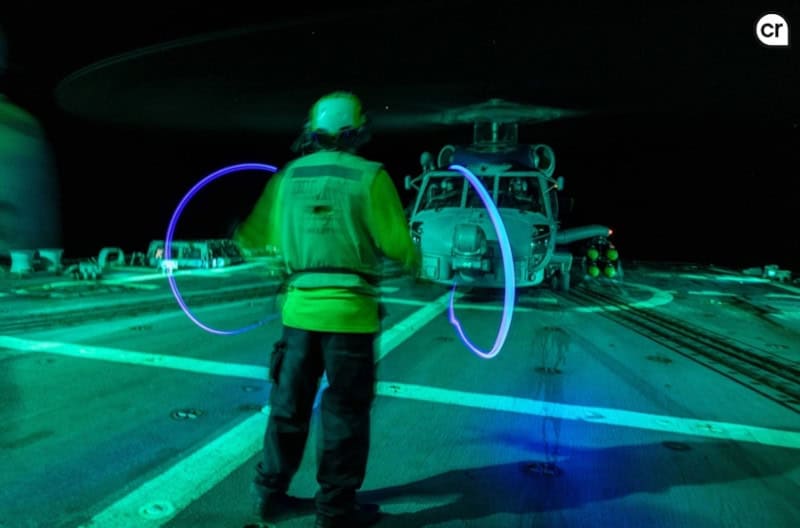
 A US Navy Sailor signals to an MH-60R Seahawk Helicopter assigned to support Operation Southern Spear, the US military and surveillance campaign targeting illegal drug trafficking. (Photo by Petty Officer 2nd Class Alyssa Sperle, US Navy)
On January 3, at around 2 am, the United States military began a wave of airstrikes on military targets in the Venezuelan capital of Caracas and surrounding areas. Shortly afterward, at around 4:30 am, US. President Donald Trump wrote that “The United States of America successfully carried out a large-scale strike against Venezuela and its leader, President Nicolas Maduro, who has been, along with his wife, captured and flown out of the Country.”
The US strikes targeted major military installations in the Venezuelan cities of Caracas, Miranda, Aragua, and La Guaira. Hours before the operation, the Federal Aviation Administration had issued a Notice to Air Missions banning US commercial flights from Venezuelan airspace due to “ongoing military activity.” Once the strikes began, low-flying aircraft were spotted over Caracas as La Carlota Air Base, a military airfield, and Fuerte Tiuna, the largest army base in Venezuela, were both hit. The mausoleum of Hugo Chavez, the former leader of Venezuela, was reportedly also struck.
After the strikes began, the Venezuelan government declared a state of emergency and reached out to the United Nations to protest the attacks. The US strikes lasted approximately half an hour, followed by Trump’s announcement of Maduro’s capture two hours later.
CBS News reported that Delta Force, the US Army’s most elite special operations unit, conducted the arrest of Maduro and his wife, Cilia Flores, according to US officials. US officials also stated that no American servicemembers were killed in the operation, but have not commented on injuries. Maduro’s capture is the culmination of years of US efforts to oust the dictator, who the US and much of the world see as an illegitimate ruler with a history of election fraud and narcotics trafficking.
According to US Senator Mike Lee, US Secretary of State Marco Rubio claimed that Maduro was arrested in order to stand trial in the United States. Maduro and 14 Venezuelan officials were indicted by the US Department of Justice (DOJ) in 2020 under charges of narcoterrorism, corruption, and drug trafficking. In 2025, the US State Department and DOJ increased the reward for information leading to Maduro’s arrest to $50 million. The departments released a joint statement claiming he had “[violated] U.S. narcotics law” as “a leader of Cartel de los Soles, which is responsible for trafficking drugs into the United States.”
The situation is developing, and Venezuela’s future is unclear. However, Pedro Urruchurtu, an adviser to recent Nobel laureate and Venezuelan opposition Leader Maria Corina Machado, previously stated that the opposition had developed a plan for the first 100 hours after Maduro was ousted. This plan reportedly involves the transfer of power to Edmundo Gonzalez, who ran for president of Venezuela in 2024 and is widely believed to have legitimately won the election after Maduro was accused of fraudulently manipulating it.
Regardless of Maduro’s present status, his regime, for now, is still intact. Minister of Interior Defense Diosdado Cabello said after the strikes that Venezuela remains in “complete tranquility.” Minister of Defense Vladimir Padrino Lopez and Vice President Delcy Rodriguez also remain free and unharmed. “Far from a supposed fight against narcoterrorism, this deplorable action seeks to definitely force a regime change,” Lopez stated. The Venezuelan government also issued a statement calling the strikes a “serious military aggression.”
International reactions from Maduro’s allies
Allies of the Maduro regime have condemned the US operation. Cuban President Miguel Diaz-Canel condemned it as a “criminal U.S. attack.” Cuba relies heavily on Venezuelan crude oil, importing roughly 27,000 barrels per day in 2025. These shipments account for nearly half of Cuba’s fuel deficit and close to a quarter of its total energy needs.
The Russian Foreign Ministry stated that the United States committed “an act of armed aggression” after reports of Maduro’s capture. Russia and Venezuela have a longstanding military partnership dating back to Hugo Chavez’s rule, with Venezuela purchasing over $4 billion in Russian arms since 2005. Moscow and Caracas have conducted at least nine military exchanges and cooperation activities since 2022, and the two governments signed a Strategic Partnership and Cooperation Treaty in May 2025, formalizing security cooperation for at least 10 years.
Iran’s Foreign Ministry claimed that the United States committed a “flagrant violation” of Venezuela’s sovereignty. Iran and Venezuela signed a joint defense agreement in 2022 pledging to collaborate on defense, energy, and finance. Iran is also part of the “shadow fleet” of vessels that transport oil to and from Venezuela, Russia, and China in order to avoid US sanctions. Tehran is currently facing widespread protests in which Iranians are calling for regime change, drawing a response from Trump. “If Iran shoots and violently kills peaceful protesters, which is their custom, the United States of America will come to their rescue. We are locked and loaded and ready to go,” Trump wrote in a post on Truth Social on January 2.
Notably, China has yet to issue an official statement, though Beijing is a key ally of Maduro’s regime. China is by far the world’s largest buyer of Venezuelan oil, accounting for 80 percent of the sales of Petroleos de Venezuela, S.A. (PDVSA), the state-owned oil and natural gas company. This total is equivalent to 4 percent of China’s total oil imports. Beijing officially denies supplying the Venezuelan military with arms. However, reports have surfaced of Venezuela negotiating to buy 20 J-10CE fighter jets from China, and Caracas already boasts Chinese-made infantry fighting vehicles, artillery units, and amphibious assault vehicles. On December 23, at an emergency UN Security Council meeting called by Venezuela, China joined Russia in accusing the United States of violating international law.
Capture of Maduro follows months of escalation
The military pressure on Venezuela had been building for months and escalated significantly in the weeks prior to today’s strikes and Maduro’s arrest. The US began a series of strikes on alleged drug-running speedboats in September, followed by US Secretary of War Pete Hegseth announcing Operation Southern Spear on November 13. Hegseth stated that the campaign was intended to “[defend] our homeland, [remove] narco-terrorists from our hemisphere, and [secure] our homeland from the drugs that are killing our people.”
On December 10, Trump ordered a “total and complete blockade of all sanctioned oil tankers going into and out of Venezuela.” The same day, the US seized The Skipper, a sanctioned tanker that had previously docked at an Iranian port with two million barrels of oil bound for China. On December 20, a second tanker was intercepted by US forces off the coast of Venezuela. The US pursued a third tanker, the Bella 1, the following day after its crew refused to submit to boarding, and continues to pursue this vessel. The US blockade has substantially reduced the amount of illicit oil flowing out of Venezuela.
On December 29, the US had conducted the first strike inside Venezuelan territory since the beginning of Operation Southern Spear. Trump claimed “there was a major explosion in the dock area where they load the boats up with drugs,” though US officials have not clarified exactly what was hit or where.
Update on 1/3/26 at 8:05 pm EST:
The Chinese Foreign Ministry released a statement saying it was “deeply shocked by and strongly condemns the U.S.’s use of force against a sovereign state and action against its president. Such hegemonic acts of the U.S. seriously violate international law and Venezuela’s sovereignty.”
At a press conference, President Trump and members of his staff clarified the nature of the operation and the next steps in the conflict. “We’re going to run the country until such times as we can do a safe, proper, and judicious transition,” said Trump, adding, “We’re going to be running it with a group … and we’re going to rebuild the oil infrastructure. … We’re not afraid of boots on the ground … we’re going to make sure this country is run properly. We’re not doing this in vain.”
When asked who would take over for Maduro, Trump claimed, “There is nobody there to take over. You have a vice president,” referring to former Venezuelan Vice President Delcy Rodriguez, “who’s been appointed by Maduro and … she was sworn in as President just a little while ago. She had a long conversation with [US Secretary of State] Marco [Rubio], and she said, ‘We’ll do whatever you need.’ I think she was quite gracious, but she doesn’t really have a choice.” Rodriguez later stated, “There is only one president in Venezuela, and his name is Nicolás Maduro Moros.”
Seemingly contradicting earlier Venezuelan opposition reports claiming Maduro’s capture was part of a secret deal, US Chairman of the Joint Chiefs of Staff General Dan Caine stated that US personnel were under fire and injured during the raid, though the mission produced no American fatalities.