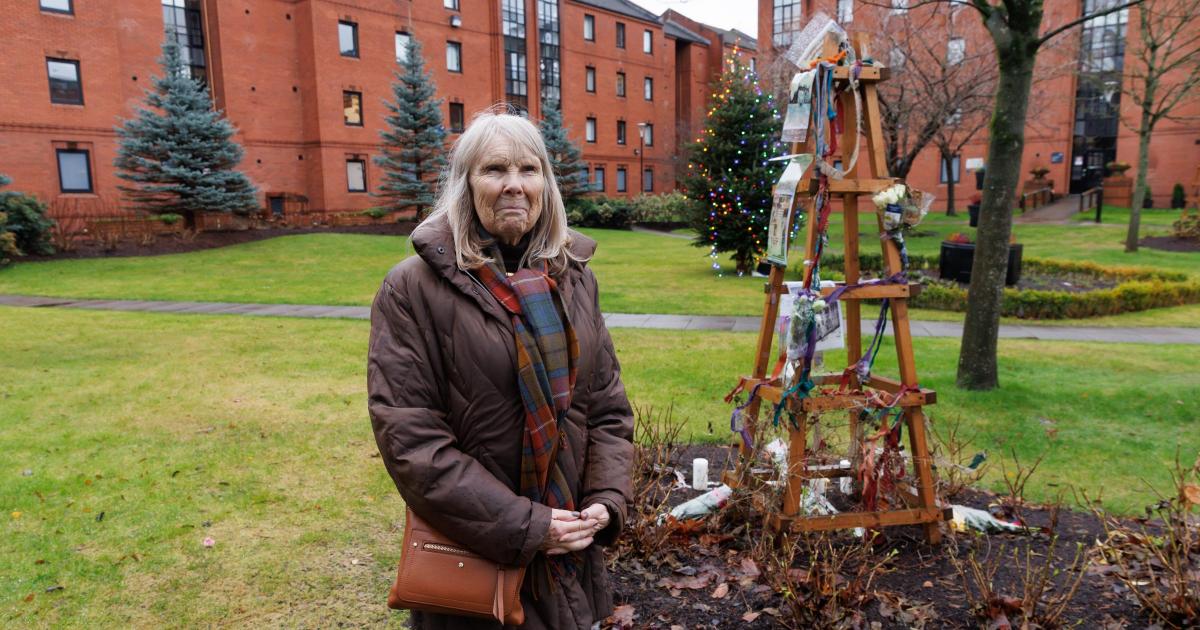
The memorial, which would be placed on the grounds of Strathclyde University at Rottenrow, would be for the memory of the tens of thousands of women and children who were admitted to the hospital with venereal disease (VD), or as we now know it, syphilis and gonorrhea.
Toe-curling medieval treatments were used in an effort to “cure” those who were admitted to the hospital, but most didn’t survive.
Glasgow Lock Hospital before demolition in 1955 (Image: Frank Wordsall Collection/GCA/Mitchell Library)
READ MORE:
The brutal history of Glasgow’s forgotten Lock Hospital
Glasgow Necropolis charity celebrates 20th anniversary
Glasgow Necropolis heroes’ stories that shaped city
Council plans ‘could be the end’ for Glasgow Necropolis
Anna Forrest, Lock historian pictured in the Lock room at the Royal College of Physicians and Surgeons of Glasgow. as there are Calls for memorial for Glasgow’s forgotten Lock Hospital (Image: Colin Mearns)
The memorial plans have been backed by leading Lock Hospital historian Anna Forrest, who has been uncovering the truth behind the institution for over 30 years.
Records that Anna has found show that from 1805 to 1881, 33,000 women and girls were admitted to the Lock.
From 1881 to the start of the Second World War, almost 42,000 women and girls were admitted.
Children were also admitted; a 1916 report indicates that approximately 16,000 children were treated, some as young as one year old, but primarily between the ages of eight and 14.
Anna said: “When I saw people’s names and their conditions, I thought, these were human beings. These were people who lived.
“Because I saw their names and their ages written down, that was the hook for me.
“It was just wrong that they should be forgotten.
“I went to school at Rottenrow and never knew about the Lock.
“Once I did, I used to walk up and down a lot, and I could hear their voices.”
There is a room in the Royal College of Physicians and Surgeons on Sauchiehall Street dedicated to the Lock, where Anna spent a lot of time looking through old records – but no official public memorial or notice currently stands at the site of the hospital.
The room is dedicated to the memory of the Glasgow Lock Hospital. (Image: Colin Mearns)
READ NEXT:
‘Fake £20 note’ fall out with venue ruined my wedding in Glasgow
The story behind ‘ornate’ old building in middle of modern Glasgow hospital
Glasgow nurse faces trial over allegedly giving patient fatal dose of wrong drugs
GV of Rottenrow at the University of Strathclyde. At left (now student halls of residence) is the site of Glasgows second Lock Hospital that existed from 1846 to 1947. (Image: Colin Mearns)
The original Glasgow Lock Hospital opened in 1805 in a villa at 151 Rottenrow Lane, near the Montrose Street end.
The first Lock closed in the 1840s amid scandal over its treatments and reputation.
The memorial is planned to be situated at the site of the second Lock, which opened in 1846, at the High Street end of Rottenrow – number 41 – now part of the University of Strathclyde campus, where the Thomas Crawford Hall of Residence stands today.
Anna is standing at a temporary memorial to the women and children of the two Lock hospitals that were situated on nearby Rottenrow from 1805 to 1947. The temporary memorial is adjacent to the site of where a permanent memorial will be built. (Image: Colin Mearns)
A temporary memorial has been erected on the site by Anna and other volunteers while they await the final commemorative symbol.
Anna said: “We’ve been doing this temporary thing for a few years now.
“I got hold of the gardeners and asked if we could use one of the wooden frames they had lying around.
“It’s something there at least.
“The chosen site for the actual memorial is the student village in Strathclyde University, which is beautiful, and it will be a good home for the monument.”
Anna Forrest, Lock historian pictured at the University of Strathclyde. (Image: Colin Mearns)
A spokesperson for the University of Strathclyde said: “The University has committed to creating an appropriate memorial to the Lock Hospital and is discussing the plans for doing so with the Heritage Lead of the Royal College of Physicians and Surgeons of Glasgow, Claire McDade, and community groups.”
Anna’s research has shed light on the forgotten, dark history of the Lock Hospital, and she spoke with the Glasgow Times at length about her findings.
She hopes that the memorial will be a fitting memorial for the poor women and children who suffered at the Lock and that they will be remembered.