Barclay was initially dismissive. “I’ve worked in this field for long enough that this isn’t the first time that there’s been strange things reported so by default it goes into that category of. ‘Well, it’s most likely somebody has seen something but it’s most probably not lynx.”
The officer sent images. The first, a cat’s pawprint in the carpet of snow, hard to judge in terms of scale. Then a second , which for him was unmistakeably were “two lynx sitting in a forest”.
Lynx paw print (Image: RZSS)
“I’ve spent most of my working life working with cats,” says Barclay. “I specialise in cat management and cat conservation so as soon as that image came through with the ear tufts, I had no doubt that was lynx.”
The very first thing the team did was to “double check and triple check” that their own lynx were in the enclosure where they should be. They were. “Once we checked that one off,” he recalls, “we were working on the assumption that probably, for whatever reason, people have purposely put those animals there.”
Barclay called his boss, David Field, CEO of the Royal Zoological Society of Scotland (RZSS), down the road in Edinburgh, who recalls, “The wine stain on my carpet probably reflects my kind of shock horror that what was happening and the realisation that these lynx were loose and that we needed to assess what was to be done.”
A year in the life
A year on and the police investigation into who released those lynx is still ongoing, but in the early days of 2024, the UK was gripped by the unfolding tale of cats on the loose. It sparked debates over lynx reintroduction and guerrilla release, triggered reaction among farmers and local community, and also tapped into fears and concerns over the cats themselves.
But the story of their capture and care, tells a great deal about who they were, their nature as a species, and provides possible clues as to where they came from.
“It’s a year on,” reflects Barclay on the lack of answers, “and where are we with this? And if it’s not being progressed, why is it not being progressed? I think there definitely is a role for the UK Government to really push this and support the police in resolving it. It’s probably as much for the Government to answer as the police, because it’s the Government that sets the legislation for release of native species, non-native species and so on.”
Straw marked the spot
That day last January, having contacted the police, Barclay went out on site to an area at the edge of the snow-cloaked forest. At the spot, down a quiet road, around a mile away from the Highland Wildlife Park, he observed a pile of straw on the floor with food mixed into it.
null (Image: RZSS)
“At that point in time, we didn’t know if these animals had perhaps escaped from somewhere or dumped or released or whatever the reason was. But knowing what I know from cat management and animal management, obviously you don’t chuck lynx in the back seat of your car, you put them in a box. So they most were likely in a box with straw with some food and when they were released, they just they opened the box, the lynx came out and all the straw came out and it had some food in it.”
While waiting for the police, he decided to take a short walk into the woods, following the cats’ pawprints. To his surprise, a relatively small distance in, he came across the lynx crouching in the trees, those distinct ear tufts silhouetted against the snow. “They were sitting, looking at me two of them hunched behind a log. I kept eyes on them for a while, but by the time the police arrived the lynx had gone.”
null (Image: RZSS)
Barclay and his team were asked by the police if we could support them in trying to catch the animals. Immediately they started planning to get live capture traps out there and to go about trying to trap these animals as quickly as possible.
The lynx did not move far from the spot at which they were released and there were a couple of other sightings in the vicinity over the next 12 hours. Barclay and his team put down three live traps and baited them with food, leaving live cameras to monitor the traps . At about 4am they saw something on one of the cameras.
“We saw on camera the first cat had been trapped. And then we waited a little bit to see if there was any activity from the second cat, and there wasn’t. So we decided to go out and remove the first cat and then leave the traps active for the second one.”
“It was quite surreal,” he recalls, “to be in the forest at 4am when it’s -15C, pitch black and you’ve got a lynx in a cage trap. Knowing that the lynx were there is one thing but having one in front of you in a trap was quite surreal.“
Staff at the Highland Wildlife Centre, following trapping of the lynx, with David Barclay third from left to right (Image: RZSS)
Some of the team started preparing to move the lynx that had been trapped but Barclay was keeping a close lookout for the other cat. “Then the second lynx,” he recalls, “walked out of the forest and stood not even 5 metres from me. And at that point we could get quite a good look at the lynx. We could see that these are clearly young animals. Probably, 6-8 months old.”
At one point, he thought that lynx was going to jump into their pick-up, whose doors had been left open, but it didn’t. They carried on with their work, and, after a while, that second lynx strolled over to a log pile and sat down and watched them.
“We established quickly,” he says, “that these were most likely animals that were bred in a captive environment possibly with quite close management with humans. They didn’t seem to have a a fear of humans and of course they were still young animals, so quite naive.”
Once the first lynx was removed, they reset the traps, and drove to the edge of the forest, only a couple of 100 metres away and waited there to see if the second one went in.
It didn’t take long. Barclay recalls: “After about 15 minutes it did so and at 4am, we had two lynx trapped.”
Job done, two lynx caught
The team then moved the two lynx to a quarantine area at the Highland Wildlife Park, leaving the equipment in the field, including the cameras, but leaving the traps deactivated. Cleaning up wasn’t a priority; managing the captured lynx was. At the end of the day, Barclay recalls, “It was all very hectic with a lot going on but it felt like everything had been resolved”.
At that point, just as everybody was heading for bed, tired, one of the staff, out of curiosity logged on to the monitoring cameras that were still out there and saw two lynx standing in front of the traps.
At first, the staff member assumed what they were seeing was actually a video of the lynx from that morning, pre-recorded footage. “But it became very clear that actually no, it was it was two more lynx.”
In the morning they went back out again to trap them. “We set up all the traps again and that evening managed to trap the other two animals. Four lynx in two days.”
Were the lynx a danger in that time to either the public or those trapping them in that time? “There’s a dangerous element,” says Barclay, “to a lot of work when you’re dealing with animals, especially carnivores. Even small carnivores can be dangerous depending on what situation they’re in. But I think the risk to public and anybody from these animals, in hindsight was always quite low.
“I think, if anything, these were quite scared animals and the people who released them were putting in this in a situation which was really unfair on their welfare.
“These animals most certainly wouldn’t have survived if we hadn’t caught them. It was the coldest night of the year. They were very young and naive. And I think if anything, they they themselves just wanted to be removed from from that environment. Like I say, these weren’t adult lynx, they weren’t aggressive, they didn’t seem to have any any fear of of humans and I think they probably wanted to get away from there themselves.”
A mystery death
Sadly, even after having been captured, one of those lynx would not survive. On January 11, it was announced that one of the last pair had died overnight. At the time, Dr Helen Senn, head of conservation at the RZSS, said: “Whatever the case, this unfortunate development just serves to further demonstrate the folly of abandoning these amazing animals in the wild, with no preparation or real concern for their welfare.”
The results of the post mortem have never been released.
In the meantime, the first pair were taken down to the quarantine space in Edinburgh and the care of RZSS curator, Jo Elliott.
One of the illegally released lynx Edinburgh Zoo (Image: RZSS)
She recalls that before they arrived they had multiple questions about how it was going to work. “We didn’t know what they were eating, we didn’t know where they’d been kept. We didn’t know how they were going to be with people. Obviously, lynx are a potentially dangerous species, so most of what we were doing was doing a bit of thinking about how we were going to manage these cats and how they were going to react to being shut in to a relatively small quarantine space when we didn’t know anything about their backgrounds.”
Then the first two cats arrived. “They came in, they got let out into their quarantine enclosure, and that’s when we really had a first impression of how they were going to be.”
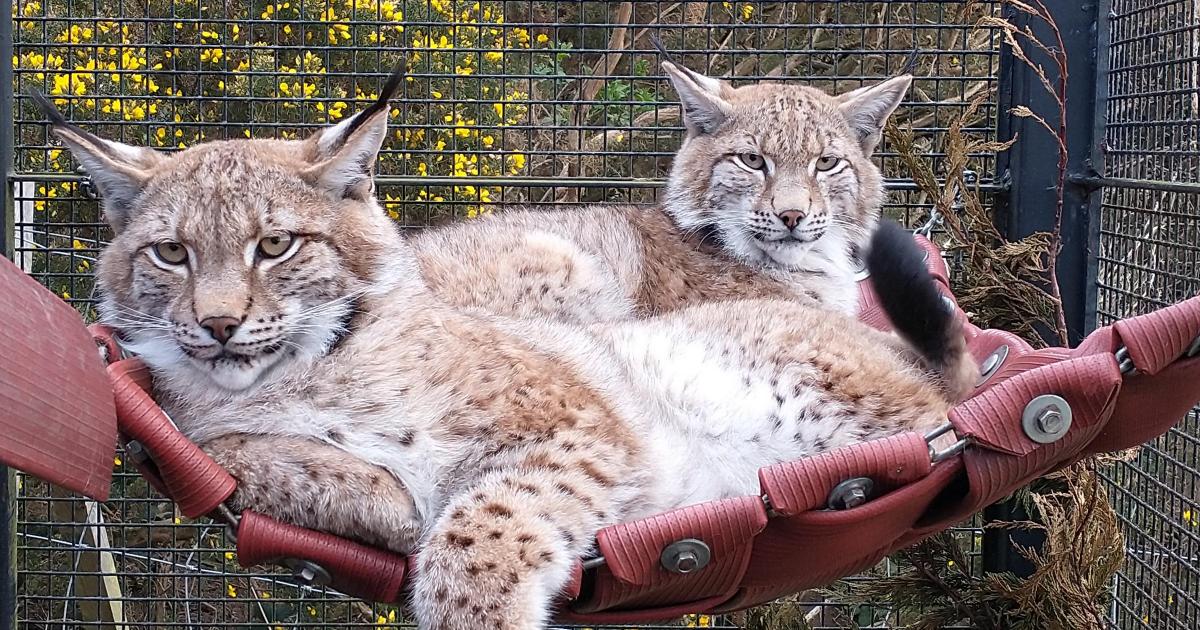
Initially, they seemed shy, and spent the first couple of days huddled up together underneath one of the little shelters the keepers had given them. “Sometimes we couldn’t even tell where those first two that came in, were one or two cats. They were just snuggled right up together, just a big ball of fluff. We could also tell that they were probably quite young. They weren’t full grown.”
The days, she recalls were stressful, “trying to figure out how we could work with these animals”. “As it turned out, all of them were relatively shy. They mostly avoided us for the first wee period, and initially, I would say they were very wary, but then given what they had just been through, released into a completely unfamiliar area, caught, then transported and popped into another completely unfamiliar enclosure, so that that wouldn’t be unexpected for any animal in that situation.”
The animals quickly warmed to the keepers and from early on it was clear that they were used to being around people. “One of them in particular seemed to seek us out, and very quickly was spending time looking out for us. So we could tell that these were animals that had been in captivity previously and that had been looked after by people before. So that was reassuring for us. They all started eating, and drinking really quickly. Which is, which is a good sign that they were they were going to settle in well.”
READ MORE:
Since lynx are an arboreal species, and it was the time of year when there are a lot of Christmas trees around, the keepers put a few into their space. “They used to,” she says, “like squirreling themselves right underneath the Christmas trees. And one in particular would sit and watch the wrens. She would sit and stalk the wrens, as if this is a good meal for a fully grown lynx. Just like a house cat she would getting all excited and clicking and watching the wrens.”
Elliot recalls feeling sad for the cats. “Whatever their background was, it certainly wasn’t being out in the wilds of Scotland on the coldest day of the year, and they clearly were not the kind of cats that were going to look after themselves easily. Once we’d done all the veterinary checks, we could see that they were very young cats, as we first suspected.
A new home in the Highlands
Ultimately, the cats were moved to the Highland Wildlife park in May, where they have made themselves at home. Often they can be seen high up in the trees, right out to the edges of the branches in the enclosure.
“They love the views,” says CEO David Field, “and they they’re doing really well. They’re really, really well. And the lynx themselves, they do give us an opportunity because we talk about the link story at the highland wildlife park, so we we’re able to tell people there is this rewilding support, this one there is this rewilding don’t support that one.
RZSS has been highly critical of those who released the animals. David Barclay says: “It was such a harsh time of the year. And these were young, naive animals. And of course, if the intention of whoever did it was to try to get lynx back into the wild and do it as part of a rogue lynx reintroduction, then it goes against all kinds of bad best practise for this type of work. That’s obviously something we don’t support.”
Barclay is keen to see the perpetrators brought to justice. “We’ve been trying to support the police as much as possible, because this is an ongoing police investigation and we hope that the police and the UK Government continue to push this and make it a priority because I think this has the potential to set a really bad precedent for illegal releases of animals if nobody is brought to jail.
“I’m just hopeful that it’s being taken seriously and not just by the police, but by the UK government because the police will have their processes, but I think it’s really important that the UK Government, with the the likes of Defra and APHA and Animal Health are equally as supportive of this getting resolved. It’s not a good look for Scotland. It’s not a good look for legal and well planned reintroduction projects. It’s not good for any future possibility of lynx reintroduction into the UK.”
Lynx in quarantine at Edinburgh Zoo (Image: RZSS)
David Field castigates those who dumped the lynx. “Whoever did this was nasty. These people were evil. If they were rewilding, that is an irresponsible approach to rewilding. It is damaging and I think it has undermined it, to be perfectly honest.”
In the period following the trapping of the lynx, debate over reintroduction intensified. At an NFU Scotland conference John Swinney declared “My government will not be reintroducing lynx, or indeed any other large carnivorous species in Scotland.”
Field points out that, in fact, Scotland has already very successfully released some predators on exactly the wildcat programme on which Barclay was working. “Wildcats aren’t that small and and they’re doing pretty well – in fact, NatureScot just released a report about how well it’s gone.”
RZSS success with wildcats shows some of the potential of reintroduction done well. “Whether lynx come back to Scotland,” says Field, “or not, is not our decision, but RZSS will be the ones to do it. We’ve proven our worth with Wildcats. Other people make the decisions, but we can do the science and we can do the rewilding.”