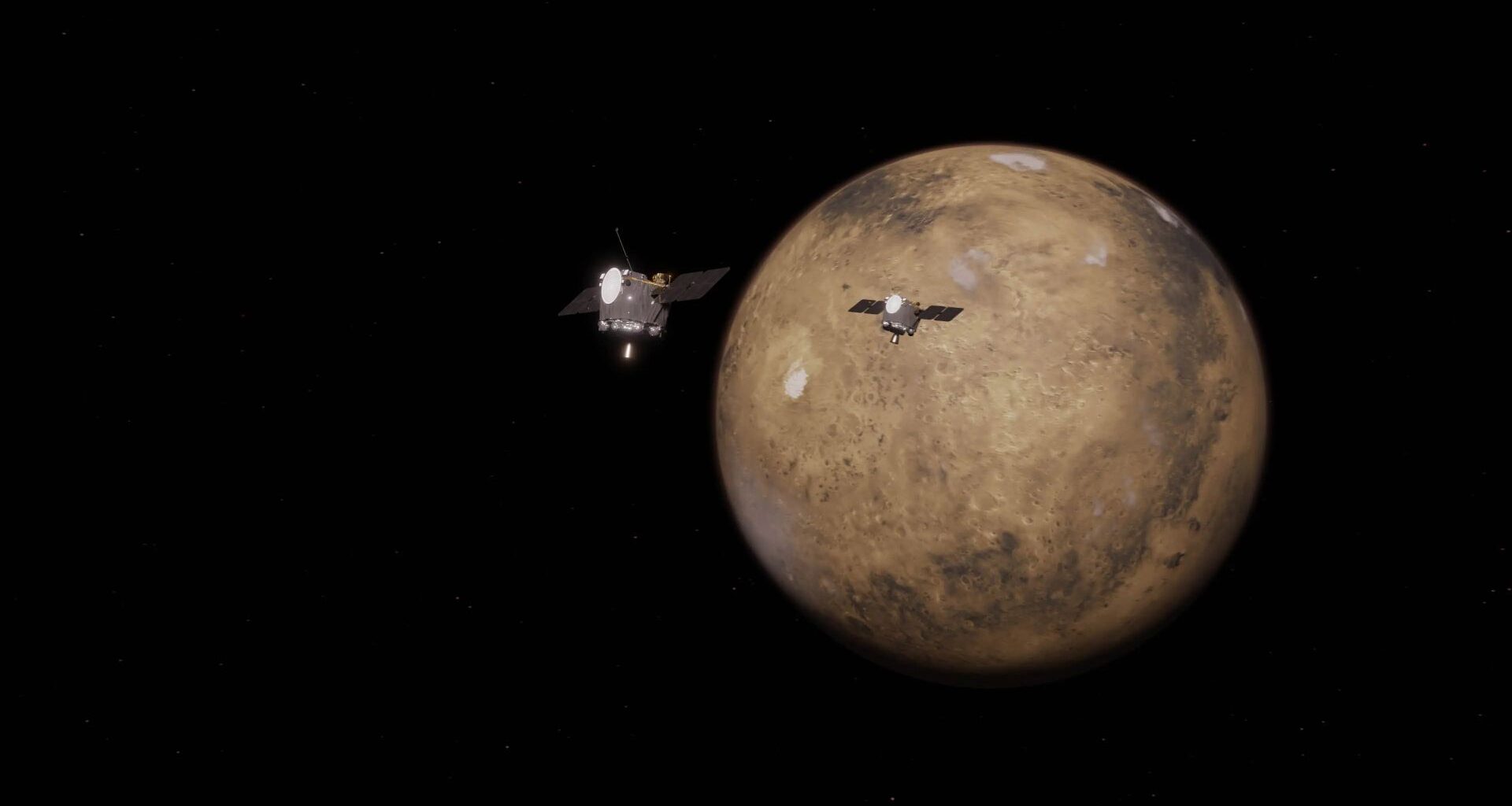
A space saga is underway, a celestial long and winding road that may also have consequences for future settlers firmly planted on the Red Planet. When NASA’s Mars-bound ESCAPADE spacecraft were launched atop Blue Origin’s New Glenn rocket on Nov. 13, 2025 from Cape Canaveral, Florida, the dual craft weren’t placed on your standard route to reach the Red Planet.
At liftoff, Earth and Mars weren’t in planetary position for a direct trip by the probes. So, the twin ESCAPADE probes (Escape and Plasma Acceleration and Dynamics Explorers) were sent into a “loiter” orbit, one that loops around Earth’s Lagrange point 2 (L2), roughly a million miles away, opposite the sun. ESCAPADE is tasked with analyzing how the solar wind interacts with Mars’ magnetic environment and how this interaction drives the planet’s atmospheric escape. That’s a blustery way to say the mission will provide critical insights into Mars’ climate history and evolution.
The next move is scheduled for the fall of 2026, when Earth and Mars align and the two spacecraft — tagged as “Blue” and “Gold” — use Earth’s gravity to slingshot toward the Red Planet. With engines firing, both spacecraft will embark on a trans-Mars injection in November 2026. After long-haul cruises they’ll undertake Mars orbit insertion maneuvers in September 2027. But that extra time in space could have some consequences for the twin probes, ESCAPADE scientists say.
You may like
“The extra 12 months in space does add some additional wear-and-tear to the spacecraft,” said Rob Lillis, principal investigator of the ESCAPADE mission at the UC Berkeley Space Sciences Laboratory in California.
“However we are confident that Blue and Gold will be robust enough to operate until the end of their nominal science mission in May 2029 and hopefully for many years beyond that,” Lillis told Space.com.
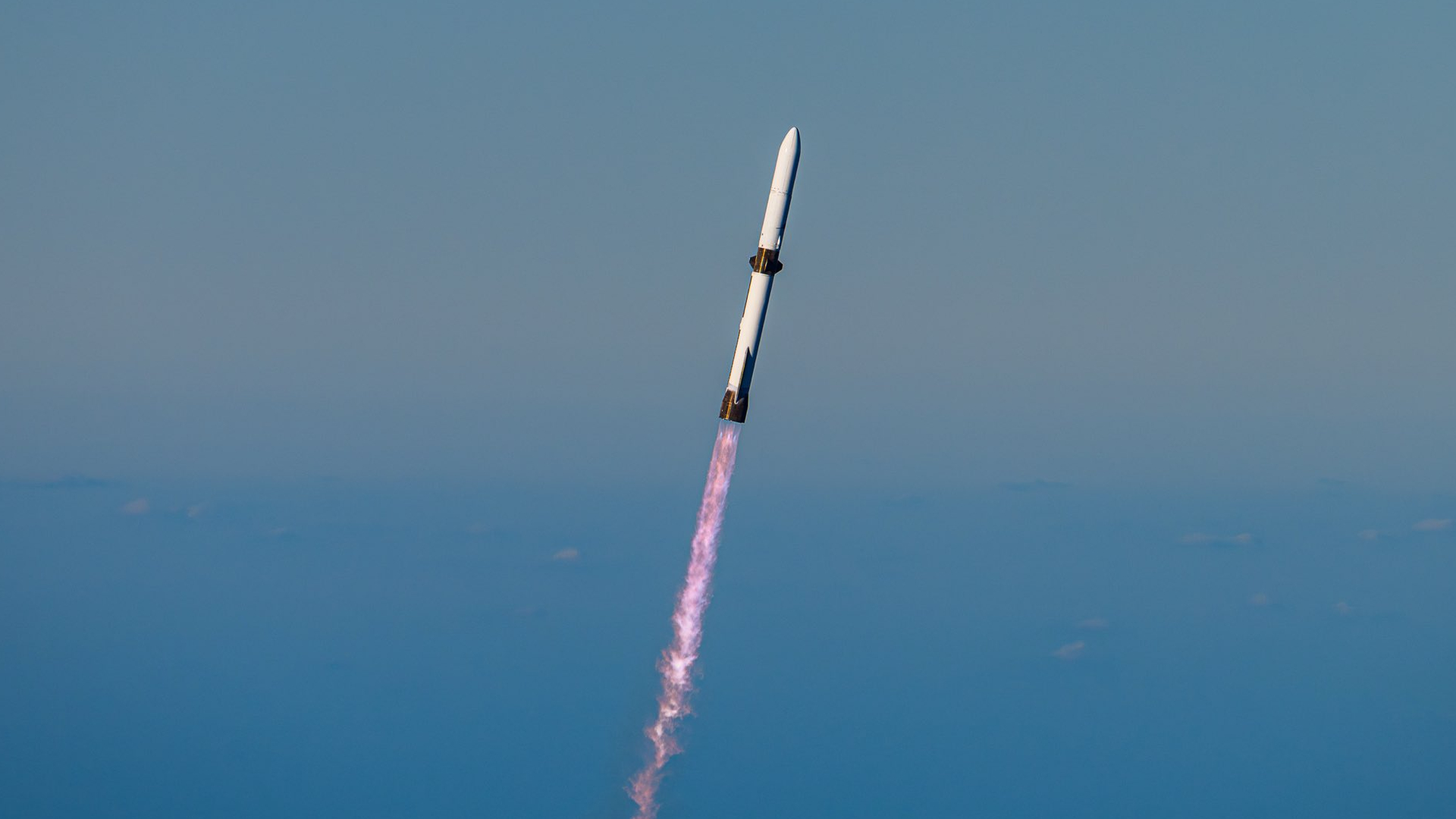
NASA’s ESCAPADE spacecraft launch atop Blue Origin’s New Glenn rocket on Nov. 13, 2025 from Cape Canaveral, Florida. (Image credit: Blue Origin)Wide-open windows
Space loitering, kidney bean paths, gravity assists, hyperbolic orbits and wide-open windows — enter the world of Jeffrey Parker, Chief Technology Officer at Advanced Space in Westminster, Colorado, the chief architect behind the ESCAPADE mission’s roundabout road trip to Mars.
Advanced Space worked with the ESCAPADE mission team since its very beginning, engaging with UC Berkeley and NASA by iterating many versions of the mission depending on launch vehicle decisions, liftoff target dates, designing spacecraft orbits, and the “get out of town” interplanetary cruise phase of the dual probes to Mars.
All that tweaking was about “how do you get to Mars when the launch vehicle is not necessarily going to Mars,” Parker told Space.com. “It was a long saga, with many, many, many changes.”
Parker’s expertise was harnessed in a way so that ESCAPADE didn’t have to wait 2.1 years before the planets lined up again. A central judgment that made that feasible was switching from ion propulsion to a chemical propellant system, a trade that increased the size of propellant tanks on each spacecraft to hold more fuel.
“Having that extra fuel really did help,” said Parker, and gave rise to multiple choices of trajectories, even looping around Earth endless times to a Venus swing-by to get to Mars.
You may like
“It’s really hard to beat the planetary alignment at launch,” Parker said, with ESCAPADE specialists ultimately finding that the L2 loitering strategy was the way to go, he said, an approach that offered a “degree of freedom.”
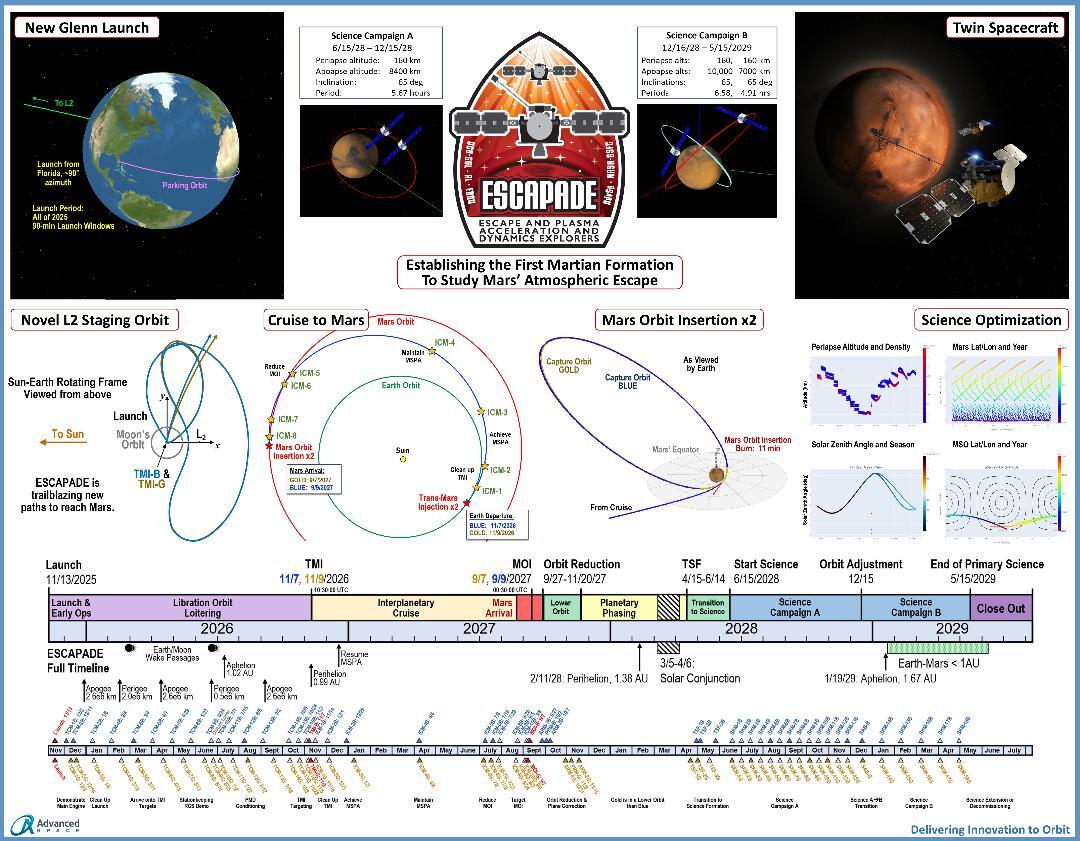
ESCAPADE mission timelines for the route to Mars. (Image credit: Advanced Space)Reasonable assumptions
Lillis gave details regarding the loiter orbit decision. Both ESCAPADE spacecraft have multiple redundant systems so that a single event upset or even a serious single event latch-up from a cosmic ray or solar energetic particle will not endanger the mission, Lillis said. “We have now checked and commissioned both redundant sides of both spacecraft and found all systems healthy,” he said.
Lillis said that the ESCAPADE team attempted to quantify the additional risk using reasonable assumptions, and shared their findings with NASA earlier this year. “We were both satisfied that the extra 12 months in space did not significantly reduce overall mission success likelihood,” he said.
Indeed, the loiter orbit requires several trajectory correction maneuvers. However, because the orbit is flexible, said Lillis, none of these are critical, in the sense that they can be re-tried or delayed if they don’t go just right the first time.
And in fact, one of these was already delayed. In an update posted on Dec. 15, NASA wrote that one of the twin probes’ initial trajectory correction maneuvers were delayed when low thrust was observed from one of the spacecraft, but noted that “there are no long-term impacts from the trajectory correction delay.”
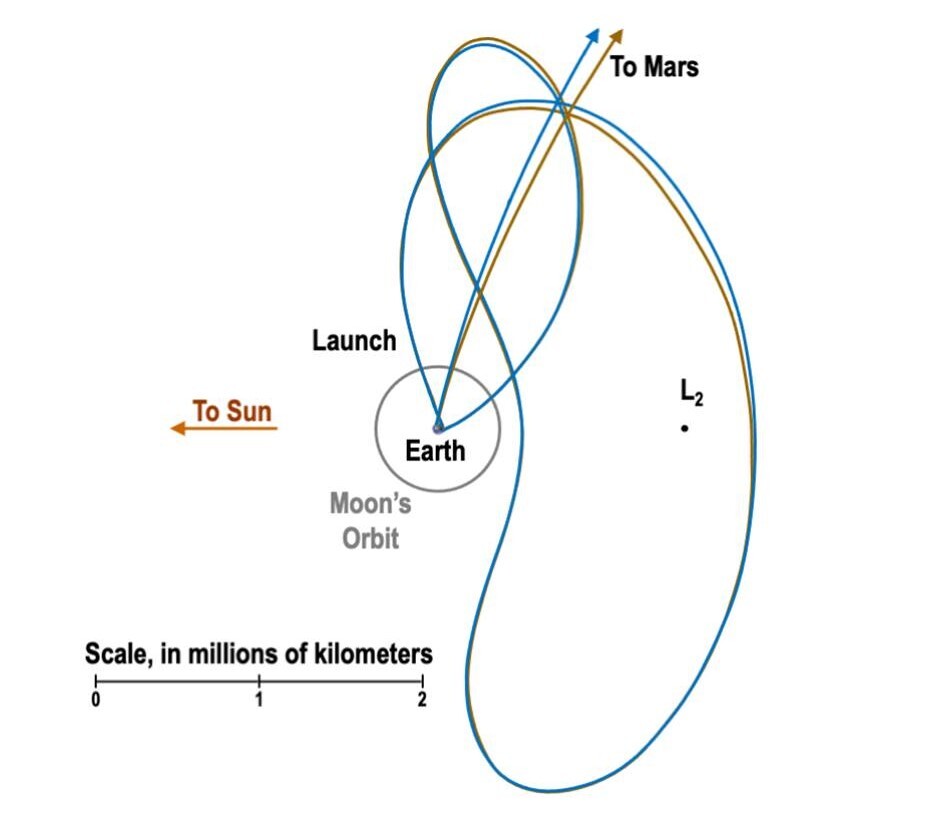
The long and winding road to the Red Planet by the twin ESCAPADE spacecraft. (Image credit: Advanced Space)All eyes on slingshots
“The loiter does add some risk from the critical trans-Mars injection engine maneuver,” Lillis said. The two spacecraft must burn their engines for just the right duration, at the right time, at low Earth altitude on Nov. 7 and 9, 2026 in order to slingshot themselves to Mars.
“If the engines fail to light, we would miss the interplanetary transfer window and have to wait two more years for a chance to get to Mars. However, that is almost a year away and we’ll have lots of opportunities to practice and become comfortable with our propulsion systems,” Lillis said, “so we see this as an acceptable risk.”
For Parker at Advanced Space, that boost in velocity for the ESCAPADE twins to head off to Mars is a critical maneuver. “We will have all eyes on that maneuver to make sure that it is completed successfully,” he said.
Clever engineering
ESCAPADE is a product of NASA’s Small Innovative Missions for Planetary Exploration (SIMPLEx) program, an endeavor geared to showcase low-cost science spacecraft. But to maintain a lower overall cost, SIMPLEx missions have a higher risk posture and lighter requirements for oversight and management, notes the space agency.
Rocket Lab, the private space entrepreneurial firm, designed, built, integrated, and tested the ESCAPE probes at its space systems production complex in Long Beach, California.
Morgan Connaughton, a spokesperson for Rocket Lab explains that the company doesn’t like to focus on what could go wrong. While Blue and Gold have to withstand extreme environments, “we’ve designed them to do just that,” she told Space.com.
In a post-launch blog from Rocket Lab, the company explained that keeping spacecraft in tip-top shape for years takes some clever engineering and notable materials science.
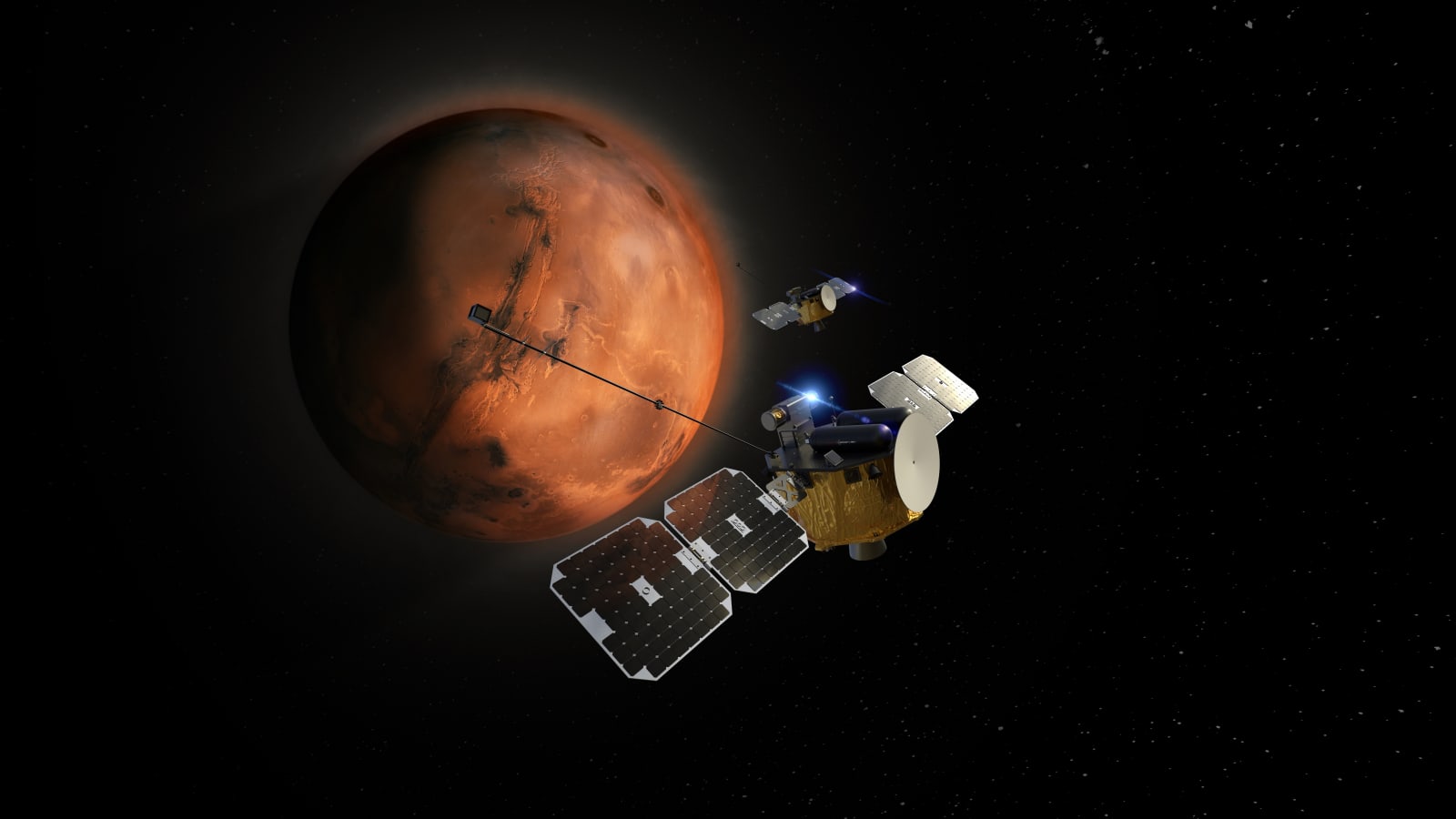
An illustration of NASA’s twin ESCAPADE probes in orbit around Mars. (Image credit: Rocket Lab USA/UC Berkeley)State of electronics
“Just like in any electronic device, chips degrade, sensors drift, radios get noisy. On top of that, cosmic rays and the Sun’s own eruptions can upset electronics. And all parts of the spacecraft are sensitive to high and low temperatures,” the Rocket Lab statement adds. “To prevent our propellant lines from freezing when they spend months facing the darkness of space, there are heaters and insulating blankets.”
All in all, Rocket Lab said they’ve made sure everything on the ESCAPADE twins can work for years on end “by regularly checking the state of electronics, testing our valves to make sure they aren’t stuck, and have redundant components for critical parts such as computers, radios, star trackers, inertial measurement units, etc.”
Template for tomorrow
Meanwhile, Parker at Advanced Space senses that the ESCAPADE voyages to Mars serves as a template for tomorrow.
“The notion of building up a colony on Mars means you are going to have to send lots of spacecraft,” said Parker.
ESCAPADE enables launches to Mars outside the two-week period every two years, Parker advised. It’s a key to sending goods and eventually humans to the Red planet anytime, countering possible logjams due to uncompromising launch windows for direct inject Mars opportunities.
“You could have a sequence of launches,” said Parker, “all flying together in a string of pearls, flying by the Earth in rapid succession and end up flying the same interplanetary window. Folks on the surface of Mars could expect the next fleet of spacecraft showing up every couple of years. And ESCAPADE is demonstrating how to do that,” he concluded.