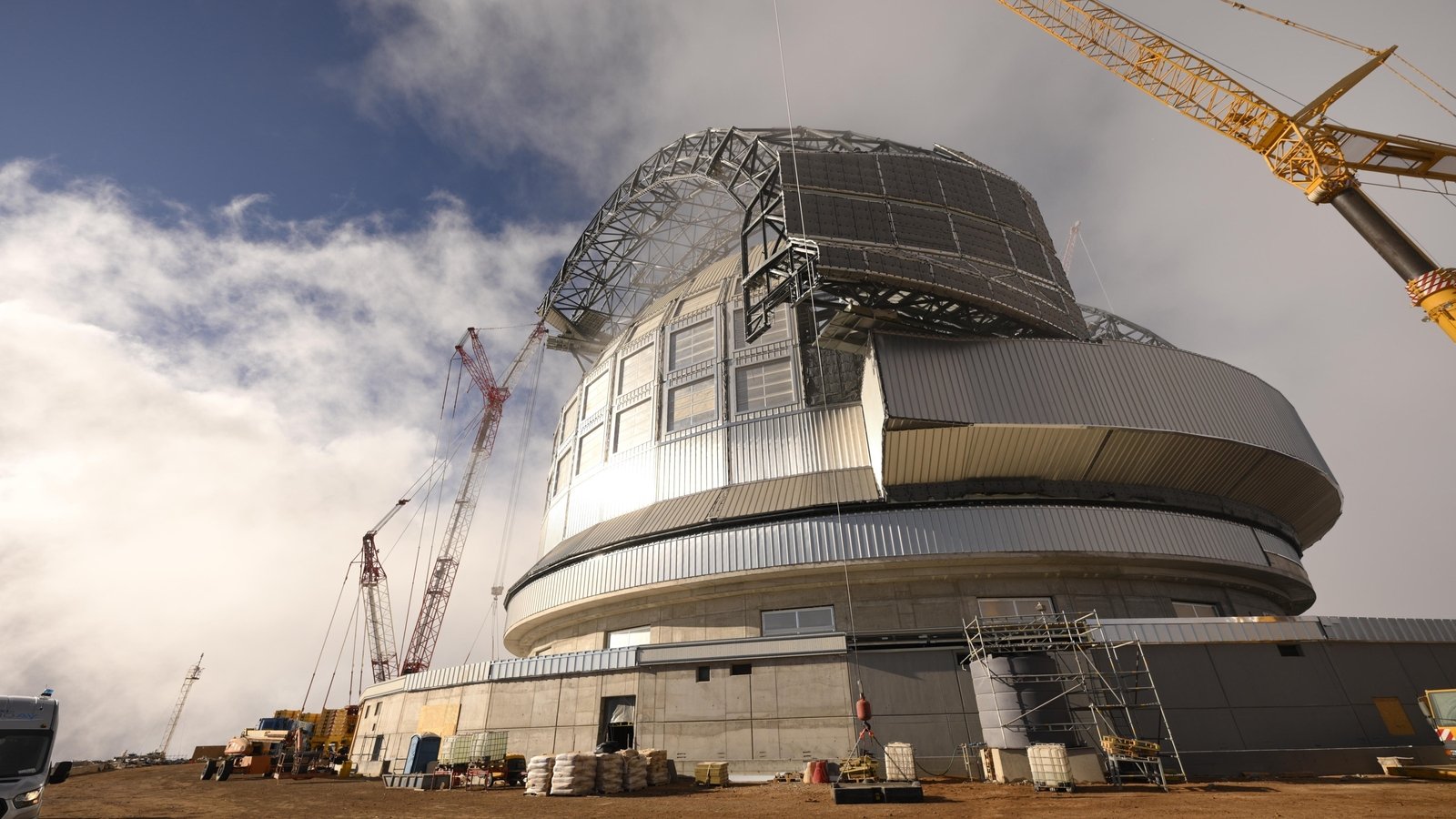
A Dublin man is leading the construction of the world’s largest ever telescope. The Extremely Large Telescope (ELT) is approximately 70% built in the Andes Mountains in Chile.
Professor Tom Ray is president of the European Southern Observatory (ESO), which is building the telescope.
“We’re talking about a mirror, right, that is 40 metres across,” he explained on RTÉ’s This Week.
“The dome is the size of the Colosseum in Rome, but actually taller than the Colosseum, but roughly about the same width.”
The ELT is due to be completed in 2028 and is expected to cost €1.5 billion.
“It is enormous compared to anything, any sort of telescope that’s been built in the past,” he said.
“And with it, it would be possible, for example, to not only image Earth-sized planets around nearby stars, but also to explore their atmosphere.
“We want to see if there’s any signs of life on the planet or whether there’s any oxygen, the things that would give rise to life.”
Ireland has been a member of ESO since 2019, Prof Ray said there is a lot of Irish input into the ELT project.
“The University of Galway, for example, is involved in building what we call an adoptive optics,” he explained this as using lasers to sharpen the images of stars as seen by telescopes.
Ireland becoming more prominent in space exploration
Senior Irish scientists say Ireland is becoming more prominent in space exploration, creating more jobs and opportunities.
In 2025, Ireland successfully completed its first satellite mission in space.
Belfast-born astronaut Dr Rosemary Coogan became a European Space Agency (ESA) astronaut this year, through UK government funding.
Norah Patten is expected to go into space on a commercial flight in 2027.
In March 2025, Ireland joined CERN, the European Organization for Nuclear Research.
And scientists in Galway will be among the first to use the ELT when it goes live.
The scientists are studying a project on exoplanets with Italian scientists, and earlier this year, found the planet WISPIT 2b. It is about 430 light-years away from Earth.
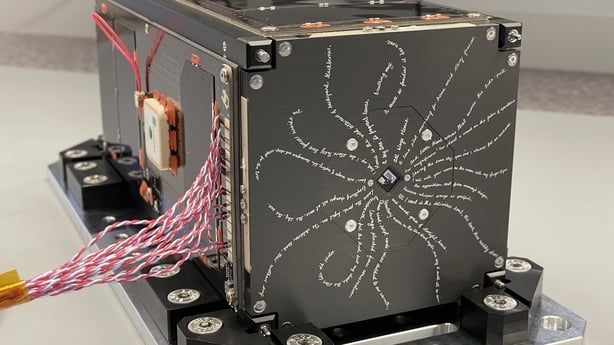
EIRSAT-1 was launched in January 2023 (File image)
EIRSAT-1: Ireland’s first satellite
EIRSAT-1 was launched in January 2023 and burned back into the Earth’s atmosphere after successfully completing its mission in September 2025.
Professor of astronomy, Lorraine Hanlon, director of UCD’s Centre for Space Research, led the EIRSAT-1 mission.
“All of the technology that we created really from our lab to a fully functioning space instrument has been tested,” Prof Hanlon told RTÉ’s This Week.
“Showing that that technology worked, that we were able to put it together and put a full spacecraft together in our labs tells us that we can actually use this technology not only for small satellites, but we can use it as building blocks for much larger instruments that would be even more powerful in the future.”
During the mission, Prof Hanlon’s team in UCD detected 12 gamma-ray bursts as well as several solar flares using the EIRSAT-1.
We need your consent to load this rte-player contentWe use rte-player to manage extra content that can set cookies on your device and collect data about your activity. Please review their details and accept them to load the content.Manage Preferences
Investment in Irish Space
Unlike many ESA member countries, Ireland’s does not have its own space agency; instead, Enterprise Ireland runs the country’s space programme.
Prof Hanon said that Ireland has not necessarily needed a standalone space agency up to now.
“But I think the case is becoming stronger for some kind of coordinating entity that would oversee education, research through to industry and innovation,” she said.
Ireland’s investment in ESA is relatively small compared to other countries; however, it is estimated that the country sees a return of approximately 7:1 on that investment.
For 2025, Ireland’s total contribution to ESA was €26 million. There are at least 116 Irish companies that have a contract with ESA.
Many Irish companies and higher education institutions now have work from membership of organisations such as ESA, ESO and CERN.
Prof Hanlon said joining these organisations is worth the membership fees.
“It means that your scientists are in those collaborations, are defining the experiments that will create the next level of challenge.
“So, your scientists are defining those problems that need to be addressed.”
Munster Technological University has already joined a scientific experiment with CERN.
The ESA is launching the PLATO mission to search for planets around other stars this year, which will include technology from Irish company Réaltra.
Another Irish company, InnaLabs, has its technology on board another ESA mission called HERA, which will arrive at the Didymos asteroid system in late 2026.
In UCD, another satellite mission called GIFTS: A 6U CubeSat for the detection and localisation of gamma-ray bursts is currently underway.
Aerial, a project with funding from both ESA and ESO, also has Irish involvement.
Prof Ray explained: “What Aerial is doing is looking at a few thousand planets and their atmosphere, but from space.
“So, we’re involved with the constructing of several parts of this and testing them, because they have to be tested at very low temperatures, I’m talking minus 230C because that’s what it’s like out in space.”
Prof Ray added that Irish scientists are doing “very innovative work in space”.
“Our students, our postdocs, people who already have a PhD, are receiving wonderful training from work not only to do with the European Space Agency, but the European Southern Observatory.
“I’ve had 30 PhD students and none of them are unemployed. They are immediately snapped up,” he said.