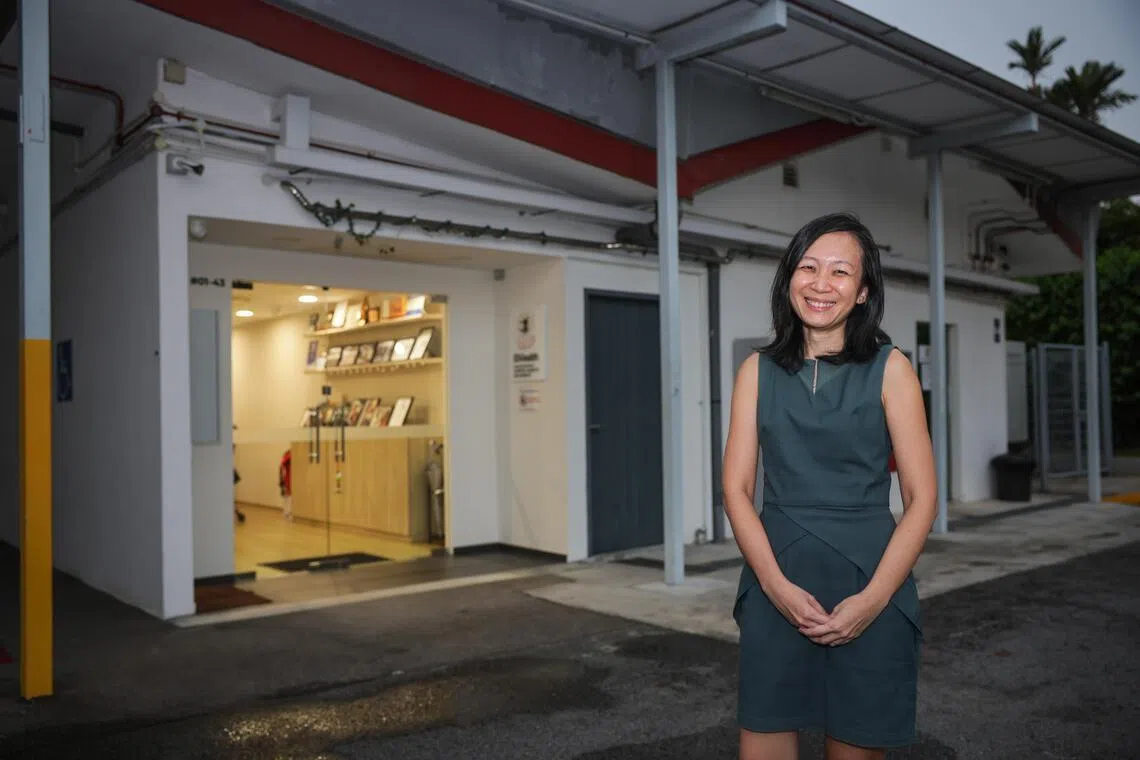
SINGAPORE – In 2014, 40-year-old Jeffrey abruptly broke from his routine.
He refused to leave home for anything, including his job at a sheltered workshop that he had enjoyed for years, or to visit his sister.
Jeffrey, who had Down syndrome, stayed home for weeks, puzzling and worrying his family and caregivers, who could not understand what was wrong.
The team at the sheltered workshop referred him to Dr Chen Shiling, who was then providing home-based medical care for people with intellectual disabilities (IDs) on her own.
Dr Chen visited Jeffrey at home and discovered that multiple factors were contributing to his withdrawal, including worsening osteoarthritis and a lack of confidence.
She worked closely with his family to address each issue in turn.
After a few weeks of treatment and improvements to his arthritis, Jeffrey, for the first time in two months, stepped out of his home, packed his bag and returned to work.
“His family was in tears, and so was I,” said Dr Chen, 44.
Experiences like this convinced her that access to holistic healthcare is crucial to the quality of life of people with IDs – and that more should be done for them.
founded a non-profit, Happee Hearts Movement,
to advocate for good-quality healthcare for adults with IDs, and a clinic, IDHealth, to serve their complex needs. Happee Hearts was registered as a charity in 2022.
The IDHealth clinic, located in Upper Thomson Road, is Singapore’s first community-based, full-service dedicated healthcare service for people with IDs.
Dr Chen is a finalist for The Straits Times Singaporean of the Year award, which is given to a Singaporean or group of citizens who have made a significant contribution to society.
This can be through achievements that put Singapore on the world stage, or by going beyond the call of duty to selflessly improve the lives of others in the community, among other ways.
Now in its 11th year, the Singaporean of the Year award is organised by The Straits Times and presented by UBS Singapore.
ID is a developmental disorder defined by three criteria: Significant limitations in intelligence, significant limitations in daily living skills, and the onset of these limitations before a person turns 18, according to the Institute of Mental Health.
People with an ID also have a higher prevalence of other health conditions, including mobility issues and sensory processing difficulties, Dr Chen said.
Those with IDs – including, but not limited to, people with Down syndrome and some on the autism spectrum – often face cognitive and communication challenges that make it difficult for them to navigate the mainstream healthcare system.
“What this means is that they can present with agitation and aggression when actually they are in pain,” Dr Chen said.
IDHealth’s service model was developed based on these issues, so the interdisciplinary team is made up of doctors, nurses, social workers and allied health professionals, Dr Chen said. Most clinics have only doctors and nurses.
The clinic also enrols caregivers as patients if they have health issues, to support them better, as there is an extremely close relationship between people with IDs and their caregivers.
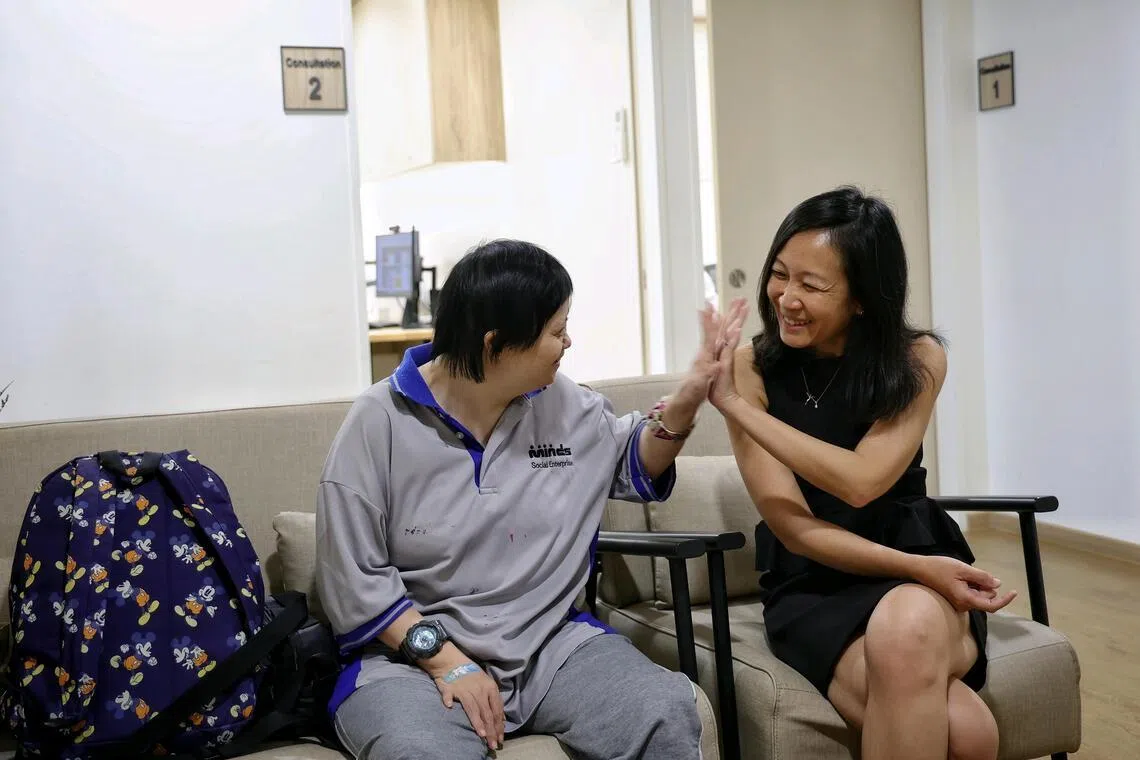
Dr Chen Shiling, who set up a clinic and charity for people with intellectual disabilities, with her patient Gladys at IDHealth, an initiative by Happee Hearts Movement, on Dec 23.
ST PHOTO: KEVIN LIM
The global incidence of IDs is often cited at around 1 per cent of the population, but this figure does not capture the broader impact of inadequate healthcare on family members and caregivers.
“Our goal is to help the families to thrive,” said Dr Chen, who is married to fellow doctor Liam Pee. The couple have a nine-year-old son.
IDHealth has served about 500 people with IDs and more than 1,000 of their caregivers since it was set up.
It receives government grants and public donations, and offers highly subsidised fees comparable to those in public hospitals, said Dr Chen. Patients pay $50 for a first assessment and $20 to $30 for reviews. Other interventions such as medical social work come at no cost to the patient.
The clinic’s scope is expanding – in 2024, IDHealth started seeing residents with IDs living in adult disability homes.
In 2026, it plans to launch three new services in palliative care, dementia care and preventive health, and will be working with clinical and academic institutions to do so.
It also aims to develop an ID practitioner course, starting with attachments for medical students, and work with more polyclinics and general practitioners.
The upcoming expansion of IDHealth’s services is a culmination of years of work by Dr Chen, who began volunteering with people with IDs as a teenager at MINDS, a social service agency.
She was 17 then, and continued to volunteer while attending medical school at the National University of Singapore.
In 2013, she gave up a promising career as a medical specialist, leaving a training programme to become a nephrologist – a kidney doctor – to find a better way to serve people with IDs.
But her early attempts to persuade government agencies, philanthropic groups and other organisations to start what she had envisioned for people with IDs went nowhere.
She eventually managed to run a small pilot with support from the Tsao Foundation and funding from the Agency for Integrated Care’s Tote Board Community Health Fund. She then decided to build the service from the ground up so that it would be more sustainable.
This effort would eventually become Happee Hearts and IDHealth.
A decade on, those early convictions continue to shape her work.
In 2025, Dr Chen sought and attained approval from the board of Happee Hearts to designate July 30 – the day that Jeffrey finally stepped out of his home – as the date of the charity’s founding.
Jeffrey died in 2024, but IDHealth continues to support his family.
Said Dr Chen: “My hope is for people with intellectual disability and their families to be able to live with dignity, and getting the healthcare that they need and deserve is a huge part of that dignity.”
The Straits Times Singaporean of the Year award is given to a Singaporean or group of citizens who have made a significant contribution to society. This can be through achievements that put Singapore on the world stage, or by going beyond the call of duty to selflessly improve the lives of others in the community, among other ways.
The award seeks to honour a Singaporean or Singapore organisation that has made a positive impact beyond our borders, contributing to Singapore’s global reputation.
The person or organisation must have delivered a project, initiative or body of work that benefited a community or country outside of Singapore.
The award seeks to recognise a Singaporean who is under 18 years old and has shown courage, compassion, empathy, kindness and/or a spirit of service, and has made a positive impact among peers.

The awards are organised by The Straits Times and presented by UBS Singapore. The official airline partner is Singapore Airlines, and the global hotel partner is Millennium Hotels and Resorts.
-
$20,000 in cash for award recipient
-
One pair of Singapore Airlines business class tickets for each individual/group; up to three pairs of tickets for the winning group
-
A five-night stay in any of Millennium Hotels and Resorts’ properties globally, up to a maximum of three sets of accommodation for the winning group
-
$5,000 in cash for each individual/group finalist
-
One pair of Singapore Airlines economy class tickets for each individual/group; up to a maximum of three pairs for each group of finalists
-
A three-night stay in one of Millennium Hotels and Resorts’ properties globally, up to a maximum of three sets of accommodation for each finalist.
-
$20,000 cash for award recipient
-
$5,000 in cash for award recipient
-
A pair of SIA economy class tickets
-
A three-night stay in one of Millennium Hotels and Resorts’ properties globally