
Charles Buhler, who co-founded Exodus Propulsion Technologies, shared details of the project in an interview with The Debrief, stating that the system achieves center-of-mass movement without expelling mass. Though Buhler once worked at NASA, where he helped launch the Electrostatics and Surface Physics Laboratory at Kennedy Space Center, he emphasized that this project is not affiliated with the agency. His announcement has surfaced at a time when the scientific world continues to view propellant-less propulsion systems with deep skepticism, especially following the downfall of earlier controversial concepts.
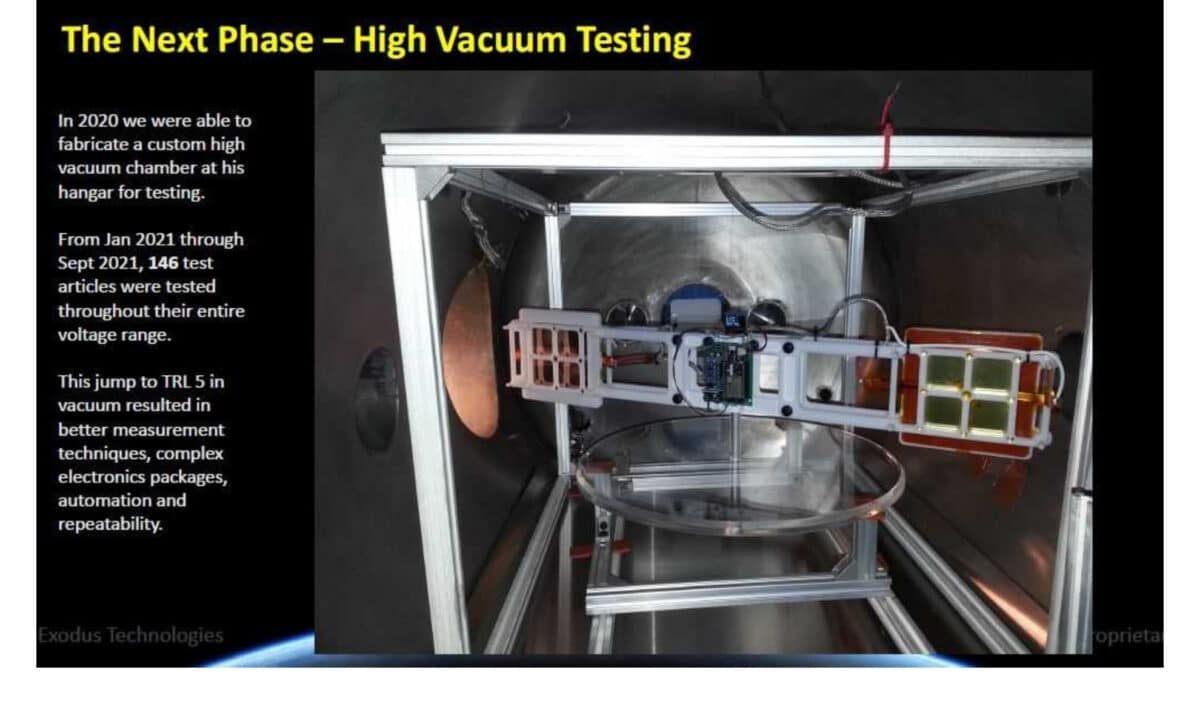 This slide from Dr. Buhler’s APEC presentation shows the custom-made vacuum chamber built to test their propellantless Propulsion drive in a simulated space environment – © Exodus Propulsion Technologies, Buhler, et al
The idea behind such systems is not entirely new. What makes this recent attempt notable is the involvement of a veteran engineer and a team made up of members from NASA, Blue Origin, and the U.S. Air Force, individuals who have been exploring this line of research for decades. Despite their backgrounds, experts stress that any extraordinary claims must be subjected to rigorous third-party verification before being accepted.
Roots In A Long-disputed Propulsion Theory
In 2001, British engineer Roger Shawyer introduced a system known as the EmDrive, nicknamed the “impossible drive”, that claimed to generate thrust without releasing mass. The concept sparked widespread interest because it appeared to bypass the principle of momentum conservation, a fundamental tenet of physics.
Initial excitement surged when NASA’s Eagleworks team reported detecting measurable thrust from the EmDrive in 2016. But according to Popular Mechanics, follow-up studies, including a detailed investigation by Dresden University of Technology, detected no thrust at all. By 2021, the EmDrive was widely considered discredited.
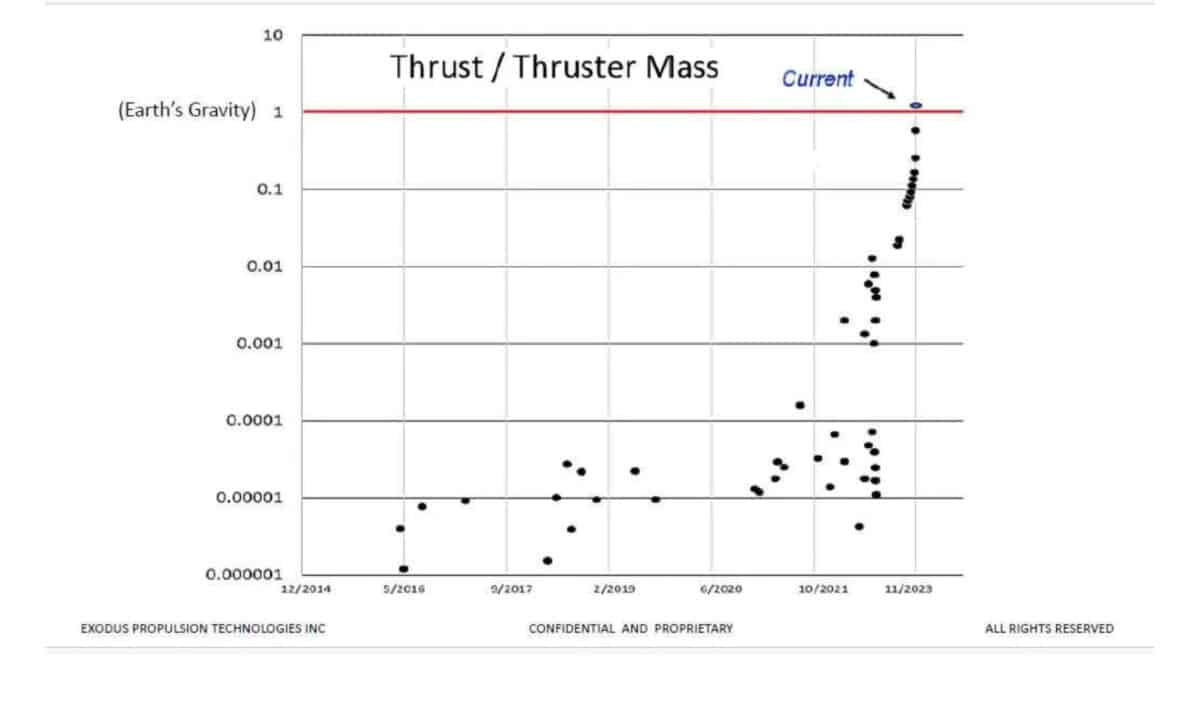 A slide from Dr. Buhler’s APEC presentation highlights just a few of the hundreds of tests his team ran on their propellantless propulsion drive between 2016 and 2023 – © Exodus Propulsion Technologies, Buhler, et al
Despite that, efforts to achieve a functioning propellant-less engine never fully disappeared. Buhler’s team now enters the field with a design that shifts focus from microwaves to electrostatics, presenting their work not as a refinement of the EmDrive, but as a fundamentally different approach altogether.
Thrust Through Electrostatic Asymmetry
Buhler told The Debrief that their breakthrough occurred after years of testing devices that initially produced negligible results. The turning point came in 2023, when the team saw measurable thrust generated through a configuration exploiting electrostatic properties.
“Essentially, what we’ve discovered is that systems that contain an asymmetry in either electrostatic pressure or some kind of electrostatic divergent field can give a system of a center of mass a non-zero force component,” Buhler explained. He referred to this phenomenon as a “New Force,” suggesting that electric fields alone, under the right conditions, can create sustainable motion.
In the same interview, he stressed that this new mechanism enables an object to move by altering its center of mass without ejecting material. The principle, if verified, would represent a major shift in current physics and open new avenues for spaceflight propulsion.
Unverified And Controversial Claims
Buhler’s findings were recently presented at the Alternative Propulsion Energy Conference (APEC), a platform known for hosting engineers and enthusiasts searching for ways to bypass traditional propulsion limitations. While the conference draws attendees with serious technical backgrounds, it has also been criticized for entertaining speculative and sometimes scientifically unsound theories.
In a recorded discussion with APEC co-founder Tim Ventura, Buhler expanded on how his expertise in electrostatics contributed to the team’s research. He noted that while many devices over the years failed to yield practical results, improvements in configuration and understanding led to the 2023 breakthrough.
Buhler’s assertion that this “New Force” can produce enough thrust to overcome gravity puts it squarely in the realm of “woah, if true.” But given the precedent set by the EmDrive and similar ventures, the need for rigorous, independent testing remains paramount. No matter the credentials behind the team, the scientific method demands reproducibility, especially when claims challenge established physical laws.
For now, the project is being referred to as an “improbable engine,” a nod to the uncertain space it occupies between groundbreaking innovation and likely impossibility.