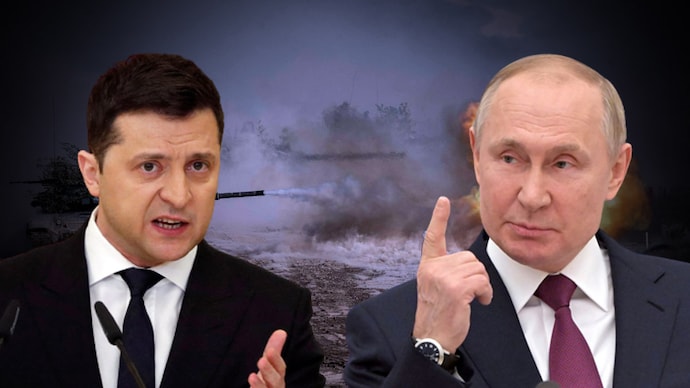
The Russia–Ukraine war entered its fourth year in 2025 and showed no sign of ending, News.Az reports.
What began in February 2022 as a full-scale invasion evolved through 2025 into an entrenched, high-intensity conflict defined by attritional land battles, heavy artillery exchanges, widespread drone warfare, and repeated missile strikes on major cities and infrastructure. Diplomacy continued throughout the year, but efforts did not result in a lasting ceasefire or political settlement. Instead, both Russia and Ukraine appeared determined to press ahead militarily while also manoeuvring diplomatically and economically.
By early 2025, the front line stretched across hundreds of kilometres in eastern and southern Ukraine. Russia controlled significant portions of the Donetsk, Luhansk, Zaporizhzhia, and Kherson regions, while Ukraine defended remaining territories and sought to prevent further incursions. The year was marked by Russia’s gradual but measurable territorial advances, particularly in eastern Ukraine. Analysts assessed that Russia captured more territory in 2025 than in the previous two years combined, though none of these advances altered the overall balance of the war in a decisive way.
Russian military efforts focused on achieving dominance through sustained pressure rather than a rapid breakthrough. The fighting in Donetsk region, especially around Pokrovsk and surrounding towns, demonstrated this approach. Urban combat, artillery bombardments, and trench warfare continued to resemble World War Two-style battles in intensity and destruction, even though modern tools such as drones and precision-guided munitions played a major role. Ukrainian forces were often forced to withdraw from exposed positions when supply routes became difficult to maintain or when Russian firepower overwhelmed defensive lines.
In the northeast, Russia expanded operations near Kharkiv and Sumy, repeatedly referring to the concept of establishing a “buffer zone” inside Ukraine. Russian military officials claimed that such a zone was necessary to reduce Ukrainian drone and missile attacks on Russian territory. Ukraine rejected this justification, calling it a clear attempt to occupy more land. Regardless of the terminology, the front line north of Kharkiv and near the Sumy border regions became one of the year’s most active combat zones.
Ukraine continued to defend key strategic locations while seeking to conserve manpower and equipment. The Ukrainian military faced challenges related to ammunition resupply, troop rotations, and the complexity of sustaining a war effort deep into its fourth year. Limited counterattacks were launched in certain sectors, but Ukraine did not replicate the large-scale offensives previously conducted in 2023. Instead, Ukrainian strategy increasingly relied on long-range precision and drone strikes, both on the battlefield and inside Russia.
Drone warfare became one of the most defining aspects of the conflict in 2025. Both sides deployed large numbers of unmanned aerial vehicles for reconnaissance, targeting, and attack missions. Drones were used to strike military positions, logistics lines, oil facilities, energy plants, barracks, and air defence systems. Electronic warfare systems also played an increasingly prominent role, with both armies attempting to jam or disable each other’s drones.
Ukraine carried out regular drone and missile strikes deep into Russian territory throughout the year. Cities including Moscow, St Petersburg, Belgorod, Kursk, and Bryansk reported repeated drone attacks. Oil refineries and fuel depots were among the most frequently hit targets. At various points in the year, Russian authorities temporarily halted air traffic at major airports due to security risks. Ukraine argued that these strikes were legitimate defensive measures aimed at weakening Russia’s war machine and reducing its ability to sustain military operations inside Ukraine.
Russia, meanwhile, maintained a persistent campaign of strikes against Ukraine’s energy grid, industrial facilities, transport hubs, and urban infrastructure. The winter months saw intense waves of missile and drone attacks that caused widespread power outages and damage to heating systems in multiple cities. Ukrainian officials warned that the cumulative impact of these attacks was severe, both in humanitarian and economic terms. Cities such as Kyiv, Kharkiv, Dnipro, Odesa, and Lviv were repeatedly targeted during the year. Some of the deadliest incidents resulted in dozens of civilian casualties and widespread destruction of residential buildings.
One of the most widely reported events occurred in Ternopil, where a missile strike killed and injured large numbers of civilians. Similar tragedies took place in other cities throughout the year, prompting renewed international criticism of Russia’s targeting decisions. Moscow maintained that it aimed at military or infrastructure objectives, while Kyiv argued that Russian strategy deliberately targeted civilians and civilian-dependent infrastructure.
The humanitarian situation inside Ukraine remained extremely difficult throughout 2025. Millions of people continued to live away from their homes, either displaced within Ukraine or having fled abroad. Many of those who remained near front-line areas were exposed to regular shelling, service disruptions, and economic hardship. Damage to housing stock persisted and, in some regions, became almost total. Schools, hospitals, shops, and administrative facilities were also hit during the conflict, affecting everyday life.
Humanitarian organisations reported serious ongoing needs in areas such as healthcare access, mental health support, food supplies, electricity and heating stability, and shelter repair. The psychological burden of living through nearly four continuous years of war was evident. Families were fractured by displacement, enlistment, injury, and loss of life. Children and elderly people were particularly affected by instability and lack of consistent services. The Ukrainian government, local agencies, and international donors continued to deliver assistance where possible, but logistics remained difficult in contested regions.
Economically, Ukraine faced another year of deep wartime strain. The national budget was heavily dependent on foreign aid to ensure salaries, pensions, and public services could continue. Industrial production remained limited in some regions due to destruction, occupation, and labour disruptions. Agricultural output, a key sector for Ukraine, was affected by damaged farmland, mines, and repeated strikes on transport routes.
The Black Sea also remained an area of strategic concern during 2025. Russian strikes on Ukrainian ports, grain silos, and shipping routes raised global alarm over food security. Ukraine is one of the world’s largest grain exporters, and disruptions to exports have global consequences, especially for developing countries that rely on affordable food imports. When Ukrainian grain shipments were disrupted by Russian military attacks or blockades, the shock was felt in global commodity markets.
Russia’s economy continued to operate in wartime mode as well. Defence spending increased further, and arms manufacturing became a major industrial priority. Russia relied heavily on revenues from energy exports and on alternative trade channels with non-Western countries. Labour shortages, sanctions restrictions, and international isolation remained challenges for Moscow, but the Russian leadership appeared willing to absorb these costs in order to continue the war. The Russian state also continued to mobilise and rotate personnel into the armed forces, despite social and economic pressures.
Diplomatic engagement took place throughout 2025 but did not produce a framework for ending the conflict. Ukraine repeatedly called for sustained Western support and long-term security guarantees. Ukrainian officials argued that only permanent, enforceable international backing could prevent future aggression. Discussions were held regarding potential security agreements, assistance packages, and post-war reconstruction commitments. Western governments maintained sanctions against Russia, though some internal political debates emerged over cost, duration, and strategic objectives.
Russia, for its part, showed no willingness to withdraw from occupied territories or recognise Ukrainian sovereignty over those regions. The Kremlin insisted that Ukraine and NATO posed direct security threats to Russia, despite repeated Western denials of this narrative. Russian leadership argued that the war would continue until Moscow’s objectives — which included control over occupied territories and guarantees on Ukraine’s international posture — were met.
Several international actors attempted mediation or de-escalation efforts during the year. Proposals emerged regarding temporary ceasefires, prisoner exchanges, humanitarian corridors, and frameworks for negotiations. However, deep mistrust and incompatible political demands prevented meaningful progress. Neither Russia nor Ukraine appeared prepared to make significant concessions. Each side believed that compromise, at least at current battlefield conditions, would weaken its long-term strategic position.
The information environment surrounding the war remained highly contested. Both countries used state-aligned and independent media to shape domestic and international perceptions. Ukraine highlighted Russian strikes on civilians and infrastructure, presenting itself as a democratic state defending its territory and sovereignty. Russia emphasised its battlefield gains and claimed to be defending against Western encroachment. The volume of propaganda, misinformation, and unverifiable battlefield claims increased as both sides sought psychological advantage.
Casualties increased steadily through 2025. Although precise figures were difficult to independently verify, analysts agreed that tens of thousands of soldiers on both sides were killed or wounded during the year, adding to already high cumulative military losses since 2022. Civilian casualties also remained significant, particularly during missile and drone strikes on urban areas. Both militaries lost large quantities of equipment, including armoured vehicles, artillery systems, aircraft, and drones. Despite these losses, neither side showed signs of running out of critical resources, partly due to external support and expanded wartime production.
Toward the end of the year, attention turned to what 2026 might bring. Many observers predicted a continuation of the same broad dynamics: slow but steady Russian pressure on the ground, continued Ukrainian strikes inside Russia, persistent missile attacks on infrastructure, and further reliance on drones and electronic warfare. The possibility of a negotiated settlement remained uncertain. Some analysts believed the war could continue in its current form for several more years if neither side achieved a decisive breakthrough and international support remained relatively stable.
The war’s consequences extended beyond the battlefield. European security policy was reshaped by the conflict, with NATO increasing defence spending and reinforcing eastern-flank deployments. Global energy markets adjusted to sanctions and supply disruptions. International law, norms on sovereignty, and the post-Cold War security architecture continued to be tested by the conflict and by the responses of major powers.
Within Ukraine, national resilience remained high. The government emphasised that the war was existential and that surrender or partition would endanger the country’s future independence. Civil society organisations, volunteers, and local communities played a substantial role in supporting the population and the military. At the same time, fatigue and frustration were evident, as society carried the burden of prolonged conflict and uncertainty about the future.
Russia also navigated domestic pressure, although public dissent was limited. State authorities maintained strict controls on political expression and information. The Kremlin projected confidence that time was on Russia’s side, believing Western unity would eventually erode and Ukraine’s capacity to resist would weaken. The Russian leadership framed the war as part of a broader struggle against Western dominance, appealing to nationalist sentiment.
In summary, the Russia–Ukraine war in 2025 was a year of continued devastation, strategic stalemate, and incremental territorial change rather than sweeping military breakthroughs. Russia maintained the initiative in ground operations, while Ukraine leaned heavily on long-range strikes and international support to offset manpower and resource disadvantages. Diplomacy continued but did not resolve core disagreements. Civilians bore immense hardship, infrastructure damage increased, and the conflict remained one of the most consequential geopolitical crises of the 21st century.
As 2025 drew to a close, the war was firmly entrenched, with no clear path to peace. Ukraine showed no intention of yielding sovereignty or accepting Russian territorial claims, while Russia remained committed to its strategic objectives. The result was a prolonged confrontation with far-reaching humanitarian, economic, and geopolitical implications — a war that continued to reshape Europe and influence global affairs, with uncertain prospects for resolution in the year ahead.