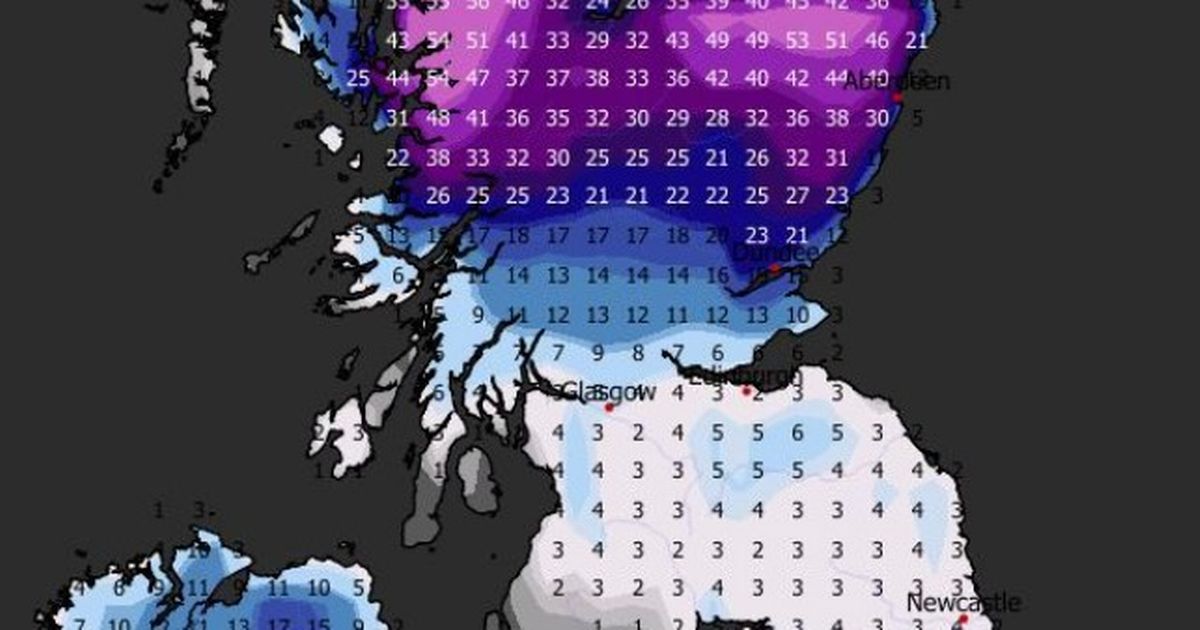
Locals are also being urged to exercise caution due to the increased danger of slipping on icy surfaces and icy patches on some untreated roads, pavements, and cycle paths.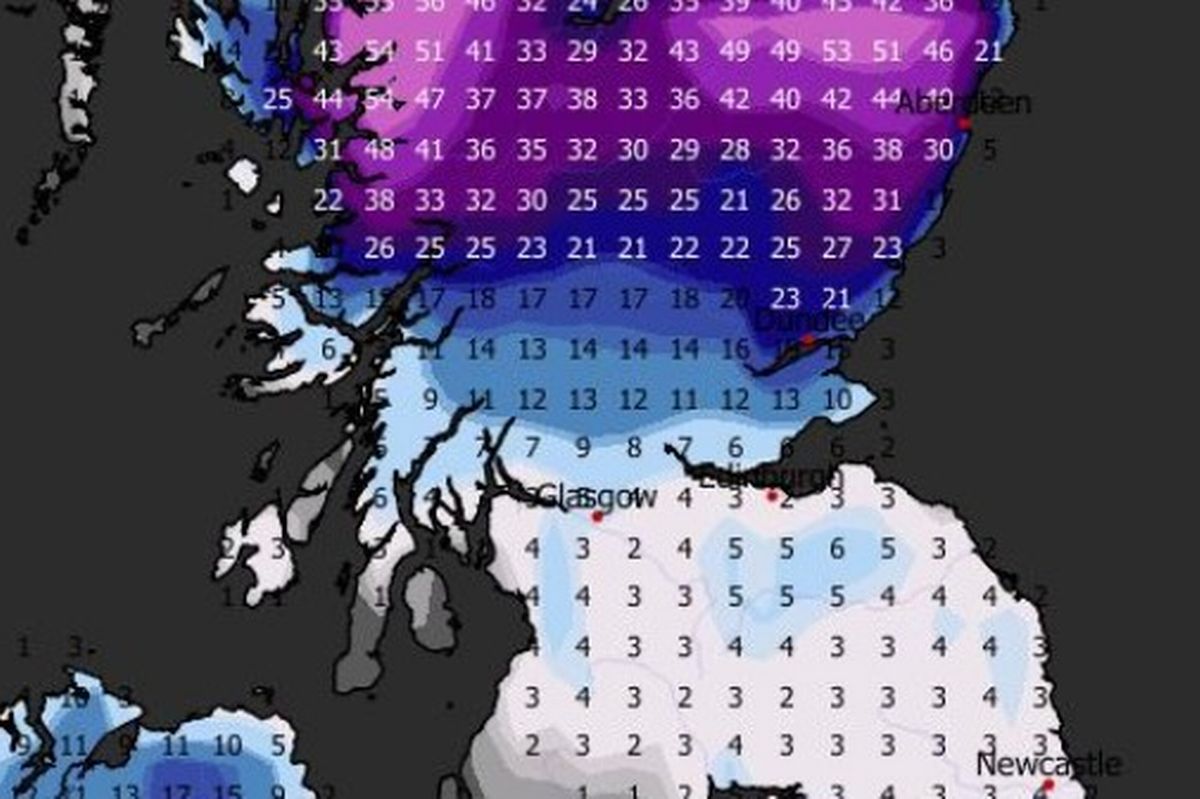 WX charts show the depth of snow in Scotland
Glaswegians are being warned of possible disruption on Tuesday amid a snow and ice alert from the Met Office. A yellow weather warning is in place for January 6 as a weather front is set to bring icy conditions to the city’s streets.
Meteorologists say that some roads and railways are likely to be affected with longer journey times. Locals are also being urged to exercise caution due to the increased danger of slipping on icy surfaces and icy patches on some untreated roads, pavements, and cycle paths.
The warning is in effect from midnight on January 5 until 11:00am on Tuesday.
It comes as the Met Office has said that much of northern Scotland, including Loch Lomond, could see ‘frequent and heavy snow’, which could cause travel disruption.
Amber weather warnings are also in place for snow in parts of Scotland. Schools in Shetland, Orkney, the Western Isles and Aberdeenshire will be shut on Monday, while a number of flights have been cancelled and some train lines are also affected.
The amber warning expires at 10am on Monday and covers Aberdeen, Aviemore in the Cairngorms, and Ullapool, Ross-shire. The warnings cover much of the Highlands and Aberdeenshire areas, Orkney, Shetland, and Outer Hebridean Islands, from Sunday evening until 10am on Monday – with the potential for another 5-10cm of snow accumulating at low levels, with the potential for 20-30cm on high ground.
 A yellow warning has been issued.(Image: Getty Images)
Separate yellow warnings for snow and ice cover much of the UK, including Northern Ireland, Wales, much of Scotland, south-west England, north-west England, the Midlands, east England and the north-east of England, stretching up to the Scottish Borders.
Amber weather warnings are issued when there is an increased likelihood of impacts from severe weather, including the possibility of travel delays, road and rail closures, power cuts and the potential risk to life and property.
Yellow warnings are issued for a range of weather situations, including when it is likely that the weather will cause some low level impacts, including some disruption to travel in a few places, or when the weather could bring much more severe impacts to the majority of people but the certainty of those impacts occurring is much lower, according to the Met Office.