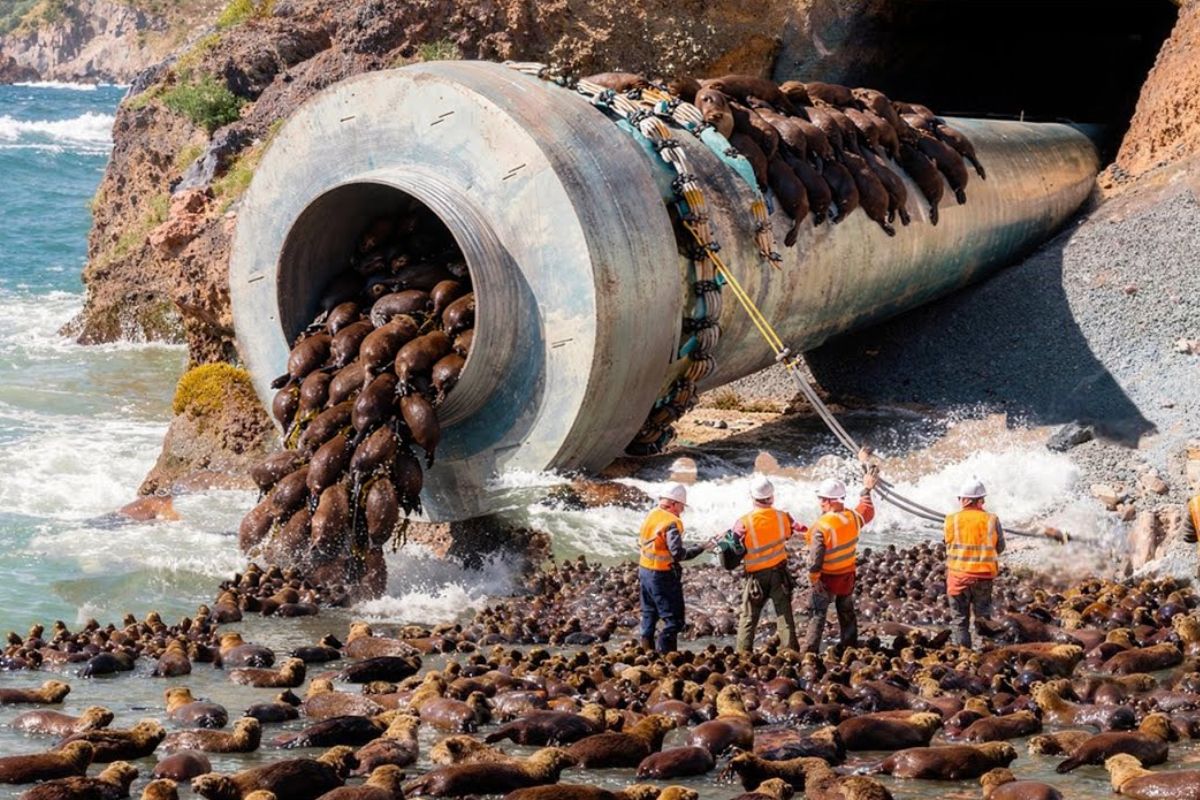
Sea otters are being reintroduced to Monterey Bay on California’s central coast after the starfish decline syndrome in 2013 paved the way for sea urchins to devastate kelp forests. Between 2014 and 2020, the area shrank by 51%, and in some sections, 95% disappeared. The plan is controversial and considered a last resort.
As Sea otters They are being returned to the ocean in Monterey Bay, California, after… between 2014 and 2020 the area of giant kelp forests decreased on average 51% and in parts of the northern coast of the state, more than 95% These forests have disappeared.
The crisis gained momentum after 2013when starfish wasting syndrome spread and wiped out millions of starfish, including the sunflower starfish, which kept sea urchins in check. With the imbalance, The hedgehogs exploded, and California was forced to gamble on the return of… Sea otters, in a decision that is dividing opinions.
Monterey Bay and the kelp forests that support the coast.
Monterey Bay is located off the central coast of California, where cold waters and nutrient-rich currents create one of the most productive marine ecosystems in the United States.
— ARTICLE CONTINUES BELOW —
Are you in favor of US military intervention in Venezuela and the arrest of Nicolas Maduro?
— Click Oil and Gas (@clickpetroleoeg) January 3, 2026
In this scenario, kelp forests function as “green cathedrals” From the Pacific: formed by the world’s largest brown algae, they can reach up to 60 meters and create a three-dimensional habitat that shelters hundreds of species.
In addition to providing habitat, these forests help weaken waves and currents, reducing erosion and protecting the coastline.
They also filter seawater and play a significant role in the carbon cycle, capturing CO2 at rates that can surpass many terrestrial forest ecosystems.
The collapse in just a few years and the warning from the numbers.
In recent years, what was considered a resilient system has been collapsing at an accelerated pace.
According to the National Oceanic and Hydrographic Administration and the National Atmospheric Administration cited in the material, between 2014 and 2020 The area of giant kelp forests in Monterey Bay has decreased by an average of 51%.
In many regions along the northern coast of California, more than 95% The kelp forests have completely disappeared, leaving behind rocky and exposed seabeds.
What’s striking is not just the scale, but the speed., described as a rupture that occurred within a few years.
The starfish disease and the domino effect that paved the way for sea urchins.
The text points to a central trigger: in 2013A disease known as starfish wasting syndrome spread along the Pacific coast of North America, causing mass deaths in a short period.
Scientists at the Monterey Bay Aquarium report that millions of starfish have disappeared, including the sunflower starfish, a keystone species in the ecosystem.
Before the outbreak, these starfish acted as ecological guardians, keeping sea urchin populations in check.
When that crucial link disappeared, the system that had seemed stable for decades lost its brakes.…and sea urchins went from being common herbivores to a destructive force on the ocean floor.
Hedgehogs explode and turn the forest into a barren “baron”.
With insufficient natural predators, the sea urchins multiplied unchecked. In parts of Monterey Bay, the density is estimated to have exceeded… 100 individuals per 10 square feetreaching levels up to 60 times above natural levels in some areas.
With jaws and feeding behavior focused on the base of the algae, sea urchins gnawed through the anchoring structures that hold the algae to the rocks, felling entire forests and creating barren areas where young algae can no longer establish themselves.
It was this explosion of sea urchins that pushed California towards the return of sea otters.
Human actions and the “century of errors” that weakened the system.
The organization asserts that the devastation is not solely a result of the disease.
It would have been exacerbated by accumulated errors over the centuries: large-scale fishing would have reduced species that feed on sea urchins, such as rockfish and cod, while… Sea otters They were hunted almost to extinction for their fur.
With these layers of natural control dismantled, the ecosystem would have persisted for decades in a “false equilibrium”.
When the starfish disease struck, the shock exposed the fragility and accelerated the collapse of the kelp forests.
Why sea otters are included as a self-regulating “mechanism”
In coastal ecosystems, the Sea otters They are described as the most effective natural predators of sea urchins.
They dive, drag their prey from the bottom, float on their backs, and use stones as tools to break shells, an unusual behavior among marine animals.
The database highlights one piece of appetite data: Each otter can consume up to 25% of its own body weight per day..
Where sea urchins are abundant, sea otters concentrate on them as a primary food source, and cited research indicates that, in these areas, The biomass of sea urchins drops drastically., creating space for young algae to attach themselves and rebuild the forest.
Limits of the “last resort”: where sea otters can’t solve problems on their own.
Despite its effectiveness, the material highlights that the return of Sea otters It doesn’t solve everything. In areas where kelp forests have completely disappeared, the seabed has become bare rock, and sea urchins survive in a state of starvation.
In this scenario, sea otters hunt fewer sea urchins because the energy required to capture them exceeds the nutritional value they offer.
The conclusion presented is straightforward: Sea otters are a necessary but not sufficient condition.They protect remaining forests and help maintain the system in balance, but they cannot, on their own, regenerate ecosystems that have already been destroyed.
Human intervention: manual removal of sea urchins from the seabed.
Faced with this limit, the base reports that divers and volunteers began to intervene directly in barren rocky areas, removing sea urchins manually or with tools.
The work is done on a case-by-case basis, requires care because of the thorns, and needs to be repeated to reduce the density to acceptable levels.
According to the text, effectiveness lies more in precision than in speed.
Where removal is consistent, sea urchin numbers drop within a few months and signs of algae recovery appear, creating conditions for nature and the algae to thrive. Sea otters support the remainder of the process.
Relevant side effect: Sea otters and the European green crab.
The material also mentions a possible additional benefit of the return of Sea ottersThey can help control the European green crab, described as an aggressive invasive species that is believed to have arrived via ballast water and spread through estuaries and coastal marshes.
Since sea otters frequently forage in estuaries and brackish waters, precisely where these crabs are concentrated, they would act as a biological barrier, reducing pressure on oyster beds, seagrass meadows, and juvenile organisms.
The “surrogate mother” program and the survival rate after release.
To reintroduce sea otters, the text states that simply releasing them is not enough. Orphaned pups raised by humans tend to lose critical instincts and do not survive in the wild.
Therefore, the Monterey Bay Aquarium developed a surrogate mother initiative: orphaned pups are paired with an adult female that cannot be released due to health limitations.
These mothers would teach essential skills such as hygiene, temperature regulation, swimming, diving, and the use of stones as tools.
Are you in favor of reintroducing sea otters as a last resort, even with the controversy, or do you think direct human intervention should be the main focus of coastal recovery?