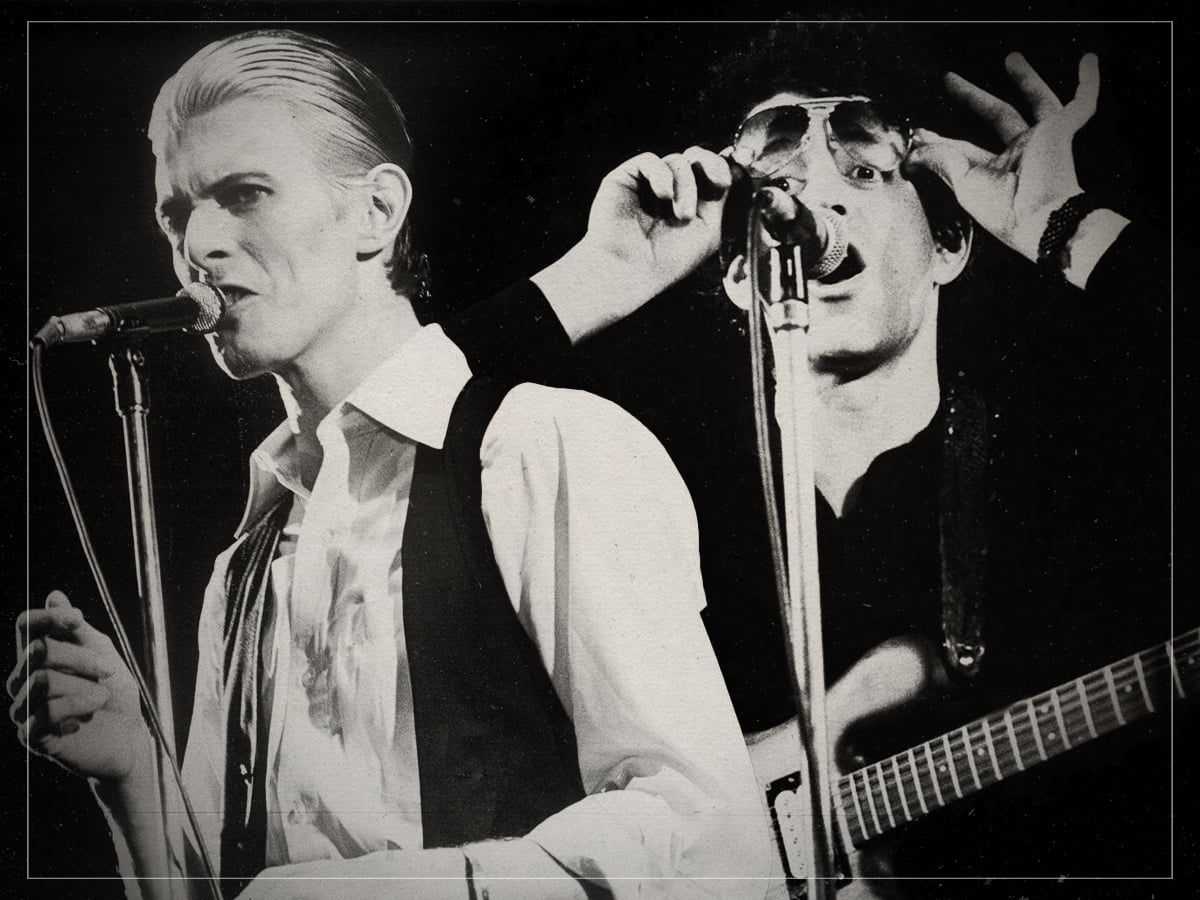
(Credits: Far Out / Alamy)
Mon 5 January 2026 16:00, UK
“Dylan had certainly brought a new kind of intelligence to pop songwriting,” David Bowie once proclaimed, “but then Lou [Reed] had taken it even further into the avant-garde.”
Bowie would soon look to join him in that rarified realm. Both men were inspired by the cutting wit of William S Burroughs – a rare wit that seemed to strip society naked, and had no bones about parading it starkers through the streets. They wrote with the point of a needle, and showed that realism was actually far more colourful when you refused to airbrush it.
Although Bowie might be noted as being more surreal, it was always Lou Reed’s alluring mix of paradoxically grounded avant-gardism that inspired him. He even embarked on a pilgrimage of sorts to find his hero in New York City before he had even made any major waves himself.
“My manager brought back an album, it was just a plastic demo of [The Velvet Underground’s] very first album in 1965-ish, something like that,” Bowie recalled in an interview with PBS. “He was particularly pleased because [Andy] Warhol had signed the sticker in the middle, I still have it by the way. He said, ‘I don’t know why he’s doing music, this music is as bad as his painting,’ and I thought, ‘I’m gonna like this.’ I’d never heard anything quite like it, it was a revelation to me.”
Further down the line, Bowie might have hailed “The Velvets” as being more influential than The Beatles, but back in ‘65, he was pretty much the only one noticing that. One of the most important albums ever peaked at number 171. Little wonder he would also go on to say, “Tomorrow belongs to those who can hear it coming.”
 David Bowie with Lou Reed’s mutual pal, Iggy Pop, in Berlin (Credits: Far Out / Alamy)
In the 1960s, that wasn’t just coming from Reed and his avant-garde gang, though. The cryptic band ? and The Mysterians were making a racket that both Bowie and The Velvet Underground found impossible to ignore. Hailing from Bay City, Michigan, this strange little garage band were pairing the thunderous spirit of their hero, James Brown, with the counterculture’s most swirling sounds.
The result is a song, purposefully swirls like a vindictive drunken walk home, that was well ahead of its time in ‘66, and showcased definite shades that The Velvets would soon share. Like Reed’s band, it wouldn’t be much of a big hit, but that only added to its appeal. Defying the mainstream, this strange staccato beat pushed pulsing pop into an alternative realm.
As Bowie put it when he spun his 50 favourite songs on the BBC, “‘96 Tears’ by ? and the Mysterians, which nobody has in their record collections… good old Beeb.” He added, “That’s an extraordinary piece of music. I was incredibly impressed by this one when I first heard it.”
Beyond the strange compositional mix, where the sound is dominated by a singular eclectic-sounding organ pushing the rest of the band humbly into the background to create an eerie depth, there’s also the flaunting of the typical macho frontman mode as Rudy Martinez sings, “I’ll just cry,” with more than a hint of being self-aware about feeling sorry for himself.
In some ways, it borrows a similar motif to ‘Just Like a Woman’ by Bob Dylan – another of Reed and Bowie’s shared heroes. But it’s even more mystic than that. And that led both the Starman and the ‘Perfect Day’ singer to place it among their favourite songs of all time. In fact, although several of the same artists pop up in both lists, this is the only song they mutually hailed as a masterpiece.
Finding the intersection of catchy pop and the cutting edge of counterculture spirit, it’s easy to see why. Over half a century later, the funny old Farfisa organ-led ditty still exudes an influence over pop culture. And while it might have fleeting clinched a spot at the top of the charts as a quirky oddity, it was Reed and Bowie who heard the tomorrow that it would help to shape.
Related Topics