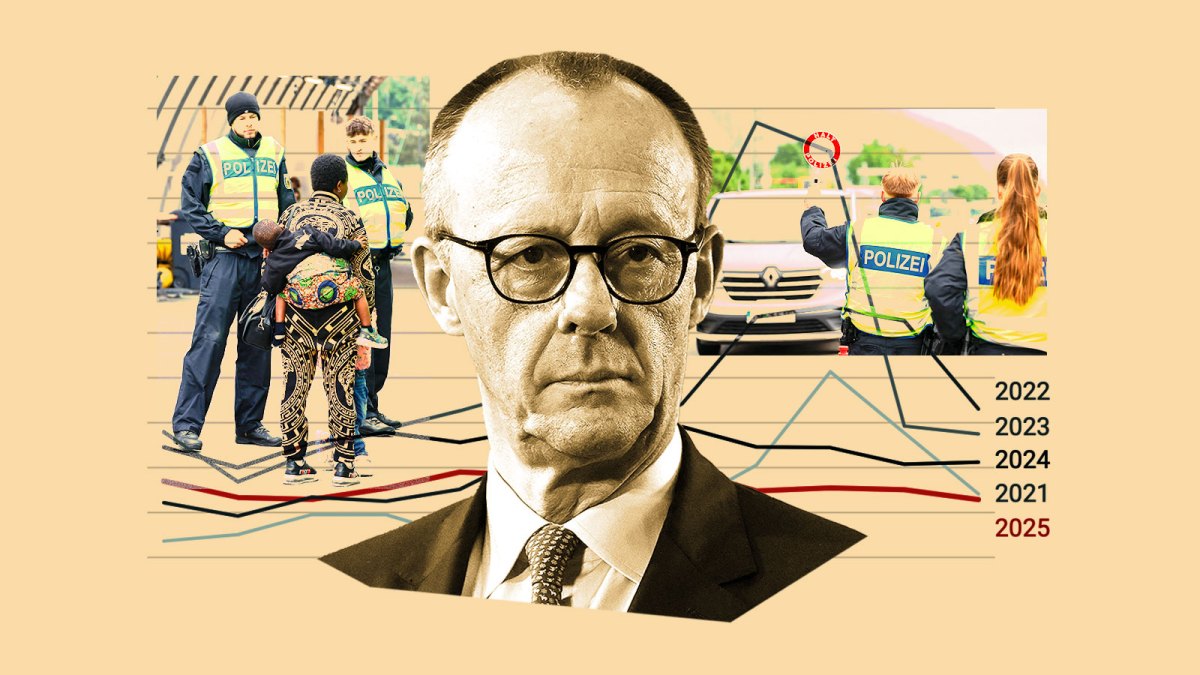
When Germany announced with great fanfare a plan to control all 2,300 miles of its land borders in the autumn of 2024, many thought it would be impossible to implement.
For hundreds of miles, the country’s borders meander through forests, mountains and meadows. Many smaller crossings are deserted. The plans were roundly condemned by neighbouring Poland and prompted dark warnings about the implosion of the Schengen free-travel zone and the corrosion of the European project itself.
Friedrich Merz further tightened border controls when he came to power last May, although the measures remained patchily implemented.
As the new year dawns, however, Germany’s beleaguered conservative chancellor may draw some consolation from new data showing that irregular immigration has dropped to its lowest level in more than a decade, barring the first year of the pandemic.
From January to November last year, the national migration agency, known as the Bamf, recorded 106,298 first-time asylum applications, putting the country on course for its smallest annual total since 2013. The number for 2024 was 229,751.
The federal police, responsible for border controls, registered 62,526 illegal entries, half as many as in 2023. Nearly three quarters of the 33,000 people who tried to cross the frontier between May and December were either turned away or, in 58 cases, physically taken back to the other side.
However, it is impossible to say how much of this decline, which began to set in two years ago, is the government’s doing. The numbers of migrants entering the European Union via Belarus, the Balkans and the eastern Mediterranean have also fallen sharply over the same period for a whole array of reasons, ranging from profound geopolitical shifts in the Middle East to Poland’s hardline policing measures on its eastern border.

A Nigerian woman and her two children at the border control station near Kiefersfelden on the border with Austria
MICHAELA STACHE/AFP VIA GETTY IMAGES
At the same time, a mild but protracted recession has made the German economy less attractive compared with some of its neighbours.
“This kind of political rhetoric or game where they say ‘OK, we’ve got refugee and migration flows under control and our restrictions are responsible’ is really very dubious,” Marcus Engler, a social scientist at the German Centre for Integration and Migration Research in Berlin, said.
What is incontestably true is that Merz has attacked the issue with gusto, accelerating the restrictive turn taken by his centre-left predecessor, Olaf Scholz. The government has declared migration a “national emergency” and ordered police to turn back virtually all undocumented migrants at the border. It has temporarily suspended family reunification, with the result that the foreign ministry issued only two such visas for relatives of asylum seekers in the past five months. It has also abandoned voluntary humanitarian refugee intake schemes. Cash benefits for asylum seekers have largely been replaced with pre-paid debit cards that can only be used in physical shops.
Now the Bavarian Christian Social Union, which controls the national interior ministry, is calling for most of Germany’s 950,000 remaining Syrians to be sent back, and for regular deportation flights to Taliban-governed Afghanistan. The ministry has also drawn up a bill that would prevent unaccompanied asylum seekers from setting foot outside migration centres set up to facilitate their return to other EU countries.

Critics say that Friedrich Merz’s relentless focus on migration has boosted rather than quelled support for the hard-right AfD
KIRILL KUDRYAVTSEV / AFP VIA GETTY IMAGES
This campaign has already led to a few skirmishes with the judiciary. Last summer the administrative court in Berlin ruled that three men from Somalia had been turned back illegally at the border with Poland because there was no justification for the “state of emergency” underpinning the order and it therefore violated EU law. Some legal experts argue that pushbacks at the land frontier may also contravene the European Convention on Human Rights, although these claims have yet to escalate to the convention’s court in Strasbourg.
• How other countries are tackling migrants — even the liberal ones
Engler said it was conceivable that all these steps, combined with Merz’s ominous rhetoric about migrants changing Germany’s “urban landscape” and queue-jumping at dental surgeries, might have added up to a kind of hostile environment with a certain deterrent effect. Yet he said the government had “absolutely no evidence at all” to demonstrate that its border regime was working. “Look at the borders: there are hundreds of kilometres of forests and mountains and meadows. These controls will be easy to circumvent for people who really want to,” Engler said.
“Perhaps the costs for the smugglers will rise a bit and perhaps they’ll have to adapt their strategies. But to put it clearly, there is no serious study that shows these border controls result in people [who are fleeing persecution] no longer coming to Germany.”
It is understood that the Home Office in London and the federal interior ministry in Berlin have each embedded a liaison officer with the other, largely to co-ordinate their joint operations against people-smugglers.
However, migration experts and officials on both sides are sceptical that the UK, as an island nation outside the EU, could draw many meaningful lessons from Germany’s example.
• What Europe really thinks of Britain’s approach to migrants
Nor is it clear that Merz and his coalition have benefited from their hyperactive toughness. The hard-right Alternative for Germany party (AfD), which has made immigration the central element of its platform for a decade, has only risen in popularity as the asylum numbers have fallen, and continues to lead some national polls.
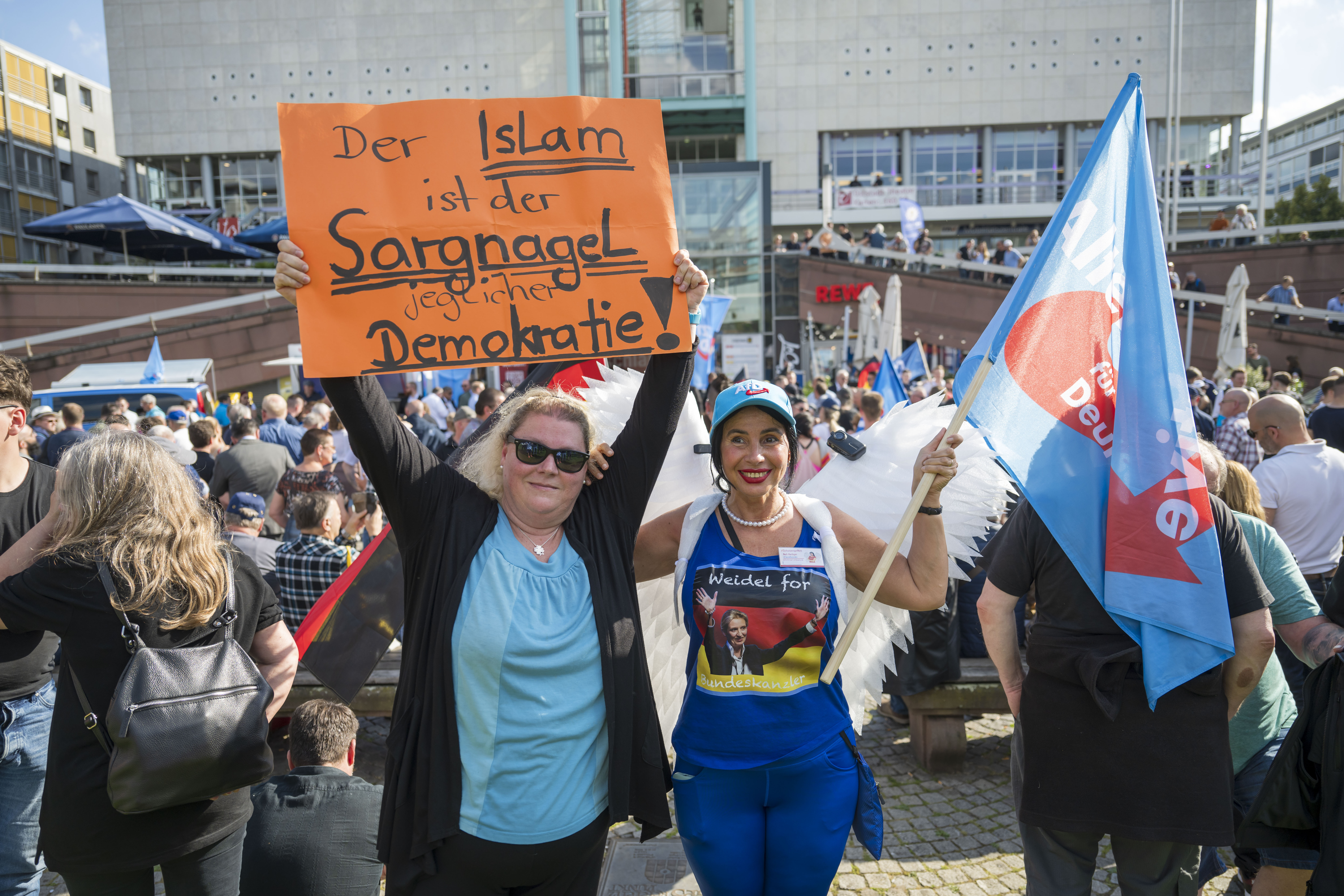
AfD supporters protest after a German police officer was killed by an Afghan migrant
THOMAS LOHNES/GETTY IMAGES
One former German official said that migration-sceptic voters seemed to be increasingly indifferent to the actual statistics and that Merz’s relentless focus on the topic was only driving more of them into the arms of the AfD.
At the same time, several sectors of the flagging German economy, such as healthcare, social care and construction, are concerned that shortages of migrant workers may exacerbate the strain on an already tight labour market.
A clear majority of the Syrians who came to the country during the 2015 migration crisis are now employed and three quarters of these workers hold skilled jobs, primarily in transport, manufacturing, hospitality and medical care. Some economists estimate that Germany needs to take in a total of roughly 1.5 million migrants a year — or a net figure of 400,000 once emigration has been factored in — to sustain its workforce at the present level.
“You need a great deal more pragmatism,” Engler said. “It’s totally frivolous to talk about deporting all these Syrians and Afghans when a great many of these people are absolutely indispensable for the German labour market.”