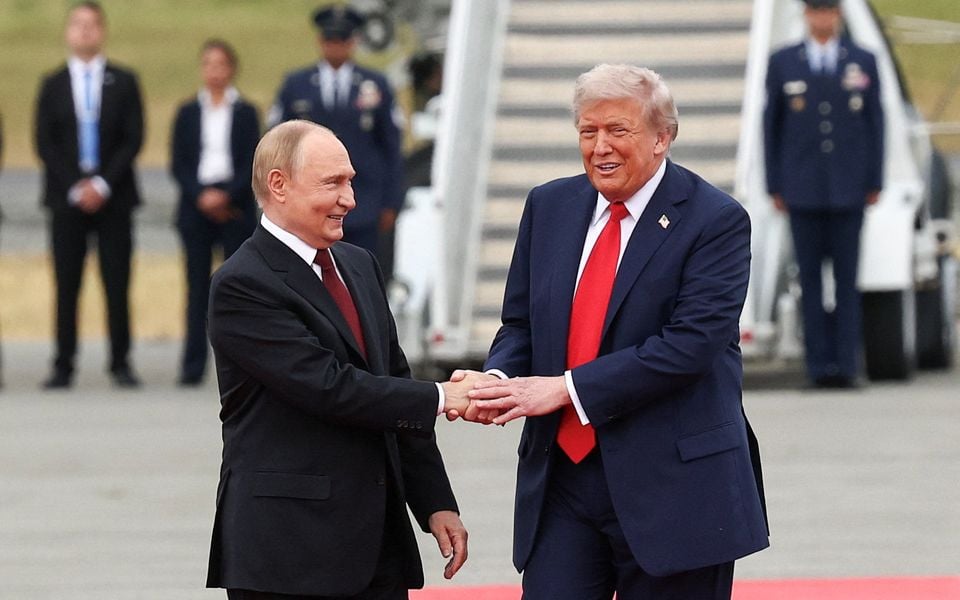
US President Donald Trump (r) shakes hands with Russian counterpart Vladimir Putin ahead of a meeting on the war in Ukraine, in Anchorage, Alaska, on August 15. [KEVIN LAMARQUE/REUTERS]
If Europe was in any doubt about the scale of the challenges facing the continent, the last days of 2025 ought to have settled the matter. It was bad enough that Russia’s barbarous assault on Ukraine, along with its intensifying hybrid war against Europe, continued unabated despite President Donald Trump’s attempt to mediate a peace process. Worse is that Europe has found itself under attack from America too.
Trump’s decision to appoint a special envoy to Greenland has reignited fears that America may seek to annex, perhaps even by force, the territory from Denmark – a NATO ally and EU member-state. Likewise, the administration’s decision to sanction five European nationals, including a former EU commissioner, involved in efforts to counter disinformation and hate speech spread via social media networks, confirmed what was already clear from the administration’s new National Security Strategy: A deep ideological rift is opening up between the US and Europe.
In a similar vein, the US trade representative has threatened to ban a number of high-profile European companies from doing business in America in retaliation for alleged discrimination against US technology companies under the EU’s Digital Services Act. That amounted to a virtual declaration of trade war, just months after Commission President Ursula von der Leyen’s surrender to Trump on trade in Scotland in July.
The inescapable reality is that Europe finds itself under a twin-pronged assault from both Russia and America. Indeed, the two are increasingly ideologically aligned, as the Russian media has been gleefully pointing out. The good news is that against this worrying backdrop, the EU did manage at its summit in December to take a few steps to strengthen its own geopolitical toolkit in ways that may prove valuable in the year ahead.
The EU’s most important achievement was to agree to provide Ukraine with a €90 billion loan. That will keep Kyiv afloat and enable it to defend itself against Russian aggression for another two years. Failure to deliver this would have increased the risk of a forced Ukrainian surrender, raising the specter of a failed state on the EU’s border.
The inescapable reality is that Europe finds itself under a twin-pronged assault from both Russia and America
Equally important was the way this funding was secured. The EU failed to back the Commission’s proposal for a reparations loan secured by Russia’s frozen central bank assets. But it did invoke emergency powers to ensure that those assets will remain frozen indefinitely. They can now only be unfrozen by a qualified majority vote of member-states, rather than remaining vulnerable to a single-country veto. That not only gives the EU valuable leverage in any peace process, but the shift to majority voting on a question of foreign policy also sets an important precedent that can help the EU become a more effective geopolitical actor.
The same is true of the decision to fund the loan to Kyiv from the issue of EU bonds. The use of common bonds helps further break the taboo against common borrowing for common challenges, essential if the EU is to make the investments necessary to enhance its strategic autonomy. It also increases the supply of a European safe asset that should enhance the global role of the euro.
Crucially, this agreement on the use of common debt was reached via a mechanism known as “enhanced cooperation.” This again circumvented the threat of a veto by Hungary, Slovakia and the Czech Republic by excluding those Kremlin-friendly countries from the costs of the loan. This too sets an important precedent for how the EU can shore up its economic and geopolitical position, since this will depend increasingly on its ability to forge coalitions of the willing, both at home and abroad. Europe’s success in 2026 will depend on how effectively it responds to four priorities.
The first must be for the EU to quickly conclude its trade deal with South America’s Mercusor bloc, whose ratification had to be postponed in December amid opposition from France and Italy. This is a key test of Europe’s geopolitical seriousness and its ability to forge alliances with like-minded countries, particularly in the Global South, to preserve as much as possible of the rules-based trading system and maintain access to resources and critical minerals.
The second is to continue to strengthen Europe’s defenses. That must include reducing its reliance on US military guarantees. This too will require forging coalitions of the willing, in this case to include non-EU members such as Britain and Norway. It will also surely need to include further common funding for the common capabilities such as satellite systems that no single member-state can afford to deliver on its own.
The third priority must be to strengthen the European economy by implementing the recommendations of the Draghi and Letta reports. Inevitably, this too will run into opposition from some member-states, not least those whose governments include far-right parties opposed to European integration. In those cases, enhanced cooperation offers a way forward.
The fourth priority must be to strengthen European democracy in the face of what is certain to be growing attempts to undermine it through disinformation campaigns and an explicit threat by the Trump administration to interfere in European domestic politics to support far-right parties.
Simon Nixon is an independent journalist and commentator on British, European and international political economy and geoeconomics.