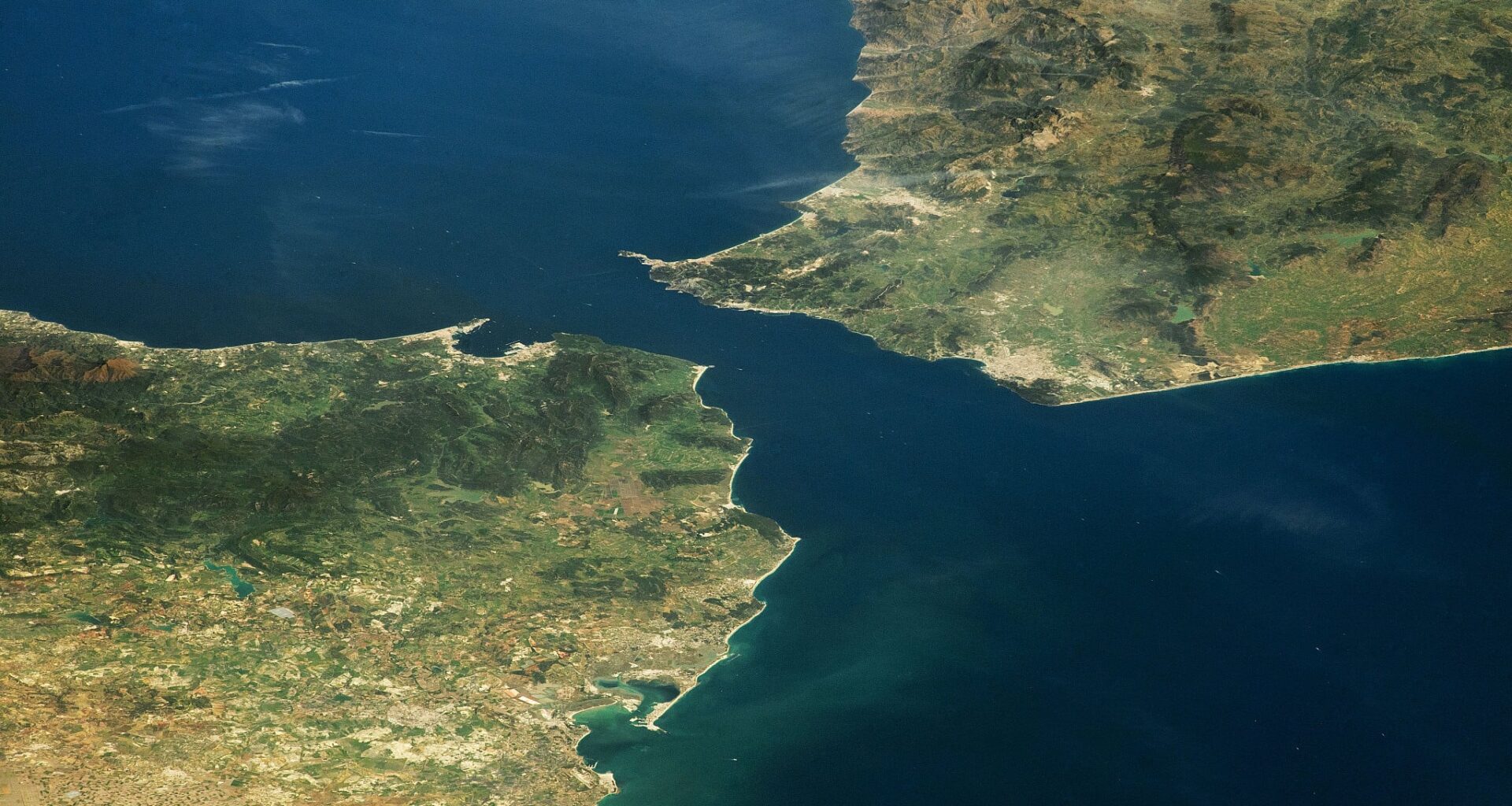
The Strait of Gibraltar has historically been the Western world’s iron gate, a fourteen-kilometer choke point where the rules of the international order were enforced by the sheer weight of NATO’s southern flank. For decades, the assumption was that this gate was manned by Madrid. That assumption died this winter. While the Spanish government has spent the last year expending its diplomatic capital on performative anti-Israel posturing, the waters off its southern coast have quietly transformed into a permissive superhighway for the Russian war machine.
The warning signs have been blinking red for months, but the events of this past New Year’s weekend confirmed the collapse of deterrence. Between December 30 and January 1, a “swarm” of Russian vessels surged through the Strait in a travel pattern that experts have described as highly unusual. This was not innocent commerce. Among the convoy was the MV Lady Mariia, an arms carrier sanctioned by the US Office of Foreign Assets Control, and the MV Pluton, a tanker blacklisted for funding the Kremlin’s war in Ukraine. These vessels, integral to Moscow’s shadow economy and logistics network, navigated the most strategic waterway in Europe with impunity.
This surge is not merely a failure of policing; it is a symptom of a NATO ally that has lost its strategic compass. Under Prime Minister Pedro Sánchez, Madrid has effectively abdicated its role as the guardian of the Strait. Naval historians and local observers have noted a disturbing trend: Spain is “silently yielding control” of the Strait’s southern bank, content to monitor only the northern shore and the Atlantic exit. This retreat has created a maritime void in the southern sector, a lawless corridor where the Russian shadow fleet now operates free from the prying eyes of European inspectors.
The reasons for this abdication are as political as they are operational. The Sánchez government has prioritized ideological crusades over hard security, focusing its foreign policy energy on delegitimizing Israel’s war against Hamas rather than securing its own backyard. It is a bitter irony that while Madrid was busy canceling ammunition contracts with Jerusalem and calling for sports boycotts against the Jewish state, it was allowing sanctioned Russian arms carriers to transit its sovereign waters unmolested. The obsession with the Levant has blinded Spain to the fire rising at its own doorstep.
Nature, however, abhors a vacuum. As Spain retreats into internal political squabbles and “personnel shortages” that keep its frigates docked, the Kingdom of Morocco is stepping up to fill the void. For the United States, the strategic picture is clearing rapidly: the only reliable partner capable of securing the southern bank of the Strait is no longer a European democracy, but an African monarchy.
This shift was made visible not in diplomatic cables, but in steel. Just weeks before the Russian swarm, the USS Paul Ignatius did not conduct its high-intensity warfighting drills with the Spanish Navy. Instead, it sailed south for the “Atlas Handshake” exercises with the Royal Moroccan Navy. The sight of an American Arleigh Burke-class destroyer conducting live-fire and anti-submarine warfare drills alongside the Moroccan frigate Tarik Ben Ziyad sent a message louder than any press release. Washington is beginning to realize that if it wants to lock down the Atlantic approaches, it must pivot to Rabat.
The operational logic is undeniable. While Spain’s access to the Rota naval base is often entangled in coalition politics and restrictive caveats, Morocco offers a partnership unencumbered by anti-American baggage. The Royal Moroccan Navy has aggressively modernized, turning its Ksar Sghir naval base—strategically carved into the coast of the Strait itself—into the region’s premier security hub. Unlike the reactive posture of the Spanish Civil Guard, focused largely on migration, Moroccan forces are acquiring the capabilities to project power and enforce order against state-level threats.
This realignment is becoming existential. The recent sinking of the Ursa Major—a Russian vessel carrying sensitive technology that went down under suspicious circumstances—proved that the Strait is now a theater of hybrid warfare and nuclear proliferation.The “Ghost Fleet” is not just carrying oil; it is carrying the components for tomorrow’s wars. With the revived project for an underwater rail tunnel between the two continents gathering steam, the physical security of this passage will soon be the single most critical infrastructure vulnerability in the region. A tunnel connecting a porous European border to a secure African one flips the traditional security script entirely.
The United States cannot afford to hold onto a nostalgic view of the Mediterranean security architecture. The “Pillars of Hercules” are only being held up by one pillar right now. Spain’s “silent yielding” of the Strait is a strategic liability that NATO can no longer ignore. If Madrid is unwilling to police the waters that connect the free world, Washington must empower the partner that is. The swarm of Russian ships passing Europa Point was a test. Spain failed it. It is time to recognize that the true sentinels of the Strait are now watching from the southern shore.