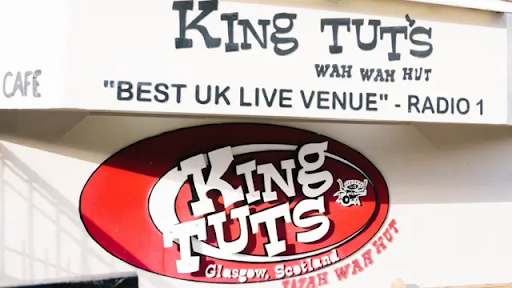
King Tut’s Wah Wah Hut isn’t just a venue, it’s a part of Glasgow’s musical identity.
For 35 years, King Tut’s Wah Wah Hut has built an undying legacy as a pillar of live music, hosting everyone from Britpop legends of the 1990s to international superstars of the 2020s. The venue continues to be a rite of passage for emerging talent with an unbeatable atmosphere and historic reputation. Three decades on, King Tut’s still stands as a symbol of Scottish music’s past, present, and future.
1990s
The Manic Street Preachers lead singer was not the only member of Britpop royalty to grace King Tut’s stage. A year before the Manics’ 1991 performance, Blur played to a mere 40 people with no singles to their name. A year later, after the release of ‘There’s No Other Way’, which reached the UK Top 10, people had to be turned away at the door. In 2023, Blur sold out two shows at Wembley Stadium, and to think one of the first successes in the band’s great escape to fame was a sell-out show at a tiny venue on St Vincent Street. However, their soon-to-be rivals made an even more significant journey to the Wah Wah Hut in 1993 — the northern hardmen from Manchester: Oasis. Blagging their way onto the bill, the Gallagher brothers brought it on down, playing four songs, drawing in music industry executive Alan McGee. McGee, who was there by chance, offered Oasis a record contract that night. The band walked into King Tut’s as complete unknowns and left ready to conquer the world. Other notable British legends like Pulp, Radiohead, and The Verve have also rocked the venue in their early days. And while King Tutankhamun’s tomb in Egypt is famed for its groundbreaking discoveries, Glasgow’s ‘King Tut’ has arguably unearthed more British greats than any other Scottish venue.
2000s
The flow of legendary performances continued into the 21st century, with 2000s icons such as Florence & The Machine, Coldplay, and Arctic Monkeys all treating Glaswegians to nights to remember. However, it was homegrown talent that truly defined the decade, as Scottish acts like Paolo Nutini and Biffy Clyro rose to stardom following their success at King Tut’s. Both artists made their debuts at the venue as teenagers, unaware of the long careers that lay ahead of them. Despite their later arena-filling fame, both Biffy Clyro and Nutini have returned to King Tut’s, out of affection for the place. Bands never forget their roots — and for many, those are King Tut’s. As David Bowie once said, a Glasgow crowd is “exceptionally exciting,” cheering for anyone who pours their heart and soul into a performance. Regardless of what’s played or who’s performing, a band that can electrify the crowd at King Tut’s can go anywhere.
2010s-today
Following another decade of performances from the likes of The 1975, The Killers, and George Ezra, King Tut’s continues to be a launchpad for acclaimed artists such as Glasgow’s own Lewis Capaldi. Having set an attendance record at the OVO Hydro earlier this year, playing to thousands, it’s remarkable to think that, in 2017, the biggest crowd Capaldi had ever played for was the few hundred who attended his King Tut’s show. As stated above, “everything’s a bonus” after King Tut’s. The venue remains a rite of passage for emerging talent because if you can make it there, you can make it anywhere. With audiences flocking to discover the next Oasis, the next Paolo Nutini, or the next Lewis Capaldi, one thing is certain: the King Tut’s crowd will always give a warm welcome to those who give it their all.
King Tut’s Wah Wah Hut isn’t just a venue, it’s a part of Glasgow’s musical identity. Without this unassuming little basement on St Vincent Street, Scottish music simply wouldn’t be the same. Throughout the decades, King Tut’s has helped launch the careers of so many celebrated acts, from Oasis to Lewis Capaldi, enriching Scotland’s music landscape with every show. Now 35 years old, the venue should continue to be celebrated as a symbol of Scottish music’s past, present, and future. Someone you loved is bound to have played at King Tut’s, and as long as its doors stay open, it will continue to offer some of the best live performances in the world, turning up-and-coming acts into global megastars.
Image Credit: King Tut’s Wah Wah Hut