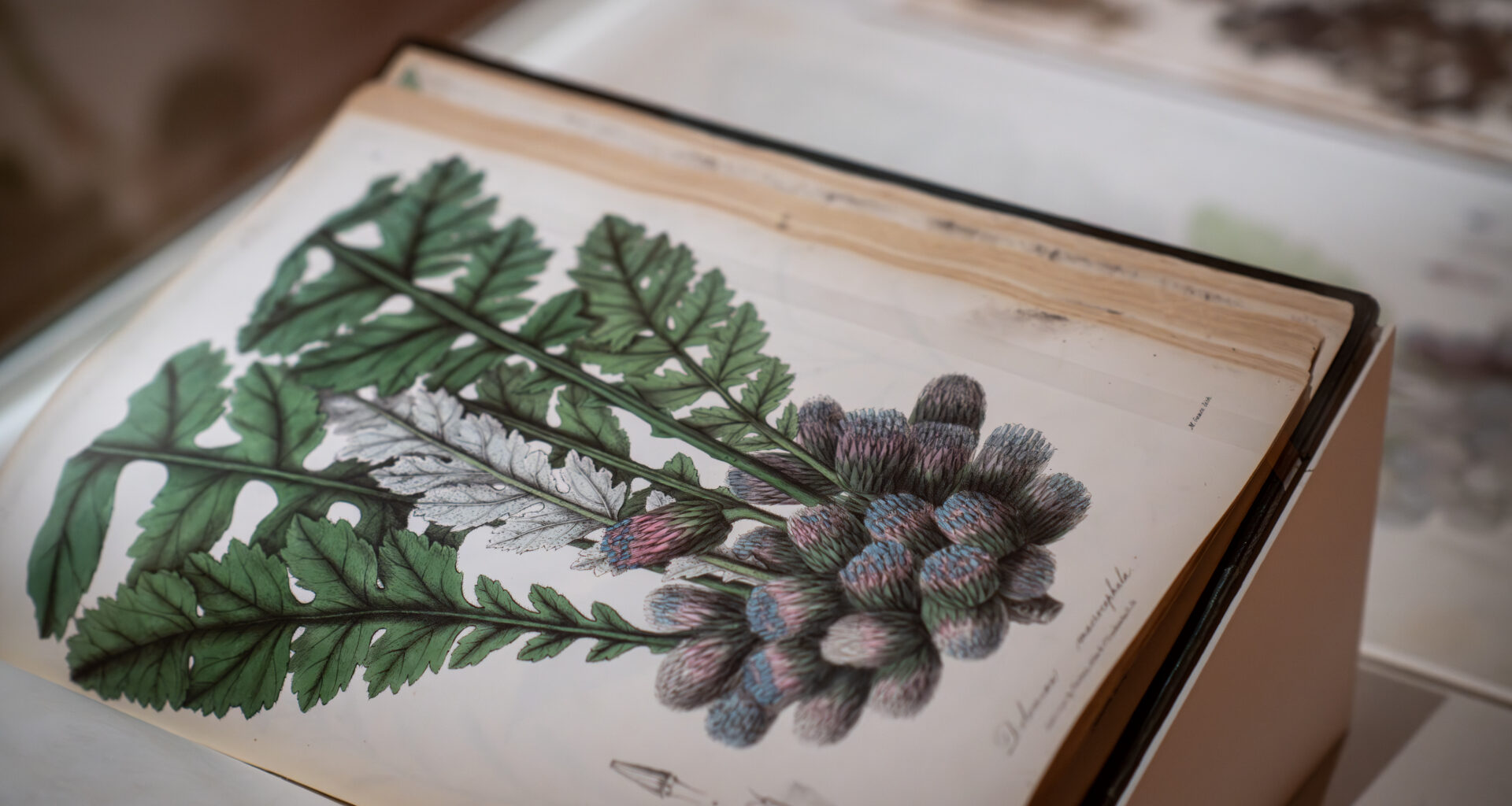
 A work in “The Singh Twins: Botanical Tales and Seeds of Empire.” Photo: Ines Stuart-Davidson, courtesy Kew Gardens
Kew Gardens is the world’s largest and most diverse botanical garden, with more than 8.5 million plant specimens, but behind the glorious gardens and stately façade of the beloved British institution lies the legacy of colonialism and imperialism. Two hard-hitting exhibitions mounted by the Royal Botanic Gardens are currently shedding light on the dark practice of economic botany: the sourcing of plants from around the globe that increased the empire’s wealth (e.g., cotton, tea, indigo and spices) often caused immense harm to local populations.
“Flora Indica: Rediscovering the lost histories of Indian botanical art” is an exhibition of 52 illustrations by Indian artists, commissioned by British botanists between 1790 and 1850 and drawn from Kew’s vast collections. Many of these delicate, impossibly detailed drawings of plants, fruit and flowers native to India—some attributed, others by unknown artists—have never been shown before and were rescued from the vaults by curators Dr. Sita Reddy and Henry Noltie. They look harmless, fragile and beautiful, but they served a more devious purpose. The East India Company—a firm originally formed to trade with India but later responsible for taking over large parts of it—commissioned these works to document the region’s botanical riches, which they then plundered for imperial gain.
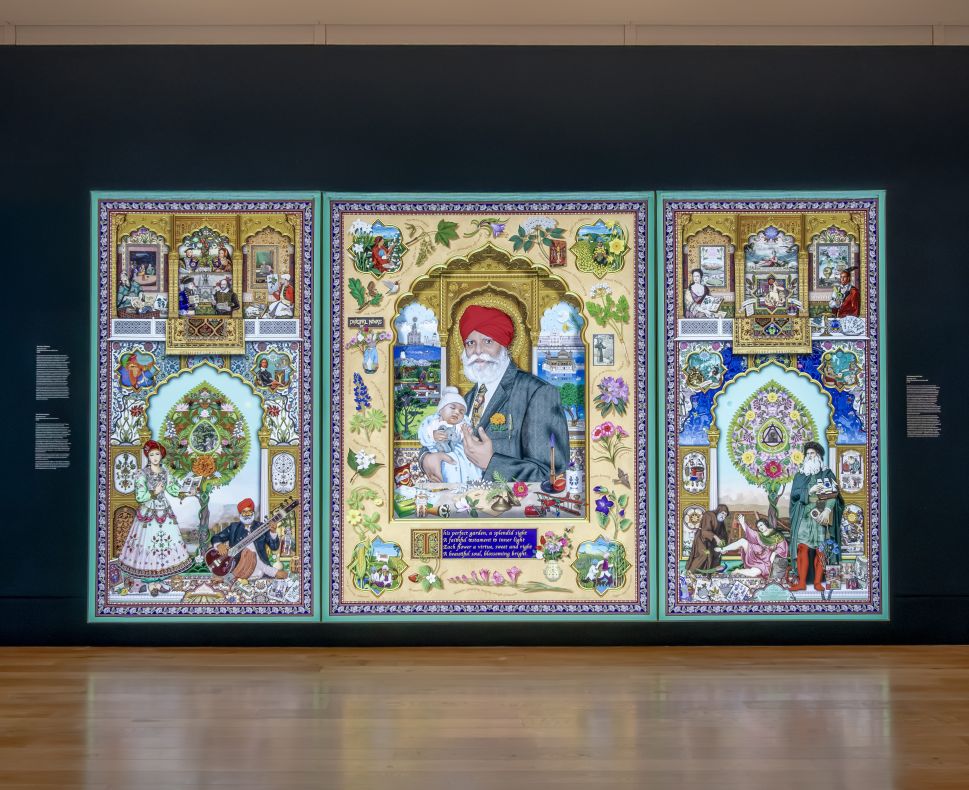
Around the corner is “Botanical Twins and Seeds of Empire,” with work by British-Indian artists The Singh Twins that explains how economic botany operated. Visitors encounter a glorious mélange of color, pattern, light and detail, with huge digital mixed-media works stretching across lightboxes that make one feel as if one is looking through a glittering, shifting, sparkling kaleidoscope. There is almost too much to absorb. Look closer, however, and this is not merely decorative art. It’s a brutal exposé of how plants were used to further imperialism, ironically told with humor and whimsy.
Dying for a Cuppa ostensibly depicts pretty floral teacups, delicate lace doilies and women enjoying a comforting cup of tea, but on closer inspection, tiny details reveal the tea trade’s dark links to the opium trade. East India Company botanist Nathaniel Wallich first identified the commercial viability of tea, and subsequent botanists stole the secrets of its cultivation from China. Britain then established tea plantations across the Indian subcontinent, powered by indentured labor. By the 1830s, the British were smuggling Indian opium into China to pay for the tea trade, creating a generation of addicts in the process.
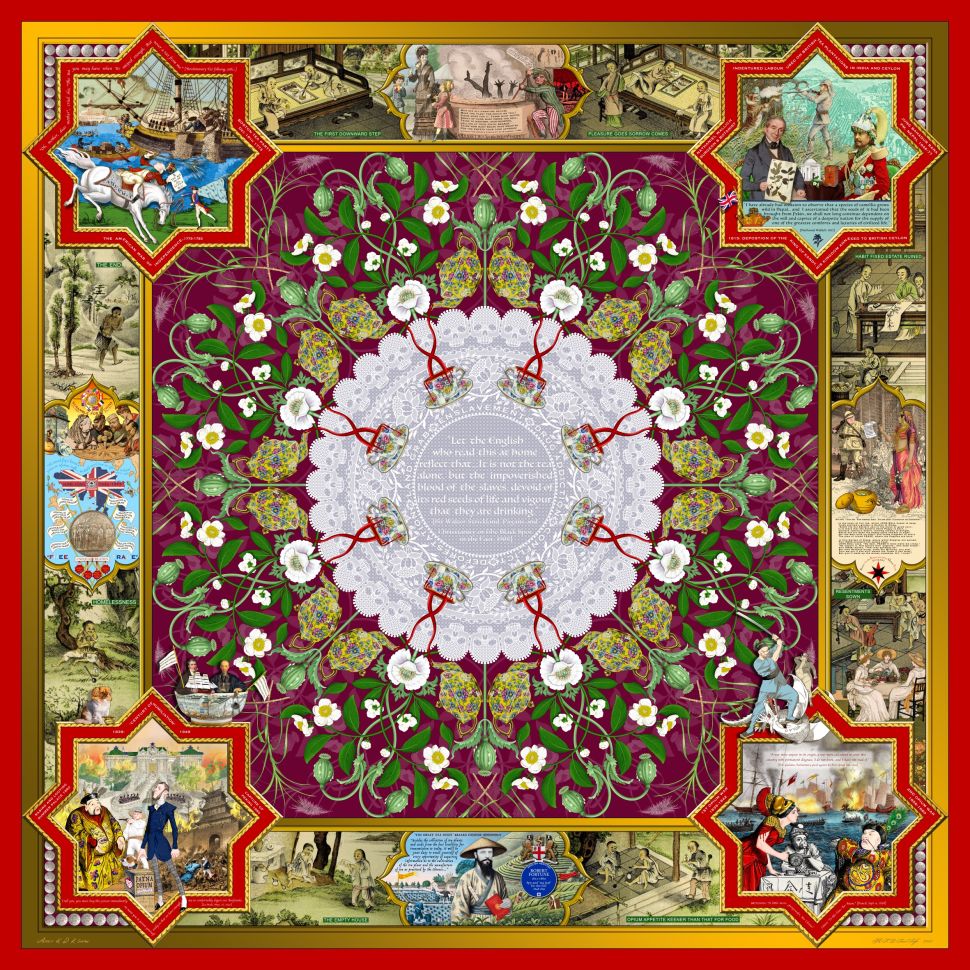 The Singh Twins, Dying for a Cuppa. Courtesy the Singh Twins
In another work, Cinchona: What’s in a Name?, a British family in India is shown reclining at Christmas in a warm domestic scene. Here again, the devil is in the details. The bark of the cinchona tree provided the world with quinine, the first effective antimalarial drug, and its value soared in the 19th Century, when malaria was one of the greatest threats to British troops in the colonies. Kew played a central role in importing large quantities of cinchona bark to Britain for study, and the spread of empire was propelled by quinine, as the Twins illustrate in the border sketches. A quote from Ronald Ross, who discovered the malarial parasite and won the Nobel Prize in 1902, says it all: “In the coming century, the success of imperialism will depend largely upon success with the microscope.” Driving the point home are quotes and images from Carl Linnaeus, the Swedish biologist considered the father of modern taxonomy, now widely recognized for perpetuating colonial stereotypes by classifying Africans as “lazy” and white Europeans as “inventive.” Scientific progress, according to the exhibition, had two faces.
In other striking pieces, Queen Victoria, Henry VIII and Shakespeare appear alongside Sikh gurus, while stately palaces are juxtaposed with shrines. A witty scene shows British families enjoying traditional delicacies, such as the beloved Lea & Perrins Worcestershire sauce, while highlighting its recipe’s Bengali roots. English aristocrats sip cocoa—another 18th-century favorite—while we contemplate its ties to the transatlantic slave trade. Smaller works explore how plants such as chillies, saffron, tulips and poppies were revered by indigenous cultures.
Throughout, there are clever nods to the murky origins of many British treats, and revealing quotes from imperial administrators, such as former British home minister William Joynson-Hicks, who was admirably blunt: “I know it is said in missionary meetings that we conquered India to raise the level of the Indians. That is cant. We conquered India as an outlet for the goods of Britain… We went with a yardstick in one hand and a sword in the other.”
The decolonization of museums is a widely debated topic in the U.K., and the Singh Twins (who prefer to be referred to jointly) were approached by Kew Gardens after their earlier work caught curators’ attention. “Kew wanted us to focus on their collection of botanical illustrations, which we did, but we also wanted to look at the big picture,” they told Observer. “Why were these illustrations commissioned? Who commissioned them? It was all about analyzing specimens, documenting them and seeing how the Empire—and other colonial powers—could cultivate them in their own territories. But we also wanted to show the cultural reverence for plants in grassroots communities.”
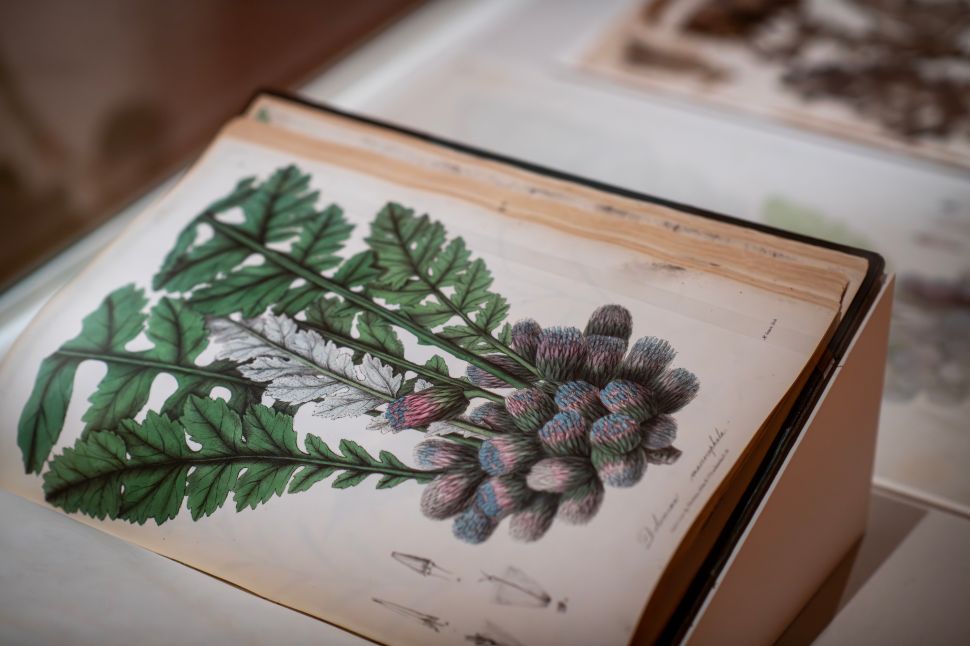 A work in “Flora Indica.” Photo: Ines Stuart-Davidson, courtesy Kew Gardens
The Singh Twins’ practice draws from Indian miniature painting, a form they were once encouraged to abandon in art school. “Our tutors always told us to study Gauguin, Matisse, Picasso, the icons of Western art.” Decorative painting, especially miniature painting, was considered outdated—and often still is. The twins responded by coining their own term, “Past Modern,” to describe their style, which blends miniature painting, Western illumination, digital art and a sharp political message. “We wanted to break away from the ‘West is Best’ narrative. After all, Western artists have always been inspired by art from the East: China, India, Japan.”
Where the exhibition falters slightly is in a video piece titled King Cotton, in which the Twins recite a poem outlining the colonial history of Indian cotton and the brutal destruction of India’s textile industry by the British. The work lacks the subtlety and visual layering of their visual art and verges on the didactic. Still, as the Twins pointed out, education is essential when so many remain unaware. “There is often a perception in the West that colonialism was a benevolent force, something to be proud of. After all, the British built roads and canals and railways. We wanted to reset that compass.” They emphasized that their goal is not to instill shame, but to encourage reflection and awareness.
Many visitors, they say, are shocked by what Kew has hidden behind its exotic gardens. Some have even been moved to tears. “We have had to give out a lot of hugs,” they said.
“Flora Indica” and “The Singh Twins: Botanical Tales and Seeds of Empire” are on view at Kew Gardens in London through April 12, 2026.
More exhibition reviews