It is ‘clear’ the US raid on Venezuela ‘undermined a fundamental principle of international law’, UN human rights office says
A spokesperson for the UN high commissioner for human rights, Volker Türk, has said it is “clear” that the US military operation to capture Maduro and his wife over the weekend “undermined a fundamental principle of international law”.
In a statement, the spokesperson said Türk, a career UN official and human rights lawyer, is “deeply worried” about the “situation in Venezuela”, which has left many Venezuelans fearful as the country’s acting president, Delcy Rodríguez, starts presiding under the apparent supervision of Washington, with Trump vowing to take control of Venezuela’s oil industry with the help of America’s biggest oil companies.
Here is more of the statement issued by the spokesperson for the UN high commissioner for human rights:
It is clear that the operation undermined a fundamental principle of international law – that states must not threaten or use force against the territorial integrity or political independence of any state.
The US has justified its intervention on the grounds of the Venezuelan government’s longstanding and appalling human rights record, but accountability for human rights violations cannot be achieved by unilateral military intervention in violation of international law. The people of Venezuela deserve accountability through a fair, victim-centred process.
As has been clear in the UN Human Rights Office’s consistent reporting on the continued deterioration of the situation in Venezuela for about a decade, the rights of the Venezuelan people have been violated for too long. We fear that the current instability and further militarisation in the country resulting from the US intervention will only make the situation worse.
Updated at 05.34 EST
Key events
Show key events only
Please turn on JavaScript to use this feature
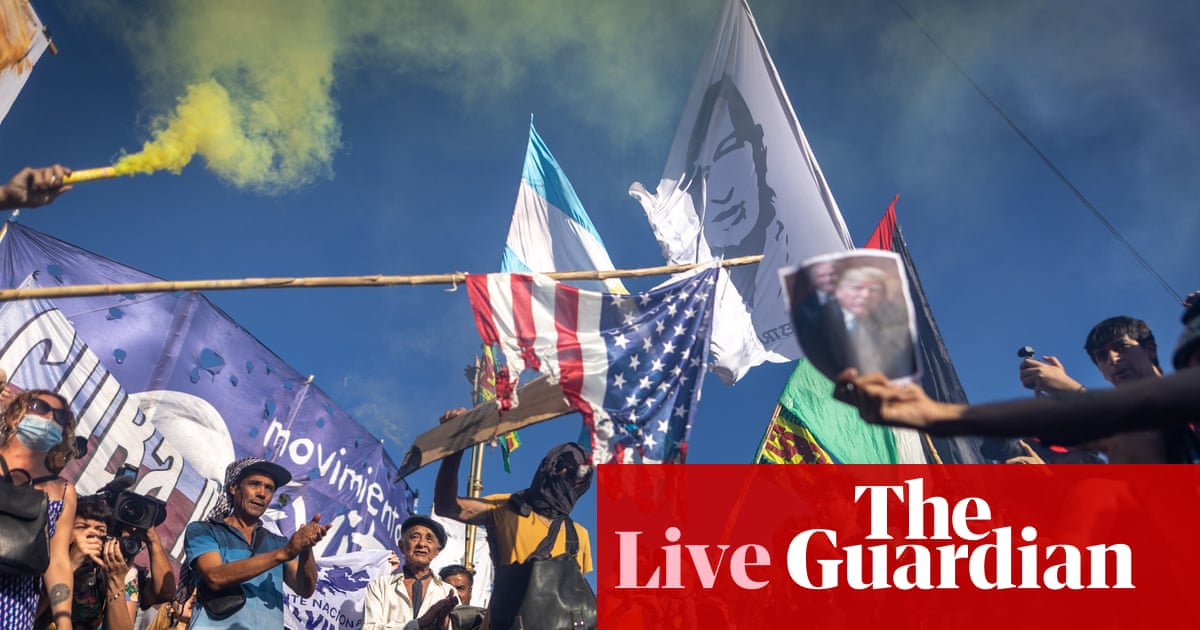
Protestors have gathered outside the US embassy in Jakarta, Indonesia, to demonstrate against the US attack in Venezuela:
Activists hold posters during a protest against the US’s attack on Venezuela outside the US embassy in Jakarta, Indonesia. Photograph: Willy Kurniawan/ReutersActivists carrying posters and a Venezuelan flag attend the protest outside the US embassy in Jakarta. Photograph: Willy Kurniawan/ReutersActivists step on a poster with the image of US President Donald Trump in Jakarta. Photograph: Willy Kurniawan/ReutersShare
If you would like to hear some reflections on Donald Trump’s first year in power (this time around) you can join our upcoming event: Year One of Trumpism: Is Britain Emulating the US?
On Wednesday 21 January 2026, join Jonathan Freedland, Tania Branigan and Nick Lowles as they discuss the first year of Trump’s second presidency. Book tickets here or at guardian.live
Updated at 06.54 EST
US trial of Maduro undermines stability of international relations, China’s foreign ministry says Amy Hawkins
Amy Hawkins is the Guardian’s senior China correspondent
China’s foreign ministry spokesperson said on Tuesday that the trial of Venezuelan leader Nicolás Maduro in New York “severely violat[ed] Venezuela’s national sovereignty” and undermined the stability of international relations.
The comments came the day after a China-backed emergency meeting at the UN Security Council in which countries condemned the US’s military operation to capture Maduro as illegal.
Venezuela is a key China ally in Latin America. The South American country has received over $100bn in Chinese loans and Maduro’s last meeting was with a Chinese delegation visiting Caracas, who he greeted hours before he was captured by US forces.
Here is some more of the statement on Venezuela from the spokesperson for the UN high commissioner for human rights:
The state of emergency declared by the Venezuelan authorities that took effect on Saturday raises concerns as it authorises restrictions on free movement of people, the seizure of property necessary for national defence, and the suspension of the right to assembly and to protest, among other measures.
The high commissioner calls on the US and the Venezuelan authorities, as well as the international community, to ensure full respect for international law, including human rights.
The future of Venezuela must be determined by the Venezuelan people alone, with full respect for their human rights, including the right to self-determination, and sovereignty over their lives and their resources.
Updated at 05.45 EST
It is ‘clear’ the US raid on Venezuela ‘undermined a fundamental principle of international law’, UN human rights office says
A spokesperson for the UN high commissioner for human rights, Volker Türk, has said it is “clear” that the US military operation to capture Maduro and his wife over the weekend “undermined a fundamental principle of international law”.
In a statement, the spokesperson said Türk, a career UN official and human rights lawyer, is “deeply worried” about the “situation in Venezuela”, which has left many Venezuelans fearful as the country’s acting president, Delcy Rodríguez, starts presiding under the apparent supervision of Washington, with Trump vowing to take control of Venezuela’s oil industry with the help of America’s biggest oil companies.
Here is more of the statement issued by the spokesperson for the UN high commissioner for human rights:
It is clear that the operation undermined a fundamental principle of international law – that states must not threaten or use force against the territorial integrity or political independence of any state.
The US has justified its intervention on the grounds of the Venezuelan government’s longstanding and appalling human rights record, but accountability for human rights violations cannot be achieved by unilateral military intervention in violation of international law. The people of Venezuela deserve accountability through a fair, victim-centred process.
As has been clear in the UN Human Rights Office’s consistent reporting on the continued deterioration of the situation in Venezuela for about a decade, the rights of the Venezuelan people have been violated for too long. We fear that the current instability and further militarisation in the country resulting from the US intervention will only make the situation worse.
Updated at 05.34 EST
Maduro’s legal team includes acclaimed lawyer who represented Julian Assange Adam Gabbatt
Adam Gabbatt is a writer and presenter for Guardian US, based in New York
When Nicolás Maduro appeared in court in New York on Monday, his choice of lawyer quickly raised eyebrows.
The captured Venezuelan president was accompanied by Barry Pollack, a top-tier US trial lawyer who spent years representing Julian Assange, eventually securing the WikiLeaks founder’s release from prison in the UK in 2024.
Pollack is a partner at Harris St Laurent & Wechsler, a law firm based on New York’s Wall Street in the financial district of lower Manhattan, just a few minutes walk from the federal court where Maduro pleaded not guilty to criminal charges on Monday.
Lawyer Barry Pollack speaks in Canberra, Australia, on 26 June 2024. Photograph: Lisa Maree Williams/Getty Images
Pollack will take on a case as Maduro’s private counsel that could prove to be just as challenging as that of Assange. Maduro was charged on Monday with drug-terrorism conspiracy, cocaine-importation conspiracy, and possession of machine guns and destructive devices, with the US government labelling Maduro a “narco-terrorist” and an “illegitimate president”. He faces up to life in prison.
Harris St Laurent & Wechsler did not respond to requests for comment about Pollack’s involvement, but it is clear that in the legal world, he is highly regarded. According to Chambers USA, Pollack is a “thorough and deep-thinking lawyer” who “lives, breathes and sleeps trials, and has such a natural way in front of juries”.
You can read the full story here:
Among the international laws the US may have breached, if it provides no justification for the attacks, is the founding charter of the UN.
Article 2 of the UN charter says all members should refrain from “the threat or use of force against the territorial integrity or political independence of any state”.
My colleague Geraldine McKelvie spoke to leading experts in the field of international law to ask for their view on the US attack on Venezuela. Here is an extract from her story:
The experts the Guardian spoke to agreed that the US is likely to have violated the terms of the UN charter, which was signed in October 1945 and designed to prevent another conflict on the scale of the second world war. A central provision of this agreement – known as article 2(4) – rules that states must refrain from using military force against other countries and must respect their sovereignty.
Geoffrey Robertson KC, a founding head of Doughty Street Chambers and a former president of the UN war crimes court in Sierra Leone, said the attack on Venezuela was contrary to article 2(4) of the charter. “The reality is that America is in breach of the United Nations charter,” he added. “It has committed the crime of aggression, which the court at Nuremberg described as the supreme crime, it’s the worst crime of all.”
The UK’s foreign secretary, Yvette Cooper, made a statement in the House of Commons on Monday about the US raid on Venezuela.
Cooper told the Commons she had stressed the importance of international law in a conversation with the US secretary of state, Marco Rubio, but would not say whether she saw the US attack as illegal, saying it was for Washington to set out its justification.
A large section of her statement focused on the brutality of Nicolás Maduro’s dictatorship. “We have seen Maduro’s regime systematically dismantle democratic institutions, silencing dissent and weaponizing state resources to maintain power through fear and corruption,” she said.
Cooper added:
I discussed with Secretary Rubio what should happen next and our continued commitment to a transition to a peaceful and stable democracy.
Our collective immediate focus must be on avoiding any deterioration in Venezuela into further instability, criminality or violence. That would be deeply damaging for the people of Venezuela, our own overseas territories, our allies in the US and other regional partners.
The UK has long been clear that leadership of Venezuela must reflect the will of the Venezuelan people.
You can read her full statement on Venezuela here.
Yvette Cooper said she reminded Marco Rubio of his duties under international law after US strikes on Venezuela. Photograph: House of Commons/UK Parliament/PAShare
Updated at 04.09 EST
British PM choosing his ‘words carefully’ over response to US attack on Venezuela, health secretary says
In the UK, the health secretary Wes Streeting has defended Keir Starmer’s cautious response to the US attack in Venezuela despite MPs wanting the prime minister to condemn what is seen as an operation against a sovereign country in violation of international law.
Starmer, always keen to keep on the good side of the US, has declined to criticise the US military operation over the weekend, unlike several Labour MPs including Emily Thornberry, who chairs the Commons foreign affairs committee.
Streeting told BBC Breakfast this morning that he had “enormous respect” for Thornberry, who was “right” to speak “honestly and candidly” about her view (that the lack of western condemnation could embolden China and Russia to take similar action against other countries).
But he added:
The prime minister and the foreign secretary have a different role and responsibility, and their words carry different weight.
And what I can tell you is that at every moment in recent days, since the US action in Venezuela, the prime minister has judged what he says and when he says it with one overriding consideration, which is how to make a challenging situation better, not worse, and how to do so in a way that protects the UK’s national interests, our collective security, particularly in Europe at a difficult time, and also the best interests of the people of Venezuela who have the right to choose their own leaders and who governs them.
That’s what the prime minister has been doing, and I appreciate there are others who have been more strident and have been more critical of the United States.
The prime minister has a different responsibility, and he is choosing his words carefully and wisely to try and influence how events unfold from here on.
Updated at 03.52 EST
My colleague Sibylla Brodzinsky has reported on the relationship between the US and Colombia, home to significant oil reserves. Here is an extract from her story:
Colombia has long been a close partner of the US in the fight against drug trafficking and enjoyed bipartisan support in Washington but relations have soured dramatically since Trump came to office.
Colombia’s narcotics trade is largely controlled by illegal armed groups such as the Gulf Clan, the National Liberation Army (ELN) and dissident factions of the Revolutionary Armed Forces of Colombia (Farc) guerrilla group, the majority of whose members demobilised after a 2016 peace deal …
Many among Colombia’s right wing opposition have allied themselves with Trump, but voices from across the political spectrum have rejected the threats of a US attack on Colombia.
The US revoked the Petro’s visa in September after he called on American soldiers to disobey any illegal orders. In October, it placed financial sanctions on Petro, his wife and several close collaborators.
At the same time the US was building up its military presence in the Caribbean and bombing suspected drug boats to put pressure on Venezuela’s Maduro, US forces have also conducted strikes on boats in the eastern Pacific region to the west of the Colombian coast.
After the deadly US military operation to capture Nicolás Maduro, and his wife, Cilia Flores, from their Caracas compound on Saturday, tensions between the Trump administration and Colombian President Gustavo Petro are boiling over.
Speaking to reporters on Air Force One on Sunday, Trump said Colombia was “very sick too” and “run by a sick man who likes making cocaine and selling it to the United States.”
“He has cocaine mills and cocaine factories and is not going to be doing it very long,” Trump said.
Gustavo Petro is a former leftist guerrilla who demobilised in the 1990s. Photograph: Thierry Monasse/Getty Images
While Colombia is the world’s largest producer of cocaine there is no evidence that Petro, who condemned the US attack on Venezuela as an “assault on the sovereignty” of Latin America, is in any way involved in the business.
In a lengthy post on X, Petro, who was elected in 2022, wrote yesterday:
If you bomb even one of these groups without sufficient intelligence, you will kill many children. If you bomb peasants, thousands of guerrillas will return in the mountains. And if you arrest the president whom a good part of my people want and respect, you will unleash the popular jaguar.
As well as Colombia, the Trump administration could target Cuba, Mexico, Greenland or Iran next. His recent attack in Venezuela – considered illegal under international law by many observers and experts – reaffirms the extent of American military power and the way the US can act overseas with little repercussions.
Updated at 05.06 EST
What exactly is the US accusing Nicolás Maduro of and what’s in the criminal indictment against him that was unveiled by attorney general Pam Bondi at the weekend?
The US alleges the deposed Venezuelan president has spent the past two decades working with international drug trafficking groups.
He pleaded not guilty – as did his wife, Cilia Flores, who said she was “completely innocent” – at their court appearance in New York.
What are the charges, how comprehensive is the indictment and who might be helping US prosecutors? This explainer has the details.
Returning now to Nicolás Maduro’s court appearance in New York, the deposed Venezuelan president pleaded not guilty to drugs, weapons and narco-terrorism charges on Monday, two days after his capture by US forces.
The brevity and formality of the arraignment hearing in federal court – barely 30 minutes long, during which Maduro was asked to confirm his name and that he understood the four charges against him – belied the far-reaching consequences of the US action, report Victoria Bekiempis and Richard Luscombe.
Maduro, 63, insisted to the judge that he was “still president of my country”, had been illegally “captured” at his Caracas home and was “a prisoner of war”.
“I am innocent. I am not guilty. I am a decent man,” Maduro said in Spanish during repeated attempts to speak over the judge.
The full report is here:
Dara Kerr
Minutes after Donald Trump announced a “large-scale strike” against Venezuela early on Saturday, false and misleading AI-generated images began flooding social media. There were fake photos of Nicolás Maduro being escorted off a plane by US agents, images of jubilant Venezuelans pouring into the streets of Caracas and videos of missiles raining down on the city – all fake.
The fabricated content intermixed with real videos and photos of US aircraft flying over the Venezuelan capital and explosions lighting up the dark sky. A lack of verified information about the raid coupled with AI tools’ rapidly advancing capabilities made discerning fact from fiction about the incursion on Caracas difficult.
By the time Trump posted a verified photo of Maduro blindfolded and handcuffed aboard a US warship, the fake images with the US drug enforcement agents had already gone viral. Across X, Instagram, Facebook and TikTok, the AI photos have been seen and shared millions of times, according to the factchecking site NewsGuard.
See the full story here:
Maduro supporters protest near a mural of him in Caracas on Monday. Photograph: Jonathan Lanza/UPI/ShutterstockShare
Updated at 01.26 EST
Fresh from his military operation in Venezuela, Donald Trump has said the US needs Greenland “very badly”, renewing fears of a US invasion of the largely autonomous island that remains part of the Danish kingdom.
Greenland prime minister Jens-Frederik Nielsen pushed back on Monday against Trump’s calls to annex the Arctic territory, while Danish prime minister Mette Frederiksen warned that any US attack on a Nato ally would be the end of the military alliance and “post-second world war security”.
Here’s a video taking us through it, including Nielsen starting by saying: “First of all I would say that our country is not really the right one to compare with Venezuela.”
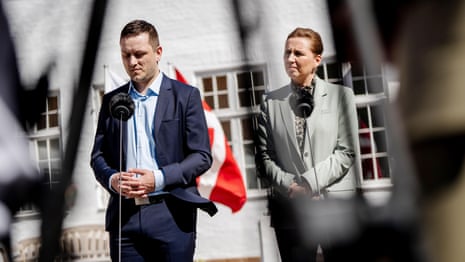 Denmark, Greenland push back on Trump remarks, say Greenland not for conquest – videoShare
Updated at 01.08 EST
Victoria Bekiempis
At noon on Monday in New York, Nicolás Maduro was escorted into a Manhattan federal courtroom following his capture early on Saturday in Caracas, completing the seized Venezuelan leader’s stunning journey from his capital city to a US courtroom.
It was a surreal display amid the fallout of a brazen US military operation to grab Maduro that has roiled global politics and stunned observers in the US and overseas.
In Manhattan the spectacle played out as Maduro’s larger-than-life persona soon filled Judge Alvin Hellerstein’s courtroom with a mixture of bravado, seriousness, jocularity and defiance.
Nicolás Maduro (front, standing) and his wife Cilia Flores (right) in a courtroom sketch. Photograph: Jane Rosenberg/AFP/Getty Images
Maduro, who was not handcuffed but constrained by ankle shackles, looked forward, toward the jury box, as he walked into court. Before sitting down, Maduro told the public gallery “Happy new year!” in English.
His wife, Cilia Flores, followed shortly after, and she had two large Band-Aids on her face.
Proceedings started in earnest with an exchange of greetings that did little to hint at the enormous significance of the events playing out in the room.
You can read the full account here:
Share David Smith
The United States has faced widespread condemnation for a “crime of aggression” in Venezuela at an emergency meeting of the United Nations security council.
Brazil, China, Colombia, Cuba, Eritrea, Mexico, Russia, South Africa and Spain were among countries that have denounced the weekend US attack in Venezuela.
“The bombings on Venezuelan territory and the capture of its president cross an unacceptable line … and set an extremely dangerous precedent for the entire international community,” Sérgio França Danese, the Brazilian ambassador to the UN, told the meeting on Monday.
Donald Trump’s UN ambassador, Mike Waltz, defended the attack as a legitimate “law enforcement” action to execute longstanding criminal indictments against an “illegitimate” leader, not an act of war.
The UN security council meeting in New York. Photograph: Brendan McDermid/Reuters
António Guterres, the UN secretary general, warned that the capture of Maduro risked intensifying instability in Venezuela and across the region. He questioned whether the operation respected the rules of international law.
I am deeply concerned about the possible intensification of instability in the country, the potential impact on the region, and the precedent it may set for how relations between and among states are conducted.
Updated at 02.10 EST
More than a dozen media workers were detained on Monday while covering events in the Venezuelan capital, including a march in support of ousted president Nicolás Maduro and the swearing-in of the country’s new legislature, the Venezuelan press association said.
All 14 of those detained in Caracas were later released, the National Union of Press Workers (SNTP) posted on X, though one was a foreign journalist who was deported.
Reuters quoted the SNTP as saying those detained included 11 people working with international media outlets and one with a national outlet.
Chavismo supporters march in support of the start of the National Assembly in Caracas on Monday. Photograph: Ronald Pena R/EPAShare
Updated at 00.04 EST
Opening summary
Welcome to our live coverage of the continuing aftermath of the US military’s weekend raid on Venezuela and removal of president Nicolás Maduro from power.
Venezuelan opposition leader and Nobel Peace prize winner María Corina Machado has said in her first televised interview since then that she hasn’t spoken to Donald Trump since October 2025.
“Actually, I spoke with president Trump on October 10, the same day the [Nobel Peace] prize was announced, [but] not since then,” Machado said on Fox News. Machado – widely seen as Maduro’s most credible opponent – left Venezuela last month to travel to Norway to accept the award and hasn’t returned since.
“I’m planning to go as soon as possible back home,” she told Fox when asked about her plans to return to Venezuela.
Trump on Saturday dismissed the idea of working with Machado, saying: “She doesn’t have the support within or the respect within the country.” US media reported on Monday that a classified CIA assessment presented to Trump concluded that senior Maduro loyalists, including interim president Delcy Rodríguez, were best positioned to maintain stability.
Despite this, Machado welcomed the US actions as “a huge step for humanity, for freedom and human dignity”.
Delcy Rodríguez (in green) is sworn in as Venezuela’s interim president on Monday after Maduro’s capture by US forces. Photograph: Marcelo Garcia/Miraflores Palace/Reuters
In other key developments:
-
Mike Johnson, the Republican speaker of the US House, emerged from a classified briefing for congressional leaders insisting that “we are not at war” and “this is not a regime change” but “a demand for a change of behaviour by a regime”.
-
Chuck Schumer, the Senate’s Democratic minority leader, expressed discontent with the briefing, calling the Trump administration’s “plan for the US ‘running Venezuela’ … vague, based on wishful thinking and unsatisfying”.
-
The reported appearance of unidentified drones over the presidential palace in Venezuela’s capital on Monday night filled the night sky with the sound of heavy gunfire and tracer fire as the regime’s security forces reacted to what they mistook for another raid.
-
Trump suggested to NBC News that US taxpayers could fund the rebuilding of Venezuela’s infrastructure for extracting and shipping oil. “A tremendous amount of money will have to be spent and the oil companies will spend it, and then they’ll get reimbursed by us or through revenue.”
-
White House adviser Stephen Miller reaffirmed to CNN the Trump administration’s position on Greenland becoming a part of the US.
Updated at 06.34 EST