(Originally published in Spanish in issue #171 of Papeles magazine. Translated by the author.)
Introduction
The European Union, with a population of about 450 million, represents roughly 5% of the global population but consumes almost 20% of the world’s mineral resources—four times more per capita than the world average. Far from narrowing, this gap is widening with the expansion of renewable energy systems, the electrification of private vehicle fleets, digitalization, and increasingly excessive consumption.
The refusal to align consumption with planetary boundaries, with principles of equity and justice between the Global North and South, and with the rights of future generations has fuelled a new form of green imperialism. This new neo-colonial patterns seeks to ensure, by all means, the continued flow of raw materials from the Global South and European peripheries to the main centres of production and consumption.
Until 2022 this dynamic had been largely legitimized under the guise of decarbonisation—framed as the transition away from fossil fuels toward renewable energy systems. In recent years, however, the narrative has taken on olive-green tones, increasingly tying mineral supply to militarization and rearmament.

Papeles de relaciones internacionales y cambio global, n. 171. November 2025
This vision rests on the assumption that natural resources are inexhaustible and that economic growth can be limitless. Yet the material reality is quite different: global mineral reserves are insufficient to sustain projected levels of consumption. As Simon Michaux warned in his 2021 report The Mining of Minerals and the Limits to Growth, copper demand alone—essential to electrification—would require extracting as much copper in the next 30 years as has been mined in the past 7,000. At the same time, ore grades have plummeted: from 10–20% in the late 19th century, to 2% in the 1930s, and below 0.5% today. This means new mines have unprecedented impacts, generating massive waste, using risky low-cost extraction methods, and expanding into pristine environments.
This article examines how access to mineral raw materials in the EU has been transformed through a process of securitization over the last two decades. What was once mainly a matter of economic policy and trade has been reframed—through narratives constructed by industrial lobbies and political allies—as an existential issue for European security and survival.
In the short term, securitization allows to secure the strategic goals of those who have driven the process: removal of environmental limitations, faster permitting, easier financing, and privileged access to minerals for “strategic” industries such as energy, automotive, aerospace, and defence.
But it has also opened the resource curse[1] Pandora’s box within the EU, with its associated early signs of democratic erosion: restrictions on access to environmental information under national security exceptions or campaigns to delegitimize local communities and environmental groups opposing mining by portraying them as enemies of society—paving the way for application of the “Criminal Law of the Enemy” (Feindstrafrecht).[2]
What Is Securitization?
Securitization is a concept developed in the post—Cold War era to explain how political, social, or environmental issues can be transformed into matters of national security—framed as existential threats requiring extraordinary measures. The purpose of this process, carried out through the construction of new narratives (often with little or no factual basis), is to legitimize exceptional actions and secure the material and financial resources required to implement them.
The concept was coined in the early 1990s by Ole Wæver[3] of the constructivist Copenhagen School. Wæver described how securitization enables elites to take absolute control of an issue, shifting it from conventional politics into the realm of emergency politics. The process begins with a speech act—the declaration of an issue as an existential threat. It succeeds when the discourse is widely accepted by political institutions and society.
Securitization measures often include suspending fundamental rights, reallocating budgets, or implementing emergency measures. They may be temporary, or the issue may become permanently integrated into the security domain. Some securitization attempts fail, remaining rhetorical. Others—such as immigration, “ecoterrorism”, or minority rights—have succeeded. In certain contexts, like Russia or the United States, securitization has spread across multiple areas of public life.
It is crucial to note that securitized issues are not necessarily objective threats: they may not represent real existential dangers, even if constructed as such. As Thierry Balzacq[4] explains, securitization’s success depends less on the reality of a threat than on the discursive power of political and private actors to frame it as such. Access to minerals in the EU is a paradigmatic case of successful securitization.
Tracing the Security Narrative in the EU’s Raw Materials Policy
Until the late 2000s, access to mineral raw materials was considered an economic and trade matter within the broader EU neoliberal framework. But as global metal prices rose sharply in the mid-2000s—prices had collapsed in the late 1980s—the EU and mining lobbies began reframing supply as a security issue.
In 2008, the European Commission and the mining lobby launched the Raw Materials Initiative, which for the next decade drove the transformation of mineral supply into a matter of European security. The process was spearheaded by the newly created Directorate-General for Internal Market, Industry, Entrepreneurship and SMEs (DG GROW) and the mining and minerals-intensive industries lobbies. The Commission’s 2008 Communication introduced the concept of security of supply and insisted that “secure access to non-energy raw materials should be fully taken into account in the European Security Strategy.”
In 2011, another Communication defined the concept of critical raw materials and created a list of 14 materials (expanded to 30 by 2020). In 2020 the European Raw Materials Alliance is launched through a new Communication. This public–private coalition now explicitly pursued a securitization agenda and, for the first time, identified “public acceptance” of mining as a key challenge, pinpointing the need to address social opposition—affected communities, environmental groups, etc.—within a security framework.

Image from the cover of the 2020 report Critical Raw Materials for Strategic Technologies and Sectors in the EU – A Foresight Study
In parallel, the increasingly widespread use of the term “critical minerals”—a political designation that is at the core of the securitization process—evidences how deeply the security narrative slowly penetrated public debate. In parallel, “criticality” has increasingly shifted from the initial pretence of justifying the need for more mining as an enabler for the “green transition” to an explicit connection of minerals with defence industries.
Russia’s invasion of Ukraine in 2022 accelerated the process, culminating in the EU’s 2024 Critical Raw Materials Regulation. This regulation designated “European Strategic Projects,” granting them overriding public interest status, exemptions from basic EU environmental principles (e.g., the Water Framework Directive’s “no deterioration” rule and specific protections under the Habitats and Birds Directives), accelerated permitting (max. 27 months), and granted privileged access to funding.
In March 2025, the EU published its first list of 47 strategic projects within the EU, followed by 13 projects outside the EU. Many of the selected projects have consistent track records of poor social and environmental practices and human rights violations. While EU member-states had veto power for domestic projects, no such provision applied to projects in third countries, imposed in a neo-colonial manner.
The Commission’s Communications on raw materials reveal a growing emphasis on “security”: 5 mentions in 2008, 16 in 2011, 18 in 2020 (including in the title A Pathway Towards Greater Security and Sustainability), and 46 in the 2024 regulation. Internal industry challenges—long permitting times, speculative financing, social opposition—were reframed as existential security threats, while global competition and price volatility were cast as strategic risks. These concerns were elevated into the core of EU security and defence architecture and have become part of mostly accepted narrative.

Strategic mining projects within the EU, as announced in March 2025. Source: European Commission.
From Rhetoric to Emergency Politics: Examples of Democratic Backsliding
This section will address examples of the erosion of the rule of law associated with the securitization of mineral raw materials in the EU. In particular, it will show how the institutionalization of this narrative has opened the door to emergency politics that openly undermine previously consolidated environmental rights—such as access to environmental information—and reinforce a logic of enemization, that is, attributing negative traits to third parties in order to socially delegitimize them. This logic targets individuals, communities, and organizations that exercise active environmental citizenship in response to harmful and/or illegal mining projects.

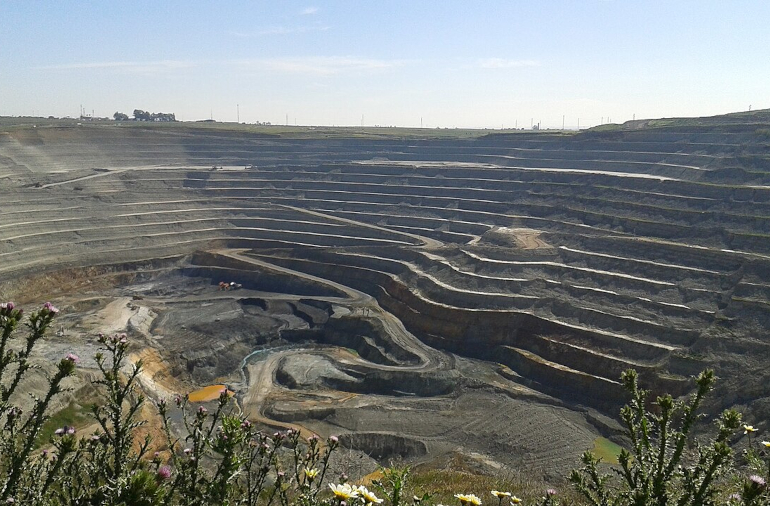
View of the Las Cruces copper mine in Gerena, Seville. Photo: Pablo Ruíz Velasco. Source: Wikimedia Commons
In March 2025, the Commission designated 47 strategic projects through a secretive process without public participation. Some involved companies with criminal convictions for environmental offenses—such as Cobre Las Cruces and La Parrilla, both in Spain. Several civil society groups requested information under the Aarhus Convention—a landmark international treaty ensuring public access to environmental information incorporated into EU and member-state’s laws.
Between May and July 2025, the European Commission systematically denied these requests, citing Article 4.1(a)2 of Regulation 1049/2001, which allows exceptions when subjects relate to military and defence matters—the first such use in an environmental context. For example, in response to a request for documents on the designation of the Doade lithium mine in Galicia, Spain, the Commission claimed that the disclosure of the 15 documents that made up the company’s application “would undermine the protection of the EU’s public interest as regards the defence and military matters”. The Director General of DG GROW further stated that:
Making the requested documents accessible erga omnes including to global competitors could jeopardise the public interest of the European Union. It would compromise the EU’s defence and military strategy on lithium used for this purpose. Furthermore, it would negatively impact the economic policy objectives on lithium which are relevant for strategic industries such as renewable energy and e-mobility.
A similar request to the Spanish Ministry for Ecological Transition, regarding the reports it had issued on the 6 strategic projects that were finally designated in that country, received a matching response. In that case, the Spanish Director General for Energy Policy and Mines argued that providing access to its report would compromise “public security”:
In the current context of global competition, and given the European Union’s efforts to achieve strategic autonomy in critical raw materials, the disclosure of information related to Strategic Projects could compromise the public security interests of the European Union and its Member States.
The infringement of rights such as the right to access environmental information is, in fact, symptomatic of an underlying logic: the enemization of those who oppose certain extractive projects, even when such projects are illegal or have been condemned for environmental crimes. This represents merely the first step in the application of the “Criminal Law of the Enemy” (Feindstrafrecht), whereby certain individuals or organizations are deemed enemies of the state and society, their rights and legal protections are rendered suspendable, and any method for their neutralization is considered legitimate. The application of this logic to environmental activism is expanding, as examples of labelling “radical environmentalism” as terrorism illustrates.
Yet, once again, this development reflects industrial concerns rather than actual threats. Whereas in the past the opening of new mines was primarily determined by economic and geological criteria, today it is increasingly conditioned by social factors, euphemistically referred to by mining companies as “social accessibility to resources” or “social license to operate” (SLO). Obtaining such a license essentially involves undermining any expression of active citizenship—for example, ensuring that individuals or community groups do not report environmental violations or corruption, or that workers tolerate breaches of labour rights. Failure to conform to corporate and government expectations often results in the pathologisation of individuals or communities as afflicted by NIMBY Syndrome implying irrational and/or selfish behaviour as a means to delegitimize concerns or allegations contrary to corporate interests.

Poster calling for a demonstration against the lithium mines in Europe. Source: Doade non é unha mina (Doade is not a mine).
Strategies to secure a “social license” encompass a wide range of tactics that may be lawful (e.g., greenwashing or sponsorships) or unlawful (e.g., physical attacks or threats), short- or long-term, and implemented by companies, governmental bodies, or both in concert. While companies may classify some of these methods under corporate social responsibility, the underlying theoretical framework is that of social engineering, aimed at changing or influencing societal attitudes at the population level—in this case, promoting the acceptability of mining and its adverse impacts. More broadly, the set of tactics employed to minimize, demobilize, or destroy social opposition has been termed “corporate counterinsurgency” or “soft counterinsurgency,”[5] encompassing anything from apparently lawful actions—such as proselytism in schools, guided visits to mine sites, or charitable activities—to direct attacks and threats, (SLAPPs, lawfare, or the use of security forces to intimidate or criminalize land defenders.
In 2021, the European Commission published its 3rd Raw Materials Scoreboard, noting the need for a sustained effort to “[c]hanging public opposition to passive tolerance or active support,” [emphasis added] and highlighting that strategies such as public relations campaigns or the use of cultural heritage (e.g., mining museums) can contribute to fostering a favourable public opinion. This objective was elevated to a standard of direct applicability across the EU through the 2024 Regulation on Critical Raw Materials, which supports the establishment of measures to “facilitate social acceptability.” At the European level, this has translated into the investment of over €180 million of Horizon public funds in at least 25 projects aimed at enhancing social engineering techniques, many involving interventions in mining operations with a long track record of environmental violations (i.e., AGEMERA, CROCODILE, MINE.THE.GAP, MIREU, NEMO, NEXT, SUMEX, TARANTULA, VECTOR, etc.).
An example of constructing such narratives can be found in the film Not in My Country by Peter Tom Jones, which attempts to portray opposition to Riotinto’s lithium mining project in Jadar (Serbia) as a disinformation movement controlled by foreign agents (i.e., controlled by Russia, China). Another work by the same author funded by EU projects LITHOS and EXCEED, Europe’s Lithium Paradox, depicts local opposition to the proposed “Mina do Barroso” lithium mine in Portugal as a violent minority intimidating the silent majority.
The European securitization process has had a cascading effect on numerous policies reflecting this new narrative. For instance, in Galicia, Spain, a 2030 Sustainable Mining Agenda, approved by the Regional Government in 2024, repeatedly identifies “radical environmentalism” (the same term used by Spain’s Attorney General’s Office in its 2022 Annual report) or the “strong activism of environmental associations” as threats, criticizing the existence of “social mobilization promoted by groups whose interests differ significantly from local and environmental interests.”
The Slippery Slope of the Resource Curse
Far from delivering broad benefits, mining has often exemplified the resource curse bringing political instability, authoritarianism, criminalization of dissent, corruption, community conflicts, and asymmetries of power between corporations and citizens.
Europe long believed itself immune from these dynamics, widespread in the Global South where communities suffer both ecological devastation, human rights violations and poor governance. Yet securitization in the EU has blurred the line between corporate and public interests. The fall of Portuguese Prime Minister António Costa in 2023, linked to corruption in lithium projects under Operation Influencer, illustrates how corruption is already surfacing in parallel to the State’s growing lack of transparency and openness, as a recent Decision by the Aarhus Convention Compliance Committee indicates.
Accelerating permits at the cost of public participation, undermining environmental rights, delegitimizing defenders, and funnelling billions into mining companies risks putting the EU on a slippery slope toward autocratisation and irreversible rule-of-law erosion. Combined with the rise of authoritarian, populist, and anti-environmental politics, mineral securitization opens up prospects for a bleak future—where Europe may face the same destructive dynamics of the resource curse that it has contribute to generate for the past century in much of the Global South.
Notas
[1]Richard M. Auty, Sustaining Development in Mineral Economies: The Resource Curse Thesis, Routledge, London, 1993
[2]Günther Jakobs, «Kriminalisierung im Vorfeld einer Rechtsgutsverletzung», Zeitschrift für die gesamte Strafrechtswissenschaft, núm. 97(4), 1985, pp. 751-785.
[3]Ole Wæver, «Securitization and Desecuritization» en Ronnie D. Lipschutz (ed.), On Security, Columbia University Press, Nueva York, 1995.
[4]Balzacq, Thierry (2005). «The Three Faces of Securitization: Political Agency, Audience and Context». European Journal of International Relations. 11 (2): 171–201.
[5]Brock, Andrea, and Alexander Dunlap. «Normalising Corporate Counterinsurgency: Engineering Consent, Managing Resistance and Greening Destruction around the Hambach Coal Mine and Beyond». Political Geography, vol. 62, 2018, pp. 33–47.
Teaser image credit: View of the Las Cruces copper mine in Gerena, Seville. Photo: Pablo Ruíz Velasco. Source: Wikimedia Commons