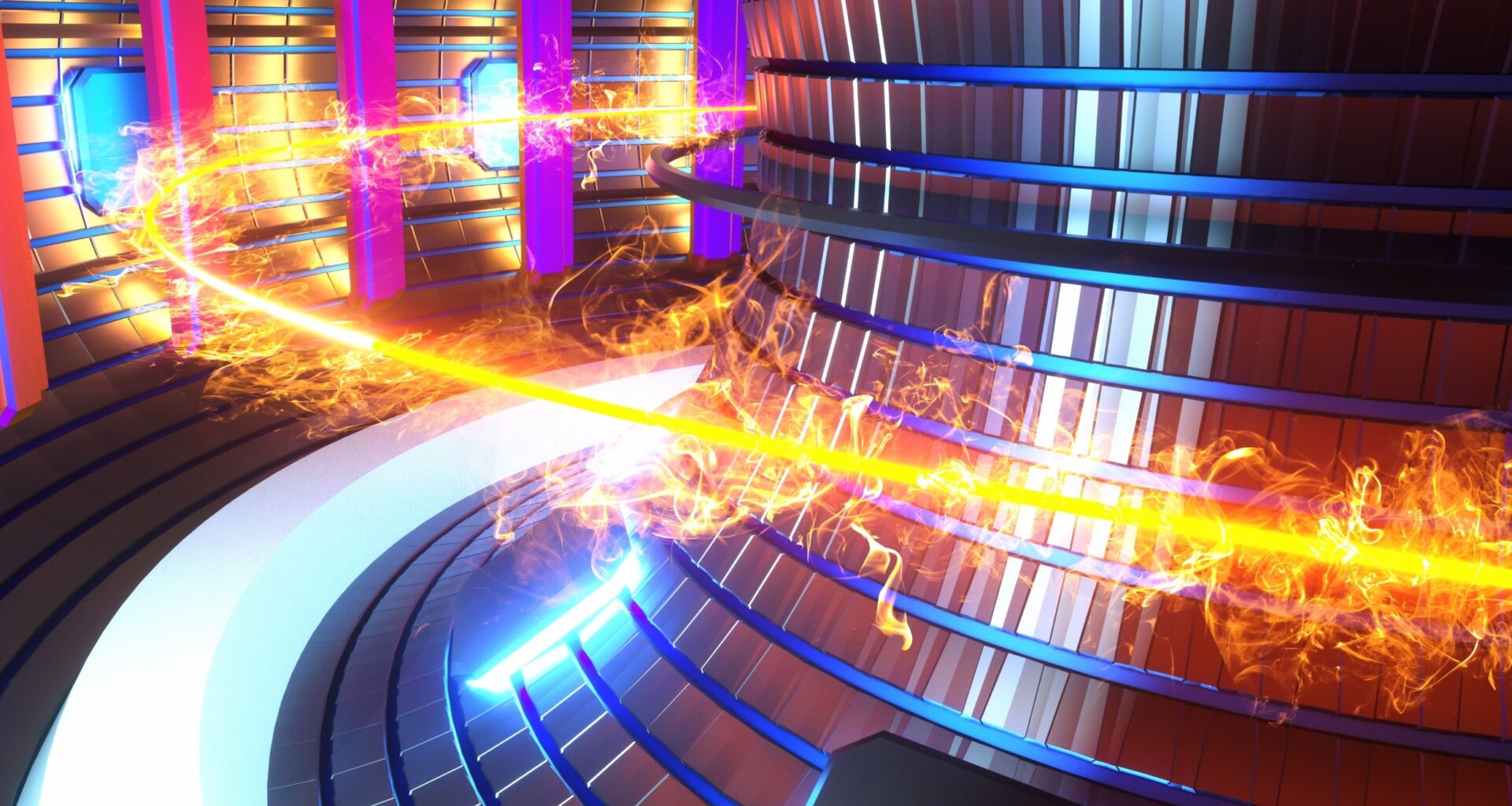
China has moved one step closer to clean fusion energy by breaking a long-standing rule in plasma physics. Scientists running the country’s artificial sun have shown that plasma can stay stable even at very high density.
For many years, high density caused fusion experiments to fail. New results now show a way past that barrier.

Fusion energy comes from joining light atoms together, just like inside the Sun. Scientists hope fusion can one day provide clean and endless power.
Achieving that goal requires plasma that stays hot, dense, and stable for long periods.
Density has always caused trouble. Once density rises too much, plasma usually collapses. New experiments on China’s EAST reactor show that problem no longer looks permanent.
The research was led by Jiaxing Liu and Professor Ping Zhu from Huazhong University of Science and Technology and the University of Wisconsin Madison.
China’s artificial sun reactor
The Experimental Advanced Superconducting Tokamak, known as EAST, sits at the Institute of Plasma Physics under the Chinese Academy of Sciences in Hefei.
EAST uses strong magnetic fields to hold plasma in place while heating it to extreme temperatures.
Full metal walls made of tungsten surround the plasma, unlike older machines that used carbon.
Why high density matters
Fusion reactions grow stronger as plasma density rises. When density doubles, fusion power rises much faster. High density helps fusion reach ignition, the point where reactions power themselves.
Despite that benefit, tokamaks face a density ceiling called the Greenwald limit. Crossing that line often triggers plasma collapse.
Older explanations blamed turbulence or magnetic problems. Many experiments tried adding more fuel or heating, but disruption usually followed. A new idea now offers a deeper explanation.
Plasma wall self-organization, or PWSO, explains density limits by focusing on interactions between plasma and reactor walls.
D. F. Escande and collaborators first developed the idea. PWSO links plasma behavior to impurity radiation caused by wall materials.
When plasma hits metal walls, tiny particles break loose. Those particles enter plasma and radiate energy away. Too much radiation cools the plasma and ends the experiment.
PWSO theory shows that balance between heating power and radiation decides how dense plasma can become.
Two operating paths appear in PWSO theory. One path leads to a density limit. Another path leads to a density-free regime. In that second path, plasma stays stable even as density keeps rising.
Why tungsten walls matter
Wall material plays a major role. Carbon walls release impurities through chemical reactions. Tungsten walls release particles mainly through physical impacts.
Physical sputtering behaves in a more predictable way at lower temperatures.
PWSO theory predicts that tungsten walls can support the density-free regime when target region temperatures remain low.
EAST uses full tungsten divertors, which creates ideal conditions for testing that idea.
Stabilizing the artificial sun
Researchers adjusted conditions at the very start of plasma formation. High initial gas pressure filled the chamber before plasma ignition. Electron cyclotron resonance heating supplied extra energy during startup.
That combination reduced harmful radiation and kept plasma clean. Lower impurity levels allowed density to rise smoothly. Plasma temperature near divertor targets dropped, which further reduced wall damage and radiation.
Measurements showed plasma density reaching about 1.3 to 1.65 times the Greenwald limit. Stability remained strong even near collapse.
The results matched predictions from both simplified and detailed PWSO models.
Theory supports the findings
PWSO models describe feedback between heating power, radiation, and impurity production. When delayed radiation stays below heating input, plasma reaches a stable balance.
Calculations showed that EAST experiments entered the density-free basin predicted by theory. Lower divertor temperatures played a key role.
As wall conditions improved over repeated experiments, density limits increased even more. That trend matched theoretical expectations closely.
Why these results matter
Fusion ignition depends on density, temperature, and confinement time working together. Removing the density barrier brings ignition much closer.
EAST results show that startup control and wall design matter as much as raw heating power.
“The findings suggest a practical and scalable pathway for extending density limits in tokamaks and next generation burning plasma fusion devices,” said Professor Zhu.
Professor Ning Yan noted that the team plans to apply the same method during high confinement operation. That step could push density even higher under stronger fusion conditions.
Fusion energy still faces challenges, but one of the hardest limits has begun to fall. With careful control and smart design, artificial suns may soon burn brighter than ever before.
The study is published in the journal Science Advances.
—–
Like what you read? Subscribe to our newsletter for engaging articles, exclusive content, and the latest updates.
Check us out on EarthSnap, a free app brought to you by Eric Ralls and Earth.com.
—–