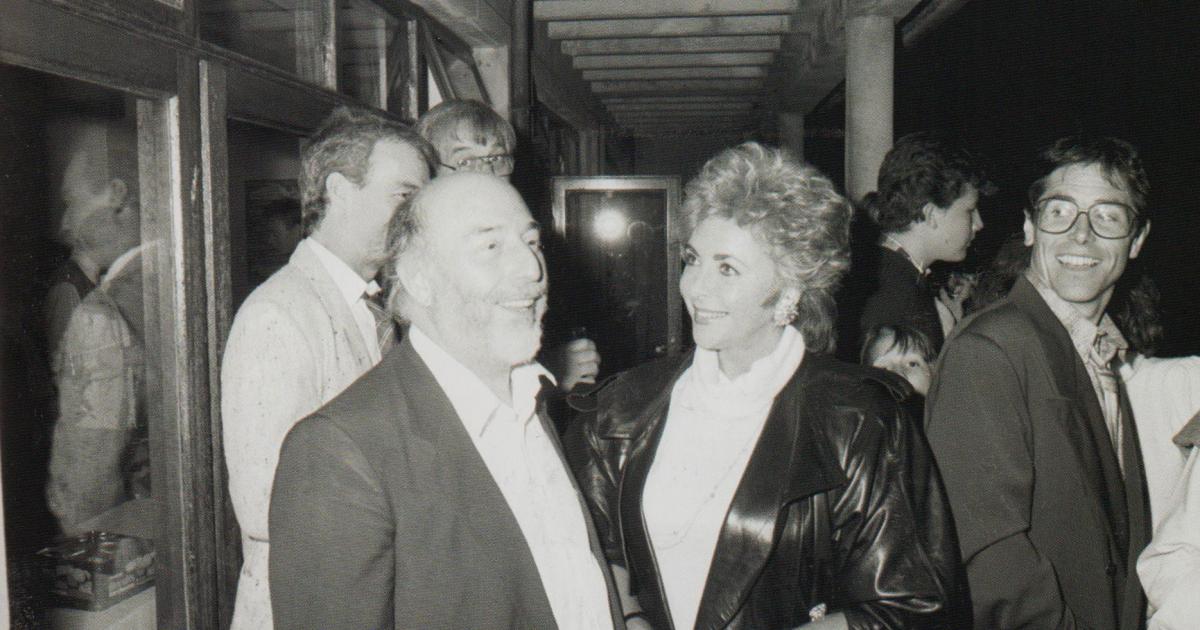
The festival has described Mr Dunlop, the seventh director of the festival, as an “exceptional” leader of the event, which began in 1947.
Read More:
The EIF also hailed him for his skills of diplomacy and his passionate belief in “the power of the performing arts to cross political and cultural boundaries”.
Among the actors he worked with throughout his career were Richard Burton, Miriam Miriam Margolyes, Jim Dale, Gary Bond, Spike Milligan, William Atherton and Clive Revill.
Frank Dunlop was director of the Edinburgh International Festival between 1984 and 1991. (Image: Contributed)
His tenure as EIF director is probably best remembered for his strong commitment to championing drama productions from around.
His programmes featured work by the Scottish writers including David Lyndsay, Sydney Goodsir Smith, James Bridie and Robert Louis Stevenson.
Miriam Margolyes has paid tribute to theatre director Frank Dunlop. (Image: Submitted)
Among those to appear in the EIF during his tenure were the dancers Rudolf Nureyev and Michael Clark, the actors Kenneth Branagh, Emma Thompson, Alan Rickman, Steve Buscemi, Willem Dafoe, Siobhan Redmond and Robert Glenister, the musicians Nigel Kennedy, Ravi Shankar, Stephane Grappelli, Humphrey Lyttleton and Yehudi Menuhin, and the Moscow State Circus.
Mr Dunlop received honorary degrees from both Edinburgh University and Heriot-Watt University.
However he was no stranger to controversy during his time as EIF director.
He inherited a previously-undisclosed deficit of £175,000 which he said would have put him off taking the job had he known about it. Mr Dunlop had a number of clashes with the Labour-run district council during his tenure over the running and financing of the festival.
Born in Leeds, Mr Dunlop founded the Piccolo Theatre Company in Manchester in 1954, took over the running of the Nottingham Playhouse in 1961 and founded the Young Vic Theatre in London in 1970.
He brought a number of productions to the EIF before he was appointed director, most notably the Trojan Woman and The Winter’s Tale in 1966, and the first professional production of Joseph and the Amazing Technicolour Dreamcoat in 1972.
EIF chief executive Francesca Hegyi said: “Frank Dunlop was not only an exceptional festival director, but a diplomat and an acclaimed theatre-maker.
“He believed passionately in the power of the performing arts to cross political and cultural boundaries, combining international ambition with a popular touch that widened the festival’s reach.
“Through bold programming and extraordinary international relationships, he helped shape Edinburgh as a place where art could bring people together even at moments of profound global tension.”
The EIF’s website recalls how Mr Dunlop’s “powers of diplomacy” were needed to avert potential disaster after the Moscow-based Bolshoi Opera were invited to his final festival in 1991.
It states: “On the morning they were due to leave Moscow for Edinburgh, tanks rumbled down the main streets in an attempted military takeover by Kremlin hardliners to overthrow Gorbachov, destabilising the Soviet Union.
“He called the Bolshoi to find out if they were permitted to leave and was told that, thanks to the warm relationships he had developed with the Soviet authorities, the only planes being allowed out were the chartered planes for transporting the Bolshoi to Edinburgh.”
Posting on social media, Margolyes recalled how Mr Dunlop had helped her bring the first version of her one-woman show about Charles Dickens, which she wrote with Sonia Fraser, to Edinburgh.
She said: “On the strength of an hour’s chat with us, Frank offered us a slot for our (as yet unwritten) play. It changed both our lives.
“He took a chance on two middle-aged women with no writing experience and trusted us to deliver. Our triumph was his.
“I honour his generous memory – a true creative artist and a magnificent human being.”
Dale said: “In 1965 Frank saw me performing stand-up comedy on a British music hall stage and literally dragged me into his world of Shakespeare’s comedies.
“He became the guru to myself and brilliant young actors at the Young Vic Theatre and the National Theatre. Over the following years he polished my performances in eight award-winning productions.
“In 1970 I collaborated with him on our most successful stage production, ‘Scapino,’ based on a farce by Moliere.
“In 1974 it played on Broadway to capacity houses for almost a year. Frank’s publication of the play became an instructional format for any young wannabe director, resulting in thousands of productions in schools throughout the world. I am heartbroken, as must be every actor who experienced the joy of working with the best of all possible directors.”
A tribute posted by the Young Vic said: “The Young Vic was established by Frank in 1970, as an offshoot of the National Theatre.
“He wanted to create a new kind of theatre for a new generation – one that was unconventional, classless, open and cheap!
“His spirit shaped the Young Vic into a space where everyone could experience the power of theatre. Our thoughts are with all that knew and loved him.”