Unlock the Editor’s Digest for free
Roula Khalaf, Editor of the FT, selects her favourite stories in this weekly newsletter.
The writer is a senior fellow at the MIT Mobility Initiative
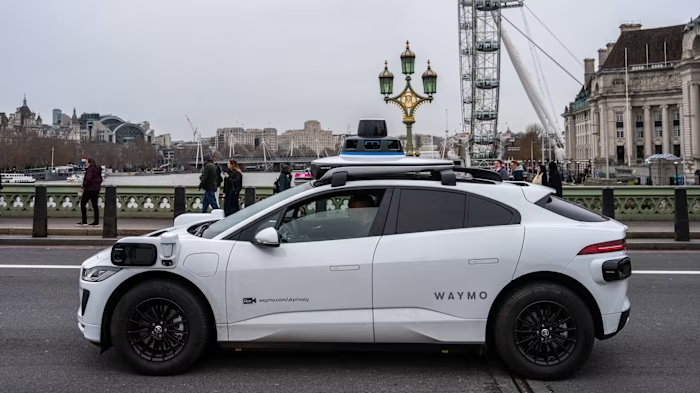
Get ready, Europe. The robotaxis are coming. This year, Londoners could see driverless cars from China’s Baidu and Waymo, the self-driving subsidiary of Google’s Alphabet. Tensor Auto and GreenMobility are planning to launch autonomous cars in Copenhagen while Stellantis and Pony.ai want to do the same in Luxembourg. European Commission President Ursula von der Leyen has voiced her support: “Self-driving cars are already a reality in the United States and China. The same should be true here in Europe.”
She is right about the first part. Autonomous rides are available in Chinese cities like Beijing and Wuhan and in the US, where I live, driverless cars from Waymo, Zoox and Tesla navigate the streets of cities like San Francisco, Los Angeles, Phoenix and Austin. Waymo is reported to provide 450,000 paid trips per week.
Driverless journeys can be pleasantly private, albeit too expensive for most people to take them regularly (Waymo rides often cost around a third more than Uber taxis). But to win over regulators and the general public, American robotaxi companies have also presented themselves as an urgently needed solution to the country’s abysmal record of crash deaths.
Such messaging is of dubious relevance to Europe, however, where roadways are already much safer than those in the US. Furthermore, Europeans are more likely to bike and ride public transportation — travel modes that are vulnerable to a deluge of self-driving cars.
So why, exactly, does Europe want robotaxis?
Driverless cars are often perceived as an embodiment of innovation and their developers have long claimed that computers can operate vehicles more safely than humans. They will not drive inebriated, exhausted or distracted.
Unaffiliated experts, such as Phil Koopman at Carnegie Mellon, say it is still too soon to know whether robot drivers are really safer. But a technological fix for crashes would be a godsend in the US, where the death count rose by over 25 per cent between 2010 and 2023. An American is more than twice as likely to die in a crash as a Canadian or Korean and more than three times as likely as an Israeli or Spaniard.
Europe is in a different situation. Smaller cars, higher transit use and more pedestrianised areas make roads safer. In 2023, the European Union averaged roughly 4.5 crash deaths per 100,000 residents, less than half the American equivalent. Roads in non-EU member states like Britain and Norway were even safer. A handful of Nordic cities like Helsinki have almost eliminated fatal crashes by slowing cars down.
This means the upside of robotaxis in Europe is lower. And there are considerable downsides to introducing autonomous cars into transportation networks that do not revolve around motor vehicles. Robotaxis have caused relatively few problems in car-centric American cities like Phoenix. But in San Francisco they have blocked bike lanes and obstructed transit vehicles. Such mishaps should be a warning for European leaders not to let their cities become beholden to the automobile.
Technological marvels they may be, but robotaxis are still cars and cars are a uniquely inefficient means of moving large numbers of people when space is at a premium. By inviting robotaxis into their narrow, busy streets, European cities risk worsening congestion. In California, data shows that Waymos spend almost half their time “deadheading” — driving around empty — which increases traffic. Gridlocked cities would undermine the quality of life and economic productivity that European leaders like von der Leyen want.
Robotaxi deployment has been compared to a race — one European carmakers have yet to start. If so, this is a race Europeans should skip altogether.