STAFF at Edinburgh’s Heriot-Watt University could go on strike over proposed cuts after members of the University and College Union (UCU) began balloting on strike action.
Union members, including lecturers and other support staff, are being asked whether to take strike action and if they would support alternative action, such as marking and assessment boycotts.
This was in response to a programme of cuts being proposed by the university which will see courses and programmes axed and more than 50 jobs potentially lost.
The university has so far refused to rule out compulsory redundancies and UCU have claimed that that the cuts could see research operations at the university jeopardised.
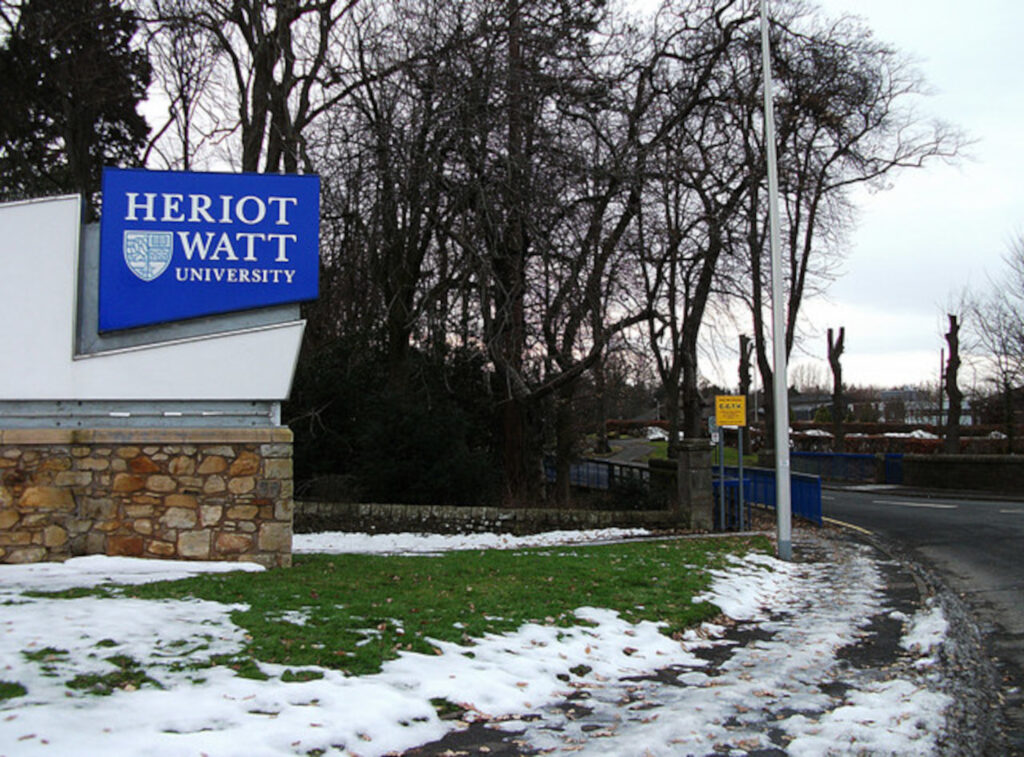
 Staff at Heriot-Watt University could go on strike, but a decision will not be made until midway through February this year (C) Michael Ely / Wikimedia Commons
UCU Heriot-Watt members began balloting yesterday along with members from three other Scottish Universities: Aberdeen, Strathclyde, and Stirling.
All four universities are undergoing separate disputes involving budget cuts and redundancies.
These developments come after successful strike action at the University of Edinburgh resulted in a breakthrough in talks in a similar dispute.
A final decision on Heriot-Watt strikes will not be made until 16 February, when the ballot closes.
Kate Sang, Heriot-Watt UCU president, said: “We are disappointed that the university have not committed to the protection of jobs in Scholar, jobs which are vital to the delivery of high-quality accessible education across Scotland.
“The university’s plans to further reduce staff numbers across the teaching teams are worrying, especially given that the management has refused to rule out compulsory redundancies.
“The proposed changes to individual staff’s research time threaten the university’s reputation as a global research leader and may cause longer term harm to the university’s research income and research excellence.
“We remain committed to working constructively with the employer.”
A Heriot-Watt spokesperson claimed that their paid scheme has already attracted “significant interest” and “will play a meaningful role in reducing any potential need for compulsory redundancies”.
They continued: “While the University is disappointed to note this development, particularly as the UCU has taken this action prior to the conclusion of our formal consultations, we remain committed to constructive dialogue and collaboration over the issues identified.
“We are actively engaging with the UCU and our other recognised unions through the scheduled Combined Joint Negotiation and Consultation Committee (CJNCC) and collective consultation meetings.
“In addition, our paid leaver scheme has already attracted significant interest from colleagues and will play a meaningful role in reducing any potential need for compulsory redundancies.
“This positive response shows that staff are engaging with the options available and taking proactive steps to shape their future.
“Our focus remains on reaching a fair and sustainable resolution that works for all parties and avoids the damaging disruption caused by industrial action.”
UCU said that Heriot-Watt’s principal, Professor Richard A Williams, is putting not only the university’s educational offer, but also the institution’s 25-year commitment to the Scholar programme, a leading online learning platform which supports learning in key subjects in schools throughout Scotland.
41 jobs in Scotland and 10 in Malaysia are thought to be at risk due to the cuts.
On the situation at all four universities in Scotland, Jo Grady, UCU general secretary, said: “We’re just days into the New Year and once again universities across Scotland are facing the possibility of industrial action, with members being forced to vote for strike action to defend jobs and force university principals to rule out compulsory redundancies.
“With a record number of jobs being cut across Scottish universities, the principals at Stirling and Heriot-Watt and those at Strathclyde and Aberdeen, who are starting off their time as principals in the most disappointing way, need to listen to their staff and commit to ruling out compulsory redundancies before these disputes escalate into strikes with resulting disruption to students.”
The Strathclyde UCU ballot ends on 9 February, the Heriot-Watt and Aberdeen ballots on 16 February, and Stirling on 17 February.
If a yes vote is returned with a turnout of over 50% then the individual branch will decide what action to take.
Related