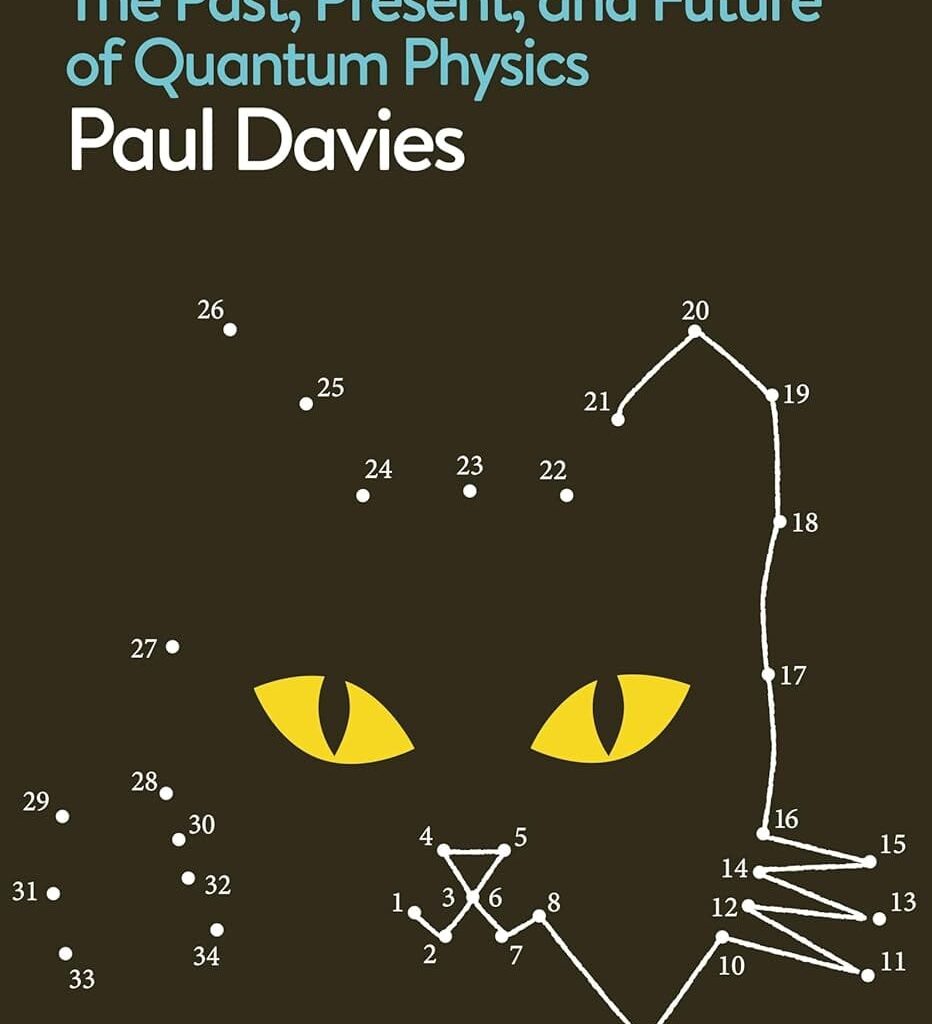
Quantum 2.0—firstly is great title. Paul Davies is a brilliant writer with a real sense of clarity. Of course, he’s a physicist, and in this book he’s working to convey some of the detailed, challenging, and genuinely strange aspects of quantum mechanics. He’s been somewhat constrained—I think a couple of equations might have helped in places—but we all know the publishing wisdom that every equation halves your readership. His hands were bound, but I think he’s done a commendable job of elucidating what quantum physics has been historically and where it might be heading, including some of the genuinely strange philosophical challenges it raises.
What’s Inside
Davies covers substantial ground across the quantum landscape, and the breadth here is impressive for such a concise volume.
Quantum Information receives thorough treatment, exploring how information behaves fundamentally differently at the quantum level. Davies traces the intellectual lineage back to Turing and Church, connecting classical computation theory and the foundations of what we consider computable to the quantum revolution that followed. This historical grounding is valuable—it reminds us that quantum computing didn’t emerge from nowhere but built upon decades of theoretical work about the nature of computation itself.
Bell’s Theorem gets the attention it deserves. Davies walks through John Bell’s profound contribution and its implications for locality and hidden variables. This is the experiment that essentially forced physicists to accept that quantum weirdness isn’t just a gap in our knowledge but a fundamental feature of reality. The universe really is non-local in ways that deeply troubled Einstein and continue to challenge our intuitions about how things ought to work.
Entanglement is naturally central to the narrative—that “spooky action at a distance” that so troubled Einstein but has since become the cornerstone of quantum technologies. Davies explains how particles can become correlated in ways that have no classical analogue, and how measuring one instantaneously affects what we can know about another, regardless of the distance separating them. The implications are staggering, and Davies conveys this without hyperbole.
Quantum Cryptography demonstrates how the very properties that make quantum mechanics so counterintuitive can be harnessed for practical application. Davies explains how quantum key distribution works and why, in principle, it offers theoretically unbreakable communication—any attempt to eavesdrop necessarily disturbs the quantum states and reveals the intrusion.
The book also touches on quantum computing, quantum sensing, and the broader “second quantum revolution” that gives the book its title—the transition from merely understanding quantum phenomena to actively engineering and exploiting them.
Clarity Without Equations
What I’ve really loved is Davies’s treatment of the toy problems that classical textbooks typically present with dense mathematical formalism. You know the ones—Schrödinger’s cat, the double-slit experiment, quantum tunnelling, spin measurements, the EPR paradox. In standard physics texts, these come wrapped in Dirac notation, wave equations, and probability amplitudes. Davies dispenses with all of that and loses nothing in the process.
For those who want a crisp, clear, and verbose understanding of quantum strangeness, Davies has done a superb job. The diagrams are genuinely excellent—not the perfunctory illustrations you often find in popular science books, but carefully constructed visual explanations that actually illuminate the concepts. You can tell real thought went into how to represent inherently unvisualizable phenomena in ways that build intuition rather than confusion.
This is the hallmark of true expertise. You know when someone genuinely understands a topic when they can communicate complex ideas with such elegance. It’s easy to hide behind equations—they’re precise, they’re rigorous, and they absolve the author of having to actually *explain* anything. The mathematics does the heavy lifting. But stripping away that scaffolding and still conveying the essential physics? That requires a depth of understanding that goes beyond mere technical competence. Davies clearly has that understanding in spades.
A Personal Reflection
I should note that when it comes to interpreting the collapse of the wave function, I’m one of those people who has never been entirely comfortable with the collapse of the wavefunction. I’ve always found it deeply unsettling. Davies, for clarity and simplicity, focuses primarily on the Copenhagen interpretation throughout most of the book. It wasn’t until around page 270 that we encountered alternatives like the Everettian many-worlds interpretation, which emerged from Hugh Everett under John Wheeler’s supervision. This isn’t a criticism of the book—it’s a sensible pedagogical choice, and Davies handles it well. It’s simply that those of us with a particular interest in the interpretational debates might find ourselves waiting a while for that discussion. But when it arrives, it’s handled thoughtfully.
What Makes It Work
This is a concise, quick read. It’s not exhaustive, but it serves as an excellent entry point for anyone wanting insight into quantum physics. What I particularly appreciate about Davies’s writing is his background: he has worked in physics, conducted research, and met the key figures in the field. He comes at this as a genuine domain expert who has since dedicated much of his time to science communication.
There’s real value in having someone with deep experience guide readers through the big themes without getting lost in the weeds. It’s one thing to read a book *about* a topic; it’s quite another to read one written by someone with genuine understanding—not just of the mechanics, but of the *meaning*. That personal perspective comes through, particularly in Davies’s belief that consciousness may be more profound and relevant to quantum mechanics than many assume.
He has met these pioneers. He has worked alongside them. He has grappled with these problems himself. And that experience translates into a sureness of touch when guiding the reader through conceptually treacherous territory.
The Verdict
Even though much of this content can be found elsewhere, the way Davies weaves these ideas together is something special. If you’re looking for an accessible overview of where quantum physics has been and where it might be going—including the technological and philosophical landscape—you could do far worse than this book.
I was happy to read it even as someone familiar with the material. I found it engaging throughout. Like all really good books, it works on multiple levels: accessible enough for complete beginners, yet substantive enough for those who want to dwell on the deeper philosophical questions that quantum mechanics raises.
A big thumbs up. I really enjoyed this. I’m genuinely impressed with this book. I’ll admit I’m a fan of the Pelican format from Penguin Books—it’s a form I really appreciate.