THE Royal Regiment of Scotland will construct a new memorial in Princes Street Gardens to commemorate the 20th anniversary of its founding in March this year.
Plans were approved in principle by the council in August last year, but the first images have now been released of the statue in planning documents.
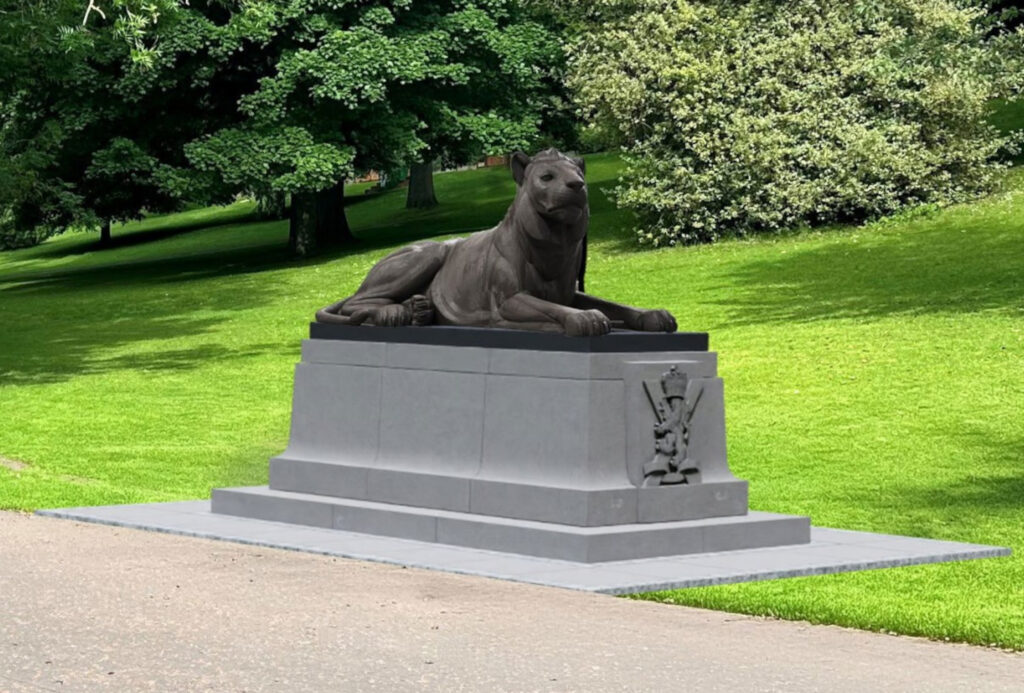
The statue will feature a lion reclining rather than rampant, to portray contemplation of the history of the regiment, which is the only Scottish line infantry regiment in the British Army.
If approved by the council, the lion would join a raft of other statues in Princes Street Gardens, in the shadow of Edinburgh Castle, including memorials to Scotland’s war dead, Wojtek the bear, and the towering The Royal Scots Greys Monument.
 The statue will feature a lion reclining rather than rampant, to emphasise the contemplative attitude of the Royal Regiment on its 20th anniversary (C) Royal Regiment of Scotland
The plans already have “in principle” approval from the City of Edinburgh Council, but full planning permission for the project is required before construction can commence.
The planning application was submitted by the Royal Regiment of Scotland last month and now awaits assessment by council planners.
The resting lion will face skywards and sit on a 1m tall plinth just off Princes Street Gardens’ main path, next to the Ross Fountain.
The sculpture will be around 2m tall, 3m long, and 1.5m wide.
The regiment has previously expressed its desire to have the statue ready to unveil for the 20th anniversary of their founding on 28 March.
The Royal Regiment of Scotland was announced in 2004 by then defence secretary Geoff Hoon as an amalgamation of six different regiments, including the Royal Scots and the King’s Own Scottish Borderers.
This amalgamation will feature in the monument’s design, which will be welded together from six separate pieces.
The formation of the regiment was a part of a larger streamlining of the British Army and reduction in the number of battalions from 40 to 36.
Since its foundation, the regiment has been involved in the ill-fated invasions of Iraq and Afghanistan.
The regiment’s headquarters is Edinburgh Castle.
 The statue will sit on the main path in Prices Street Gardens, just next to the Ross Fountain (C) Royal Regiment of Scotland
Kenny Hunter, a Scottish sculptor who lives and works in Edinburgh, and specialises in monumental civic sculpture, was appointed last year to design the monument.
In his justification for the design, he said: “To reflect on the history and celebrate the Royal Regiment of Scotland, I have chosen to sculpt a lion which has a direct relationship to the regiments cap badge.
“The memorial will also include the motto ‘nemo me lacessit impunen.
“This lion is depicted reclining not rampant, perhaps to suggest it is remembering it’s past and contemplating its future.
“Beyond representing this animal’s traditional qualities of strength and courage, I have also decided to use the structure and process of making the memorial itself to communicate how the regiment originated from six antecedents.
“Therefore, this sculpture of a reclining lion will be cast in six separate sections then welded together to create a unified whole.”
He added: “Instead of disguising the seams they will instead become a feature that tells the story of how Scotland’s six historic infantry regiments came together to form a single fighting force.
“This will be further echoed in the construction of the base and plinth, each of which comprises of six separate stones.
“Collectively this methodology of conjoining will articulate the origins of the Royal Regiment of Scotland, while making the broader point that the whole is greater than the sum of its parts.”
The sculpture will be cast out of bronze, and the plinth will be constructed from grey sandstone “for their integrity and permanence”.
Foundations will from a reinforced concrete slap and hardcore fill, and a “generous” paved area around the memorial will surround the monument and intersect with the existing tarmac path through the gardens.
The council has until 9 February to decide upon the application.
Related