By that I mean it’s art and antiquities, yet barely a week goes by without a foreign nation requesting the return of an artefact on display in a British museum, gallery or collection.
However, it’s the art and antiquities, including thousands of scheduled ancient monuments that the public doesn’t have access to, that seems such a shame.
Greater access to and a fuller understanding of these national treasures will benefit us all.
In Scotland, of the 8,000 or so scheduled monuments, roughly 80% are located on private, often agricultural, land, which means they are not automatically accessible to the public.
Scheduling a monument clearly earmarks it as something to be proud of, something of a national treasure, but that doesn’t create a public right of access to it.
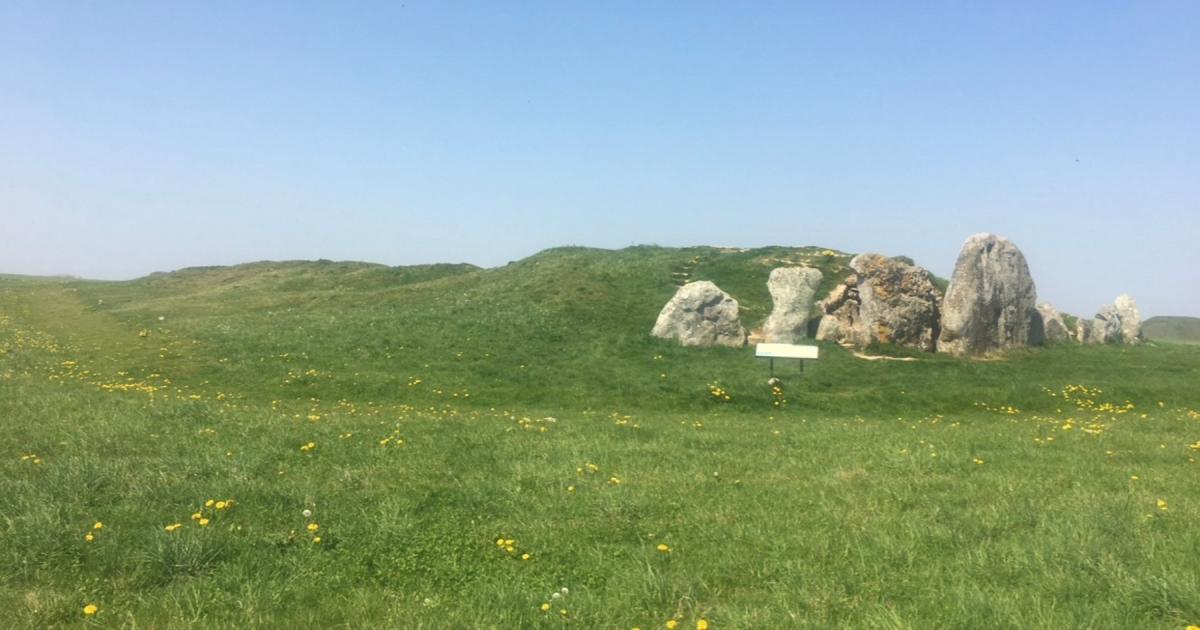
In England, just one example is Corton Longbarrow, a Neolithic national treasure located next to the Wessex Ridgeway, on private land.
Corton Longbarrow, Wiltshire, is part of our Neolithic landscape, but we can only look at it through the trees (Image: Andrew Blackall)
In other words, you can see it from the footpath, but you can’t touch it! These elongated tombs served as communal burial chambers, and there are not far off 700 across Britain.
Corton Longbarrow is just one scheduled national Monument amongst somewhere in the region of 5500 that are, for the most part, inaccessible to the public in England.
Some are in military testing areas like Salisbury Plain, whilst others are in the grounds of residential properties; these monuments can range from monastic buildings to Bronze Age burial mounds and the sites of former medieval buildings.
It’s not just our architectural antiquities that are often out of bounds, the Metropolitan Police Crime Museum in London, known as the Black Museum, contains a huge catalogue of dark artefacts relating to London’s criminal history and it too is also closed to the general public.
From the Acid Bath Murders to the Krays to Dr Crippen, artefacts and evidence, death masks, concealed weapons, and evidence related to famous crimes, the museum “serves to educate police and illustrate crime’s evolution”, but not for the likes of you or me.
Scotland Yard? Getting in is hard! (Image: Andrew Blackall)
It’s not just us Brits that get kept away from national treasures; the same pattern is replicated across the Globe.
Indeed, some artefacts and antiquities have been lost. A Bugatti Type 57SC Atlantic, known as “La Voiture Noire” (The Black Car), one of only four Atlantic models built by Jean Bugatti, vanished without a trace.
The car was due to be delivered to Louis Chiron, a famous racing driver who still holds the record as the oldest F1 driver ever to start a race at age 55.
World War II kicked off, and the car was loaded onto a train to be ferreted away from the advancing Nazis invading France. No one knows what happened next.
It’s not just cars that go missing, giant sarsen stones excavated during building work near Pinner Library were given to Brent Museum for safekeeping but they too seem to have vanished!
Whether it’s a valuable oil painting sold into a private collection, something archaeological or an artefact with a huge following, wouldn’t it be wonderful, where practical, if our ancient heritage allowed us to view it or visit it just one week a year?
Access to art should be a right, not a privilege. (Image: Andrew Blackall)
Of course, in this day and age, it’s a case of making sure any and all of these things, indeed, our heritage, is and are safe and looked after, and it may be detrimental to them to allow full on access.
However, wouldn’t it be nice if just some of our hidden heritage were more accessible? This is not a criticism of landowners or collectors; protestors seem to target art galleries and museums these days, and archaeology too.
Whilst many of us might share some sympathy with their actual aims, attacking art and antiquities that can never be replaced is distressing and will ultimately mean less accessible museums and galleries, not a more open society and indeed more security and expense. Can you guess who will have to foot the bill for all that too?
Art and Antiques, archaeology and antiquities are often displayed today in a manner our Victorian ancestors could never have imagined.
Recommended reading:
By making them even more visible, more accessible and more understood, it can only “better” the society in which we live.
Heritage should never be viewed as elitism; it should be viewed as part of our society and indeed, both its heritage past and its heritage future.
Perhaps we should return artefacts acquired under dubious circumstances to Greece and Egypt, etc. and focus more on the wonders that Britain hides away. There must be a middle ground to appease landowners and the public alike.
Who is Andrew Blackall?
Andrew Blackall is an English antique dealer with more than 30 years of experience selling period furniture and quirky collector’s items to clients across the globe. He has written and produced award-winning film and television productions. He was born in St John’s Wood, London and he grew up in and around London. He currently lives in Avebury, Wiltshire. His love of antiques stems from an early fascination with history and from visiting country homes throughout old England and the British Isles. Many of Andrew’s clients are well known on both sides of the pond, patronising his ability to source antiquities with provenance and appeal. His stock has appeared in a number of films and TV shows. Andrew has two styles of business: one selling high-end decorative antiques at The Blanchard Collective, the other selling affordable collectables at The Malthouse Collective.